Saturday, May 20, 2023

The American Dream at Severance

As part of its season ending series The American Dream, the Cleveland Orchestra last night presented works by either American composers or those focused on an aspect of American life.  The concert was led by Assistant Conductor Daniel Reith, substituting for an indisposed Franz Welser-Möst.

The concert opened with the overture to Scott Joplin’s opera Treemonisha. That’s right, Scott Joplin, the composer best known for his melodic (and very pianistic) rags, composed a full-scale opera in 1911. It was never performed during his lifetime, receiving a tragically belated premiere in 1972.  I was fortunate to see a concert performance of the work in Andover, Massachusetts during the early 1990s, and my immediate reaction was that it was worthy of more frequent performances.  Having heard recordings of it several times since then, I would amplify my statement thusly: Treemonisha ought to be presented at least as often as George Gershwin’s Porgy and Bess. 

The next composer on the program, Julia Perry, has an Ohio connection: she moved to Akron with her family when she was a child, and died there in 1979.  Short Piece for Orchestra, however, was composed in 1952 while she was living in Paris.  There are insinuations of Schoenberg in the stark, unsentimental harmonies, with skillful and colorful orchestration that would do any composer proud. 

William Grant Still’s Darker America, composed in 1924, was more broadly phrased, and mixed the kind of American sound that Aaron Copland would explore a decade later, with uniquely African-American tones.

Reith then led the orchestra in three selections from Bernard Herrmann’s score to Alfred Hitchcock’s Vertigo: The Prelude, Nightmare, and Love Scene.  Herrmann’s work, in particular this score, has been hugely influential on my own compositions – to the extent that I composed a 20-minute set of variations on the Portrait of Carlotta theme about 25 years ago.  I’ve collected numerous recordings of Herrmann’s scores over the decades and have no less than three of Vertigo.  Yet I’ve never heard Herrmann’s score to this film performed with such exquisite balance, virtuosity, transparency, or burnished tone as presented by Reith and the orchestra last night.

I have the fortune or misfortune of having a highly visual memory – to the extent that I never forget the face of someone who I like or dislike.  So imagine my amusement at seeing one of the ringleaders of the opposition to South Euclid’s LGBT+  inclusive non-discrimination ordinance at Severance with, of course, a same-sex companion.  In fact, I saw several Catholic priests at the concert, a stroke of supreme irony as one of the works presented was Voiceless Mass, by Raven Chacon – who is of Native American ancestry.  The work, premiered in 2021, is a reflection on and reaction to the forced assimilation of Native Americans by, among others, the Catholic Church.  The sparse, static dissonance of Voiceless Mass, which often hovered near the barrier between silence and sound, brought to mind images of a vast and empty desert.  The small ensemble (including electronic organ) was scattered around the hall so that the conductor was facing the audience.  Reith’s leadership was an example of astonishing concentration and control – earning a standing ovation. 

The evening’s final work, Edgard Varèse’s Amériques, had been presented by the orchestra in 2017, a performance that was recorded and released on the orchestra’s home label.  The work depicts the chaos of life in New York circa 1920, from the vantage point of someone who grew up in a small town in France.  Reith’s interpretation was harsher around the edges than that led by Welser-Möst six years ago.  Yet today’s world, in the aftermath of COVID, an attempted insurrection, and Russia’s invasion of Ukraine, is harsher than it was before, so the performance was fitting. 

It’s doubtless reaction to the strife of the past decade that has led the Cleveland Orchestra to recently present so many works by composers who don’t fit into the “dead white male” category.  What they have demonstrated is that this music is worthy of multiple hearings.  I hope this trend continues.  After all, there is musical life beyond the endless repetition of Beethoven, Brahms, Bruckner, and Mahler cycles.    


Sunday, May 7, 2023

Loggins-Hull, Barber, and Prokofiev at Severance


The lack of repertoire staples at this week’s Cleveland Orchestra concert, led by music director Franz Welser-Möst, did nothing to detract from the compelling performances or the audience’s enthusiasm.  

The opening piece was Can You See?, by Allison Loggins-Hull.  The short work is a contemplation on The Star-Spangled Banner - both the lyrics and the music, which was originally composed as To Anacreon in Heaven by British composer John Stafford Smith.  (I will interject that I don’t feel The Star-Spangled Banner is the best of all possible anthems for our nation, given that it commemorates a battle that was part of what was essentially a pissing-match with the nation that is today our closest ally, has lyrics that include “the hireling and the slave” and is needlessly militaristic.  America the Beautiful seems like a better symbol of our aspirations, but that’s just me.)  It begins with distant percussion which seems to recall the defense of Fort McHenry during the War of 1812 which inspired Francis Scott Key’s poem.  From there the music is freely associated and the listener hears harmonies that recall Smith’s original, without directly quoting it.  The music was enthusiastically received, and the composer was invited to the stage to share in the ovation.  

Cellist Alisa Weilerstein then joined the orchestra for a captivating performance of Barber’s Cello Concerto.  The work’s opening movement contrasted a syncopated drive and searing lyricism, with thematic material that was challenging to present and to hear.  One can sense the composer flirting with the twelve-tone rows that he employed in his Piano Sonata, composed just a few years later.  Weilerstein’s phrasing of the contemplative central movement was something to behold.  The dancing third movement featured some stunning passagework in the cello’s treacherous upper register.  This is a work that should be presented more often (premiered in 1945, the Cleveland Orchestra didn’t perform it until 2013).  Weilerstein received a well-deserved standing ovation.


Prokofiev’s Fourth Symphony, which drew inspiration from his ballet score The Prodigal Son, premiered in 1930, then was extensively revised 20 years later, was equally riveting.  The revised version was performed this weekend.  For decades, Prokofiev was subjected to harsh sounding performances in an apparent attempt to drive home his music’s modernism.  Prokofiev, judging by his extant recordings, was not that kind of performer himself.  Welser-Möst and the orchestra, who have given compelling performances of Prokofiev’s Second, Third, and Fifth Symphonies (all recorded and available), delivered a convincing performance that proved that strongly rhythmic, even percussive music, need not be ugly.  The slow opening, almost as if a 20th Century version of a Haydn symphony, is suddenly pushed aside for a series of rapid-fire string passages that propel the music headlong into conflict – only to be interrupted by a pastoral mood, then plunging forward again.  The second movement, with its clock-like episodes, again reminds the listener of Haydn, in this case the slow movement of his Symphony No. 101.  The third movement was classic Prokofiev, with motifs that sounded inspired by parts of his Romeo & Juliet ballet score.  The celebratory, slightly satirical finale, with its bouncing rhythm, led to a declamatory coda.  During the extended applause, percussionist Paul Yancich was brought forth for a separate bow and was cheered to the rafters.  As with the Barber Concerto, this work deserves to be heard more often. 

Tuesday, May 2, 2023

Two days in Saugatuck & Douglas, Michigan

Ever since we first met in 2006, Daniel and I have been searching for the perfect driving-distance summer vacation getaway.  Our quest has taken us to the East Coast, New England, and Canada.  Each location has its advantages and drawbacks.  Maine and Vermont are lovely in the summer and fall, but an eleven-hour drive makes getting there a chore.  Provincetown is even farther at thirteen hours, but in recent years has become crowded and crassly commercial, and as we age the summer party scene has become less appealing.  The East Coast in general is expensive and the further south we go, the longer our drive and the higher the summer heat.  Canada is closer but the smell of Cannabis can become overwhelming in touristy destinations like Niagara Falls, Toronto, or Montreal.  I could have scarcely imagined that an ideal place was not only under six hours away by car but was somewhere I’d been before.

Some of my earliest memories are climbing the sand dunes of Saugatuck with my family when I was little.  During those years, we used to regularly travel to Grand Rapids to visit family on both my mother’s and father’s side and Saugatuck was just a short drive from GR.  My Michigan memories are fond ones and fortunately I am free of the prejudice against Michigan, driven by hysteria for American football (a sport I don’t care for), that many Ohioans suffer from.  This is partly because my father grew up in Constantine and that my maternal grandmother spent many of her formative years in Grand Rapids.  Even more enticing was learning only recently that the Saugatuck-Douglas area has become an increasingly popular summer destination for LGBTQ+ travelers.  Based on that and a desire to keep our trips a bit closer to home, Daniel and I decided to pay the area a visit.  Our stay was short as we were only giving the area a “look-see”, but we liked what we saw.   

The charming downtowns of Saugatuck and Douglas are on the west coast of Michigan and within walking distance of each other on opposite sides of the Kalamazoo river.  Daniel and I arrived around 5:00 pm Thursday and checked in to The Dunes Resort.  The Dunes consists of several free-standing buildings including the King and Standard Buildings, one- and two-bedroom cottages, and an additional house a short walk from the main property.  It also has an on-site shop, bar, outside swimming pool and friendly, helpful staff – Taylor and Drew were standouts.  We found our recently renovated King room to have a casual, mid-century modern vibe and a very spacious bathroom.  High season runs from roughly from Memorial Day to Labor Day, so rooms during this time should be booked well in advance.  Based on the parking lot there were relatively few guests when we were there – we may have been the only couple in the King building Thursday night.

Danny enjoying the chair at The Dunes Resort.

After checking in we decided to grab dinner at Guardian Brewing Company.  Each table features a battery driven light which changes colors when touched.  When the light is green, it means you’re all set.  You can change it to red to call the wait staff.  The food menu is eclectic and their own selection of beers, ales, and ciders means there’s something for everyone who cares to partake.  I had a Red Dragon Cider made from Michigan apples and Danny had the Clurichaun, a dry stout with notes of coffee and dark chocolate.  As I’d had a rather heavy lunch, I ordered a Caesar salad.  (Not to worry, I sabotaged myself later by getting ice cream. In fact, we stopped off for sweets several times during our journey, the highlight of which was Chocolate Chip Cookie Dough ice cream at the Blue Star Café which put Ben & Jerry’s to shame.  They also serve a very fine breakfast, and the interior has an appealing 1950s diner vibe.)

Drinks at Guardian Brewing Company

After dinner we had our first walk through the Saugatuck downtown district, finding most of the shops had already closed – and many others hadn’t yet opened for the season.  Still, we were able to get a good feel for the area and when we returned the next day, we found a surprising array of goods for sale at competitive prices, from the usual touristy stuff to a very fine selection of Michigan Wines at the Fenn Valley tasting room.  They offer a competitive wine flight – five samples for five dollars, and we bought four reasonably priced bottles.  California, drink your heart out.  We also visited Uncommon Coffee Roasters in the morning, and had dinner at Pumpernickels – we highly recommend both.

A selection of Michigan wine

Art in downtown Saugatuck

The Saugatuck philosophy in a nutshell.

In between meals and shopping we enjoyed nature.  Saturday morning was spent climbing Mount Baldhead, a challenge for two middle aged guys who’ve struggled with their weight – but we made it to the top.  Then we spent an hour exploring Oval Beach and enjoyed the quiet of the off season. 

Saugatuck from Mt. Baldhead

The obligatory selfie

Our two days in Saugatuck-Douglas ended too soon.  We found plenty to do and a relaxed vibe.  To top things off, every person we encountered, whether merchant, local, or fellow tourist, was cheerful and friendly.   This Ohioan loves Michigan and can’t wait to return. 


Sunday, April 30, 2023

Eastman, Marsalis, and Dvořák at Severance

This weekend’s Cleveland Orchestra concerts, led by music director Franz Welser-Möst, included a Cleveland premier, a world premiere, alongside a standard repertoire favorite.  In a hopeful sign for both the orchestra and the thirst for unfamiliar music, the hall was filled to near capacity at Saturday’s concert.

An undated photo of Julius Eastman


The concert began with Julius Eastman’s Symphony No. 2, titled “The Faithful Friend: The Lover Friend’s Live for the Beloved.”  Provocative titles were commonly used by Eastman (1940-1990), an African-American and openly gay composer.  This work, dedicated and given to a former lover, was receiving only its second performance after being discovered and reconstructed in 2018.  The orchestration is ambitious enough to present a challenge to any ensemble:  six timpanists - each with four timpani, three bass clarinets, three contrabass clarinets, three bassoons, three contrabassoons, three trombones, three tubas, and a full complement of strings.  As it was, the orchestra was only able to fit 16 timpani on stage at Severance.  Despite the title, there is little in the work that would be thought of as romantic – the primary mood is one of mystery.  15 minutes long, it begins somberly with a sustained string motif; then quiet, dissonant soundings from the woodwinds – rising to a climax before sinking back into a disillusioned pianissimo.  The work received an enthusiastic response from the audience.

The second work on the program was the Concerto for Trumpet by Wynton Marsalis, receiving its world premiere.  As with the Eastman, the orchestration was ambitious and included police whistle and African hand drums, with the soloist needing two trumpets (C and B-flat).  The concerto is about 35 minutes long, easily eclipsing any trumpet concerto in the standard repertoire, and calls on the soloist to draw on every facet of his technique and use just about every type of mute available.  The six-movement work kicks off with an elephant’s call, taking the listener on a journey that includes a love ballad, Spanish and Mexican flavored motifs, American jazz, a French flavored waltz, two-step finale with an eclectic flavor ending with a return of the elephant call.  Michael Sachs, the orchestra’s principle trumpetist since 1988, was more than up to the task and delivered a performance which was technically and musically virtuous, marvelously accompanied by Welser-Möst and the orchestra.  My father, an amateur trumpetist of some ability, would have been enthralled by this work.  The audience was certainly absorbed, and the work received one of the most sustained ovations I’ve ever witnessed at Severance.

Applause following the Marsalis Concerto


The post-intermission work was Dvořák’s Symphony No. 9, titled by the composer “From the New World.”  This work is so well known that the story of its creation scarcely bears repeating: the composer, originally from what today is known as the Czech Republic, spent three years in the United States, during which he studied African-American and Native music.  The Symphony is one of several compositions from that era and has been a repertoire favorite for over a Century.  It can be argued that the Cleveland Orchestra is America’s premier Dvořák ensemble, having recorded his Symphonies from the time Erich Leinsdorf was music director onwards.  One can’t avoid mentioning George Szell, who recorded the complete Slavonic Dances, the Piano Concerto (with soloist Rudolf Firkusny), and the last three Symphonies – all of which are considered reference recordings.  Welser-Möst’s approach to the symphony was entirely his own.  He clearly sees the work as a classically structured symphony in the tradition of Brahms and Tchaikovsky, and his interpretation emphasized structure over the work’s tunefulness.  As is often the case with Welser-Möst, tempi favored the brisk end of the spectrum, with a minimum of rubato, careful attention to dynamics, and transparency between sections.  For those who mind such things, the first movement’s exposition repeat was observed.  A highlight for this listener was the second movement, offered free of schmaltz – which enhanced the work’s dignity. 

I can’t think of another non-specialist ensemble currently doing more to promote unfamiliar music.  Cleverly coupling lesser known works with repertoire staples like the Dvořák has helped to introduce these works to a larger audience and I hope they keep it up.  The concert was filmed and hopefully will be published in full on the Adella app – as well as being issued on the orchestra’s private label.

Sunday, April 9, 2023

Anxious Bernstein and rushed Shostakovich at Severance

Last night’s Cleveland Orchestra concert at Severance Hall featured guest conductor Rafael Payare in two 20th Century works that seem equally relevant to our time.

Payare was joined by pianist Jean-Yves Thibaudet for Leonard Bernstein’s Symphony No. 2, titled “The Age of Anxiety” after W. H. Auden’s epic poem, which serves as a program for the work.  I know little about the poem, but the Symphony is the work of a young composer filled with ideas, chomping at the bit to put his stamp on the musical world, yet still finding his voice.  In Bernstein’s case, it was a distinctly American voice.  Each of the six movements has its own individual mood and style, from the desolate improvisatory tonality of the Prologue, to the twelve-tone motif of the Dirge, to the jazzy energy of the Masque.   

Thibaudet brought his usual brand of musical virtuosity to the piano part.  His performance enforced my conviction that Thibaudet remains one of our era’s most interesting, eclectic pianists – far more so than the latest stock of competition winners and “influencer” pianists who merely rote out the same standard repertoire.  Payare and the orchestra contributed a performance noted for a burnished quality of tone one does not usually hear in Bernstein’s work, and the performers were greeted with a sustained ovation.


I noticed after intermission that the audience had dwindled from about three-fourths to two-thirds of capacity.  Perhaps the early exit folks were expecting the opening work to sound like something out of West Side Story, which was definitely not the case.   

Payare returned to lead the orchestra in Shostakovich’s Fifth Symphony.  The Cleveland Orchestra has a long history with that work, first performing it in 1941 under then-music director Artur Rodziński, who recorded it with the orchestra shortly thereafter.  It has been heard with some regularity since, including a memorable performance led by Stanisław Skrowaczewski.  As a work written under the ominous shadow of Josef Stalin, it seems to equally reflect the current situation in Russia under Vladimir Putin – at a time when artists, journalists, and others unwilling to toe the party line are being disappeared.

Last night’s rendition, more a run-through than a performance, lacked the characteristics that made Skrowaczewski’s performance so memorable.  Tempos in the outer movements were rushed, so that Shostakovich’s opening theme lacked pathos and drama, and the menacing development started off by the piano lacked contrast.  The coda lacked the irony which has become a mainstay of modern Shostakovich interpretation.  Overall, a surfacy affair. 

Friday, March 24, 2023

One week in London

Ever since Daniel and I returned from our first trip to the UK in 2015, we’ve wanted to return. Various factors led to us putting off a return trip, but it wasn’t until last week that I was able to make it happen. Unfortunately, Dan was not able to join me, so this was a solo trip from Wednesday March 15 to Wednesday March 22.

As British Airways now offers a nonstop between Pittsburgh and London, that was my departing airport -well worth the two-hour drive from home to avoid a layover. I’ve had a fear of being late since my school days - which occasionally surfaces in my dreams. So, I arrived at Pittsburgh International Airport well in advance of the “three hours before departure” recommendation. But I didn’t have to wait long for the BA desk to open and get me checked in. From there it was a quick trip through security and onto the train that whisked me to the air terminal. PIT has four concourses shaped like a giant X with restaurants and shops where the concourses meet. I was pleased to see a Bar Symon so I dropped in for a drink and snack. I was still very early but a lengthy FaceTime chat with a dear friend helped me pass the time. Soon enough I boarded the Boeing 787-9 and took my seat in World Traveler Plus. The overnight flight itself was rather uneventful.

Surprisingly there were no available air bridges available when we landed at London Heathrow Airport, so we disembarked via air stairs onto a bus that took us to border control, which has changed since we were last there in 2015. Now it’s largely automated and I was quickly through and on my way to baggage reclaim, and from there to the underground station to take me to Soho via the Piccadilly line. I recommend all visitors to London download the Transport for London app and get an Oyster card.

When planning this trip, I selected Hotel Indigo in Leicester Square and I couldn’t have been happier with that choice. Sofia and Cindy at the front desk not only checked me in early (before noon) at no extra cost, they gave me two drink vouchers for the rooftop bar/restaurant and provided me with an umbrella for use while walking the streets of London.

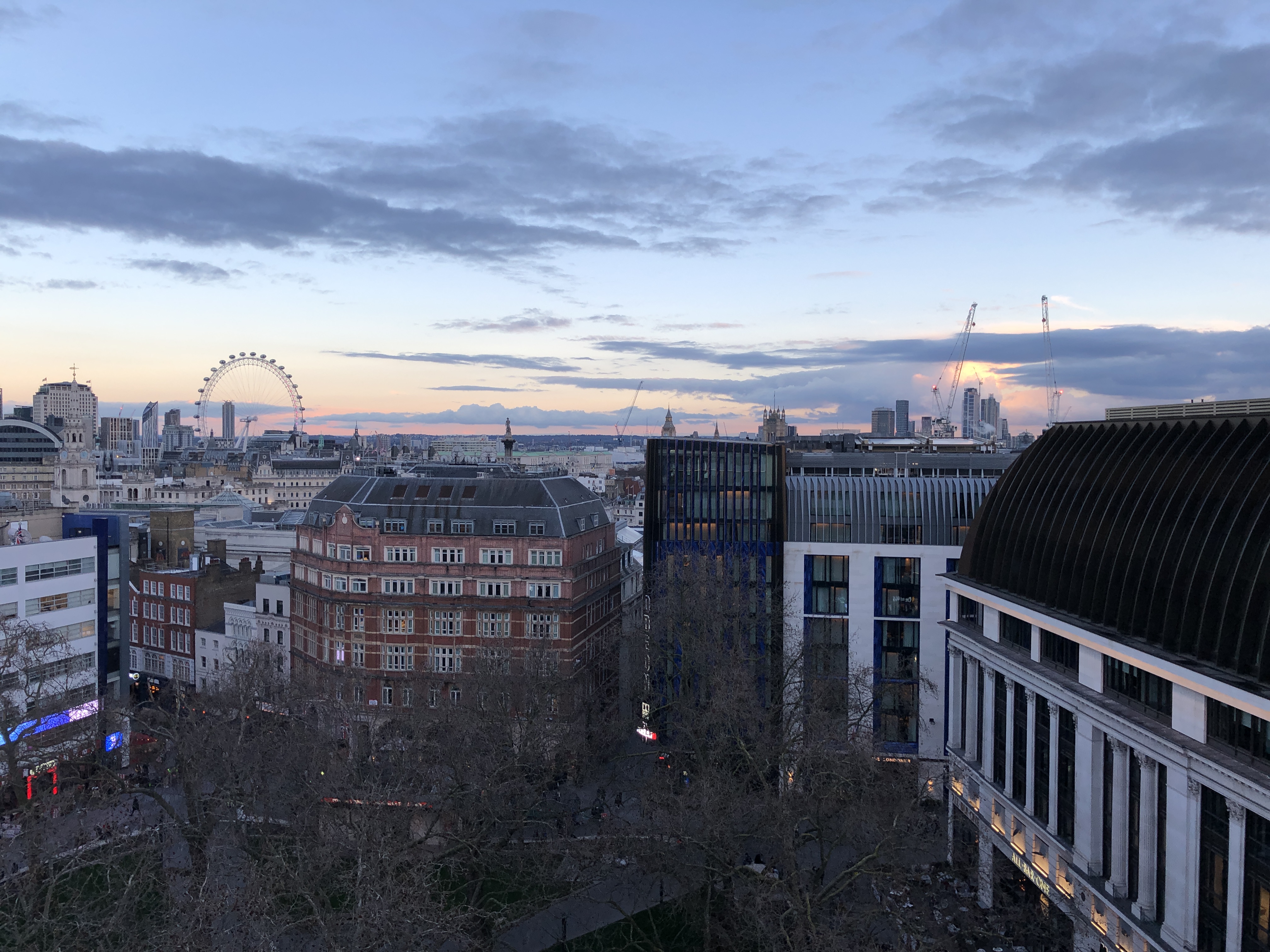
Leicester Square from Hotel Indigo's restaurant

I took it easy that first day there. My sole tourist destination was the London Transport Museum in Covent Garden. Truly London’s public transport network is a model to be followed - efficient, clean, cost effective, and as safe as possible given the multitudes who use it. Given London’s high population density and the organic way the city evolved, it’s also necessary. The US has nothing on this level - only New York’s relatively dirty and dangerous system comes close. The London Transport Museum shows how London went from horse drawn carriages to early rail, to double decker buses and more modern options. It’s appropriate for all ages.

An old-school fashionably appointed train.

Friday was the busiest day. It started with a walk to Buckingham Palace for the Changing of the Guard - which was unfortunately canceled at the last moment due to the weather. Then I headed back to Soho to try fish & chips at Poppie’s. Despite the hip 1960s vibe of the place, I found the food itself disappointing: the fish batter was soggy and the fries devoid of flavor. Arthur Treacher’s in Ohio wins by a country mile - and they offer Hush Puppies. Then I hopped the tube to the London Bridge station to see the replica of Sir Francis Drake’s Golden Hinde. I remember as a child I helped my father build a model of this ship - meaning my dad built it and I watched. The British Drake apparently had no children, although he had several collateral descendants. I’ve no idea if we’re related but my family has a history of service in the Military. Although Drake is an important figure in navigational, seafaring, and world history, we must face up to the fact that his record is not untarnished. He engaged in the trade of human beings. But he also circumnavigated the Earth in an incredibly small ship, an act of daring which cannot be ignored.

Interior of the Golden Hinde

I considered this as I walked the South Bank of the Thames past the replica of Shakespeare’s Globe theatre and Royal Festival Hall (infamous for its mediocre acoustics). By now I was back in Westminster and couldn’t resist watching Big Ben strike three, followed by a walk through the statue garden outside the Houses of Parliament and past the Royal Horseguards. In all I walked over ten miles that day.

An obligatory selfie


When Dan & I went to London in 2015, some family members were disappointed we didn’t visit Abbey Road’s famous crosswalk. Saturday, I hopped bus route 139 and was there in less than half an hour. Honestly, it’s not all that and a bag of crisps but I did the obligatory walk, then hopped the return bus. After Friday’s long walk, I decided to take it easy. I stopped at a cinema and saw the new Shazam film, then headed St. Pancras for a quick walk to the Queer Britain Museum at Granary Square. Then a bit of bar hopping for some interesting conversations with nice people. It was here I realized many Brits have misconceptions about life in America that that they are often as ignorant of our geography as we are of theirs. Many had no idea where Ohio is and thought the entire US had undrinkable water. I gently explained that that truth was more nuanced but didn’t make a big deal of things.

On Sunday I returned to Buckingham Palace for the Changing of the Guard. Quite an impressive display. Unfortunately, by the end of the day I felt a cold coming on. By Monday I felt terrible. Although I did several miles of walking, I had to abandon plans to see George Takei’s Allegiance at Charing Cross Theatre out of consideration to fellow audience members.

By Tuesday I felt well enough to hop the route 24 bus and head to Hampstead Heath, where I walked over five miles while staying at a safe distance from other people. The rest of the day I took it easy, seeing 65 (weak execution of an interesting concept); then it was dinner and drinks at the hotel restaurant.

Wednesday I checked out and headed back to Heathrow for my return flight home. Despite negative publicity last year about operations there, my experience at Heathrow was orderly and pleasant, despite the fact that my flight’s departure gate was not announced until less than an hour before boarding.  I was home before midnight local time.  While I’d enjoyed the trip, it lacked the spark that comes with experiencing new places with a loved one, and I resolved never to travel alone again unless it was to see family/friends or for business.

Sunday, March 5, 2023

Farrenc, Ravel, and Mussorgsky at Severance


Severance Hall last night

The Cleveland Orchestra continued its practice of commingling the familiar with the unfamiliar in this weekend’s program featuring music director Franz Welser-Möst and guest pianist Víkingur Ólafsson.

The opening work was the Symphony No. 3 in G minor by French composer Louise Farrenc, completed in 1847 receiving its Cleveland Orchestra debut.  The work has seldom been performed since its premiere 1849.  The program notes unequivocally pins the reason for this work’s neglect on “the systemic sexism and misogyny long upheld by the classical music establishment.”  That may well be part of the reason.  Another cause may be the Symphony’s highly conservative, one might even say old-fashioned construction.  One could easily pass this off as an undiscovered early symphony by Mendelssohn, and there were passages that reminded me of that composer’s incidental music to A Midsummer Night’s Dream.  The orchestration and architecture of the piece were excellent, but there was nothing in the way of innovation.  Thus, it was interesting to hear, but only once.  

After a quick stage change, orchestra and conductor were joined by Ólafsson for Ravel’s Piano Concerto in G major.  This concert marked the first time I’d heard this pianist in the flesh, and it was a fine experience.  Ólafsson brought exceptionally free metrics in the first movement, yet the structure of the work emerged clearly, along with the jazz influences brought to the fore by Welser-Möst.  In the second movement the soloist was exceptionally attentive to inner voices and phrased the ¾ melody with a soulfulness seldom heard by all too many pianists who simply plunk it out.  The finale was not merely thrilling, but coherent from a structural perspective.  Ólafsson’s seemingly effortless technique, including perfect use of the pedals, was matched with solid musicality.  Of the 15 or so live and recorded performances I’ve heard of this concerto, this ranked very near the top.  The audience gave the pianist a standing ovation and he gave a lovely encore: the Bach-Siloti Prelude in B minor, in a poetic rendition with sensitive control of the lower dynamic levels. 

Ólafsson following the performance

Following intermission Welser-Möst returned to lead the orchestra in Mussorgsky’s Pictures at an Exhibition.  As is well known, Pictures was originally written (rather clumsily) for piano solo in tribute to the composer’s friend, painter and architect Viktor Hartmann.  There have been several orchestrations, with Ravel’s being the most popular.  Personally, I’ve always found Ravel’s approach insufficiently Russian, and I prefer Stokowski’s and Ashkenazy’s orchestrations.  But the problem here was not the orchestration, nor the technical quality of the playing, but the conception.  Despite a fine opening Trumpet solo from Michael Sachs, Welser-Möst’s rushed, metronomic, colorless approach left this repertoire staple wanting.  Passages which benefit from a bit of freedom were rhythmically straightjacketed, phrasing was flat throughout.  It was as if poor Mussorgsky was being rushed from picture to picture at his own exhibition.  I was far from the only listener to feel this way, and several boos were clearly audible afterward – the first time I’ve ever heard them at a Cleveland Orchestra concert.  Welser-Möst can be a convincing interpreter in the right repertoire – this wasn’t an example of that.