Friday, October 6, 2023

2023 Election Endorsements

November 7, 2023, will mark an off-year election in Ohio.  Turnout tends to be low in this type of election, so each vote is especially important.  Vote by mail and early in person voting starts on October 11. 

Issue 1: Reproductive rights – YES

Officially titled "The Right to Reproductive Freedom with Protections for Health and Safety," this proposed Constitutional Amendment is listed on the ballot as Issue 1, having been certified despite the efforts of Ohio’s Secretary of State Frank LaRose and other extremist Republicans and pro-birth activists.  The centerpiece of this issue is allowing women to control their own bodies, including the right to have an abortion. 

These same activists, having failed in their attempt to raise the bar for passage to a nearly impossible level, are kicking up quite the fuss over this proposed amendment.  They are claiming that passage will lead to a rash of partial birth abortions and underage people obtaining gender reassignment surgery.  To use a polite term from another era: Poppycock!  Even Ohio’s Republican Attorney General, Dave Yost, has pointed out that there is nothing in the text of the amendment that even references gender reassignment or transgender people.  Read the complete text for yourself here.  Besides, is there an epidemic of young people in Ohio, or anywhere, seeking gender reassignment?  How would those wanting such a change even pay for it?  I don’t imagine the hourly wages at McDonald’s or wherever young people work would be sufficient.  As for partial birth abortions, the proposed amendment guarantees the right to an abortion during the time the fetus is determined to not yet be viable, as decided by the woman’s physician – unless that physician determines that continuing the pregnancy poses a danger to the woman’s life or health.  Less than .2% of abortions nationally have involved intact dilation and extraction and have generally been performed following a miscarriage.

I’m a gay man.  The chances I would get a woman pregnant are, well, basically zero.  But when it comes to allowing women to control their bodies, I stand with the vast majority of women.  I also believe that, as former Surgeon General C. Everett Koop did, the only way to lower the number of abortions is to lower the number of unwanted pregnancies – which means better access to contraception.  Not coincidentally, this is also something pro-birth extremists are trying to curtail.  Ultimately, whether or not to terminate a pregnancy is a decision best left to the individual woman in consultation with her physician.  Do Ohioans and Americans in general want to align themselves with countries like Yemen, Myanmar, Pakistan, or Nicaragua – or would we rather stand with Ireland, Germany, the United Kingdom, or the United States before Roe v. Wade was repealed? 

I strongly favor passage of Ohio Issue 1.


Issue 2: Recreational Cannabis – YES

In 1975, the Ohio legislature passed, and Governor James Rhodes signed a bill decriminalizing cannabis – making Ohio the sixth state to do so. 

In 2016, the Ohio legislature passed and Governor John Kasich signed a bill allowing Medical use for Cannabis to treat 21 health conditions, and setting up rather byzantine regulations for creating Cannabis dispensaries.  It also severely restricted licensing for cultivation of medical cannabis.  By 2021, only 20 cultivators had been licensed and 125,000 patients approved for medical cannabis.

The Regulate Marijuana Like Alcohol initiative, to be listed on the ballot as Issue 2, will legalize recreational cannabis within Ohio, subject to the following:

  • ·        Legalize the possession of up to 2.5 ounces of cannabis and 15 grams of concentrate for adults 21 years of age and older.
  • ·        Allow the cultivation of six plants for personal use, with a maximum of 12 plants per home by adults 21 and older.
  • ·        Allow the sale of cannabis at licensed dispensaries, with a 10 percent sales tax imposed.
  • ·        Divide tax revenue between social equity and jobs programs (36 percent), localities that allow dispensaries to operate (36 percent), education and substance abuse programs (25 percent), and administrative costs (3 percent).
  • ·        Allow landlords and business owners to prohibit use of cannabis within their property.

Legalizing recreational cannabis does not equate to approval of same.  It’s simply an acknowledgement that people use cannabis, just as they smoke tobacco and drink alcohol.  Use of these is a decision best left to the individual, and regulations should be consistent: just as one is not allowed to smoke tobacco in public buildings or airplanes, cannabis use should take place where others will not be impacted by second-hand smoke.  Just as one must be over 21 to legally drink, cannabis should be similarly restricted.  The proposed issue makes provisions for all these matters.  As a homeowner, I will continue exercise the right to ask visitors to step outside if they want to smoke tobacco or cannabis.  Who is going to be harmed by passage of this issue?  Drug traffickers who profit over the semi-illegality of cannabis in Ohio. 

I favor passage of Ohio Issue 2.


Issue 5 – Cuyahoga Community College tax levy

I have stated elsewhere that I am in support of free community college for all who seek it.  While this property tax levy does not reach that goal, it helps keep the costs of a college education under control for the modest cost of an additional $14 per year for every $100,000 of taxable home value.  It’s a bargain which only the sociopathic would oppose.


South Euclid Mayor: Georgine Welo is running unopposed for her sixth term as mayor.  Just in case someone tries to mount a write-in campaign, let us review her accomplishments.  Welo became mayor in 2004.  During the decades before she took office, none of the previous administrations tried to stop the local slide in population, quality of life, or local amenities that began in the 1980s.  Here are just a few of the developments which have taken place since Welo became mayor:

·        Complete replacement of Cedar Center North shopping center.

·        Construction of Oakwood Commons shopping center.

·        Partial replacement of the May-Green shopping center.

·        Creation of the Food Truck Park.

·        Cutters Creek housing development.

·        Removal of several troubled houses on Greenvale Road; additionally, multiple decaying, unoccupied homes were torn down during and after the Great Recession – many since replaced by new homes.

·        Creation of several pocket parks.

·        Multiple infrastructure improvements on Green Road and South Belvoir Boulevard, with smaller improvements on side streets.

For the first time in recent memory, nearly every store front in South Euclid is occupied.  Further, home values are up, and South Euclid is now a sellers’ market.  There was a house Dan and I considered buying several years ago, and in retrospect I wish I had because it is now out of our reach. 

Mayor Welo wants to continue to build on these successes, and deserves to continue in the job.


South Euclid-Lyndhurst School Board

There are four candidates running for the two open seats on the South Euclid-Lyndhurst School Board.  I endorse Cathy Covarrubias for one of the two open seats. 


Tuesday, September 19, 2023

Farewell, Richmond Mall

Like many locals I have numerous memories of Richmond Mall.

The first was from not long after my family moved to the area in the early 1970s. My father and I went to Woolworth, which was near the center of the mall. I wanted to explore the toy area. My dad consented but warned me to stay there while he went to get whatever he was looking for. Soon I became bored and wandered Woolworth looking for my dad. Failing to see him there, I stepped outside the store and saw him, with his back to me, talking with someone else. I walked over to him and grabbed his hand. He turned around and asked me “How can I help you, little boy?” It was NOT my dad. I screamed bloody murder.  My dad, who had been looking for me, heard my scream and retrieved me.

Despite my misadventure, I made regular trips to the mall, with my parents or sister at first, and later on my own with my high school friends. Richmond Mall seemed to have everything. A small second level near the mall’s center included a magic shop which I found fascinating.  I saw King Kong at the theater there - the mural outside the theater was more memorable than the movie. My grandmother and I frequently dined at a fancy restaurant there. I bought my first suit at Diamond’s men’s store. Shortly before graduating high school, I got a job at the Waldenbooks there.

The central fountain at Richmond Mall


Until I was about ten, there were two local malls: Severance Center and Richmond Mall. They were separate and distinct entities with different stores, restaurants, and cinemas. Initially, Severance was the more upscale of the two, boasting Higbee’s and Halle’s as anchors, while Richmond Mall had Sears and JCPenney.  Severance was my mother’s mall of choice, Richmond Mall was my father’s preference.

The Geranium room at Halle's

From Severance I remember Halle’s, which had a restaurant called the Geranium Room where my mother would buy me lunch as a reward for not misbehaving as she did her clothes shopping. There was also a small deli near the mall’s center, where my mom would get us sandwiches, and we would sit near the fountain and watch the water show as we enjoyed our food. When I was ten, I saw Star Wars three times at one of the two theaters at Severance. After graduating from high school, I worked at The Music Box - a classical and jazz record store recently relocated from Shaker Square.  I left Cleveland shortly thereafter.  Returning in the mid-1990s, I was struck by the deterioration both at Severance and Richmond Mall.

The west entrance to Richmond Mall.  
This striking architectural feature was removed 
when Macy's was added as a third anchor in the 1990s.

Richmond Mall underwent a major remodel in the late 1990s, being rebranded as Richmond Town Square.  But the traffic never returned to the levels it enjoyed during its heyday of the 1960s and 70s and the stores became increasingly generic.  Mall rents were simply too high for the independent retailers that were there before.  Once the Barnes & Noble there closed, I had little reason to goto Richmond Mall.  B&N became a Planet Fitness which Daniel went to until a new branch opened at Cedar Center.  

Shortly before the turn of the millennium, Severance was essentially turned inside out and reopened as Severance Town Center, with entirely new stores: Borders, Home Depot, Walmart, a grocery store, a Bally’s gym.  Again, generic stuff you could find anywhere else.  Borders died during the Great Recession and the Bally’s location became another gym.  Walmart moved to Oakwood Commons in 2013.  Severance Town Center suffers from low occupancy, with some of the outlying buildings, including the former IHOP, shuttered.  Somehow, it continues to limp along despite poorly maintained and nearly empty parking areas.

A certain type of person will blame the demise of Richmond Mall as the result of “urban” culture ruining the shopping experience. Others will blame online shopping.  I won’t wallow in nostalgia for an era that was not objectively “better.”  Both Richmond and Severance both started going downhill after Randall Park Mall (claimed to be the world’s largest shopping mall when opened, now torn down and replaced by an Amazon warehouse) and Beachwood Place opened. By the 1980s, I noticed the carpeting along Richmond Mall’s long corridors was looking frayed.  This was, obviously, long before online shopping became an option.  Truth be told, there are only so many shopping centers that can be supported in an area with a declining population.

This begs the question: should older, out of date shopping centers like Severance and Richmond Mall be somehow protected when newer and arguably better shopping centers like Legacy Village and Pinecrest are serving the area’s consumers?  I believe not.

As Terence Mann (played by James Earl Jones) said in Field of Dreams: “America has rolled by like an army of steamrollers. It has been erased like a blackboard, rebuilt and erased again.”  That is what is happening near the northeast corner of Richmond and Wilson Mills Roads.  The new development, Belle Oaks, is arguably the best use for this parcel of land.  After years of delays, I look forward to seeing the finished product. 


*Photos courtesy Cleveland Historical Society and Cleveland Memory

Wednesday, August 30, 2023

86 hours without electricity

In August of 2003, while working as a piano store manager, I saw the lights dim for about 30 seconds, then flicker, finally failing entirely, unaware that I was experiencing the first moments of a blackout that covered much of the northeastern United States and parts of Canada.  The area on the west side of Cleveland where I was living and working saw its power restored within 24 hours.  Many others experienced a far longer period without electricity.

Almost exactly 20 years later, just after midnight on Friday, August 25, 2023, I was awakened by a howling noise outside our home in South Euclid, Ohio.  Noticing my electricity was out, I looked out my bedroom window and saw branches on the two large oak trees on our front lawn bending with the wind in a manner I did not know was possible.  Unaware that tornado warnings had been issued locally, I took no special precautions, but went back to bed, confident that power would be restored in short order. 

When I awoke again shortly before 5:00am, I looked out my window again and saw darkness.  Grabbing a flashlight and stepping outdoors, I spotted our recycling bin upended on my neighbor’s property.  I gathered the scattered recyclables, returned them to the bin, then returned the bin to its proper resting place.  Branches of varying sizes were scattered throughout the property.  I heard a work crew nearby.  Following the sounds, I saw they were dealing with a fallen tree one block over.  Walking back to my own street, I saw a tree leaning on a power line. 


Clearly, this was no ordinary storm. The Cleveland area received a record number of tornado warnings within a short space of time – with several touching down and one causing extensive damage in Cleveland’s Midtown district.  Our area is used to winter challenges, summer heat, and seasonal thunderstorms – multiple tornadoes, not so much.  As I wrote in an email to a young relative: Some people will just say “Oh, the climate has always been this way.”  But I am more and more inclined to believe that Mother Earth is pissed-off at us humans, and I don’t blame her.  Beyond a doubt, we are the primary cause of climate change.  Tornado warnings were almost unknown in our area – but we’ve had several in the last 10 years, last night’s caused a lot of damage, and the number of severe storms has increased exponentially.

After Dan left for his job, I headed to my employer’s campus to work (I’ve been largely working from home since the early days of COVID).  As information came in about the extent of the storm and blackouts, I decided to book a hotel for Friday night.  But I was hopeful, as the total number of customers lacking power had gone from over 224,000 without power at 8:00am to 160,000 by 4:00pm.  After work and before heading to the hotel, Dan & I spent about an hour cleaning up the yard.  Fortunately, there was no damage to the house – including to our new storm windows.  A few days before, a major rainstorm confirmed that our street’s newly refurbished water runoff inlets were functioning well, with none of the flooding on our street we’d become accustomed to after even small rainfalls. 

After awakening in our hotel room Saturday morning, Dan & I headed back home to see power was not restored, largely as I expected given that I was following the outages listed on First Energy’s website.  I took advantage of the relative quiet on our street to make some piano recordings – fortunately, my old Mason & Hamlin upright does not require electricity.  


Piano by candlelight

We spent the rest of the weekend seeking out places to go where we could pass the time in relative comfort: walking in some parks, dining at restaurants, seeing a film – while periodically checking to see if power was restored.  While driving around, we saw the damage in Midtown.

Damage at the Dunham Tavern Museum
  

I also perused social media, posting information where useful, and observing posts and comments from various people.  A long-held belief of mine was confirmed: An appallingly high percentage of people have no idea how the world around them works.  I saw posts blaming the mayor of my municipality and those of other municipalities for everything from the time they were without power to the presence of flooding.  In our area, the Northeast Ohio Regional Sewer District is responsible for maintaining the sewers; if your street floods, contact them.  If your local creek floods, well, that’s what creeks do when it rains, and if you made the decision to live next to a creek, that’s on you.  If your power hasn’t been restored yet, the mayor has no control over that.  For what it’s worth, I will comment that the South Euclid services department was at work clearing branches as soon as the weather had cleared; further, the city advised that people could come to city hall if they needed to charge their devices.   

I have no complaints about the line workers from First Energy who worked long hours to get power back online – to say nothing of the many workers who came from outside of Ohio to help.  They worked their butts off.  The problem, as it often is, stems with poor management, from the CEO on down – which puts profit over providing a service which people rely on.  They did not prepare, and their communications were poor.  For example, I signed up to their automated system so I could be informed when my power was restored.  Within a few hours, I received multiple communications giving conflicting information.  First, I received a text that power would be restored by 2:00pm Monday; a half hour later, another text stated the power would be restored by 8:00pm Wednesday – followed by an automated phone call stating the same; 40 minutes later a further text stated that power would be restored by 4:00pm Monday, followed by another text 20 minutes later that power had been restored.  It had been out for 86 hours.


Make up your mind.


Here are some lessons learned from the past week’s experience:

Northeast Ohio’s tree canopy needs to be better managed, especially in more densely populated communities.  Our tree canopy is a wonderful thing – relatives and friends who have moved out of state have told me how much they miss it.  The two oak trees on my property, which I spend plenty of money to keep trimmed, provide enough shade to keep my electric bills at a reasonable level.  But in communities such as South Euclid, trees should not be permitted to grow without a plan for management – especially those trees which are near homes or power structures.  The repair of our localized loss of power was delayed because a large tree fell onto an unoccupied house, taking down several power lines and a transformer with it.  

Tree damage at a nearby house

The other item is something I’ve believed for years: The United States should embark on program to upgrade, modernize, and protect our energy grid from hazards including weather events and hacking.  Wherever possible, utility lines should be moved underground.  A colleague of mine did not lose power, largely because her community is newer and their power lines are underground.  Those of us who live in older communities, and who pay the same for electricity, should enjoy the same reliability.  The nationwide migration of utilities underground would be a massive undertaking, but no more than the building of the Interstate Highway system or the infrastructure created during the New Deal.  It would require cooperative efforts from Federal, State, and Local governments along with utility providers.  The biggest obstacle is the lack of leadership in both parties to lower the hammer and make it happen – because an effort of this magnitude would require at least partial public funding, which would require a tax increase on the wealthy.  So, a project such as this, which would have the added benefit of greatly improving aesthetics in our neighborhoods and commercial districts, will likely not happen in my lifetime. 

As I said in the email to my young relative: Our climate is changing.  We’re not going to be able to conserve our way out of the climate crisis.  We need to be prepared.

Wednesday, August 9, 2023

Why I still have hope for Ohio

As I had hoped and advocated for, Ohio’s Issue 1 was defeated at the polls.  In the end, the margin was more than a landslide, it was an earthquake: 57% against to 43% in favor. 


My own vote was cast at my local polling place just after it opened at 6:30 am.  Since my driveway is currently under construction, I decided to forego the arduous task of maneuvering my car over the lawn to get onto the road and walked to the polls.  It was a beautiful morning and made for a nice start to the day.  There was a line of people waiting outside, not as large as in Presidential or Gubernatorial elections, but substantial enough to buoy my hopes for the Issue’s defeat.

The obligatory post-vote selfie.


I was recently speaking with a younger friend who, like me, despises Ohio’s politics.  But he has never lived in Ohio, only visited.  So, I had to explain a few nuances: Ohio is really two states: the larger cities of Cleveland, Columbus, Cincinnati, and their suburbs - along with smaller cities like Toledo, Dayton, and Youngstown, which are reliably blue; then there are the outer ring suburbs and the country, which are reliably red.  But the voters who really hold the cards in Ohio are neither Republican nor Democrat – they are unaffiliated and tend toward the fiscally conservative and socially moderate.  Social perceptions change with time.  While Ohio’s voters in 2004 were comfortable passing a Constitutional amendment to outlaw marriage equality (subsequently overturned by the Supreme Court), it’s doubtful they would do so today.

Ohio has long had a reputation as a swing state and a reflection of America’s politics in general.  It’s not so much a leader as a follower – about a decade behind the national trend.  During the height of the Reagan era, Ohio’s governor and both Senators were Democrats.  Today, the state leans red, while previous red states, including Virginia, North Carolina, and Georgia, have become purple and even lean to the blue.  Ohio’s Presidential vote matched the electoral vote in every election after 1960 and before 2020. 

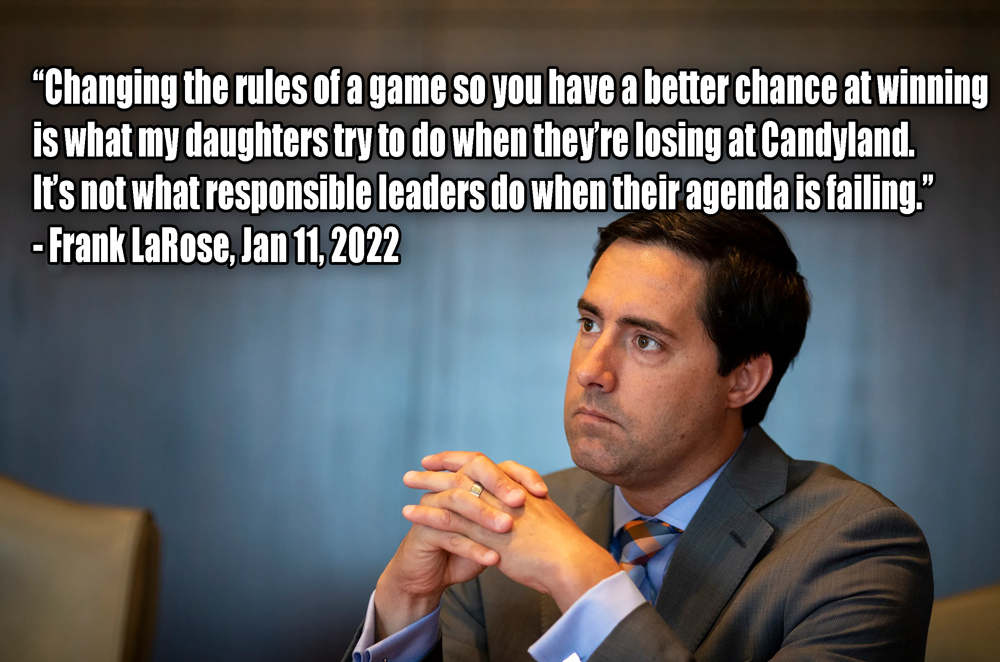
Ohio’s Secretary of State, Frank LaRose, pushed this issue and worked to put it onto the ballot in August – despite a recent law forbidding such one-off elections.  LaRose and fellow Republicans did so hoping that low turnout would help their cause.  In doing so, LaRose exposed his own hypocrisy for all to see.

"Changing the rules of a game so you have a better chance at winning is what my daughters try to do when they are losing Candyland.  It is not what responsible leaders do when their Agenda is failing."  -  Frank LaRose January 11, 2022

Ohio’s Secretary of State now has egg on his face, as does Governor Mike DeWine – who has styled himself as a moderate-conservative, but is substantively a right-winger.  DeWine is term limited and will likely retire from public life after his term expires. 

The winners: First, the women of Ohio, who now have a fighting chance to control their own bodies.  Second, those in Ohio who support the principle of one person, one vote.  Third, those active in Ohio politics – whether officeholders or not, Republican, Democrat, and unaffiliated – who opposed this Issue, including former Cuyahoga County commissioner Lee Weingart, former governors Bob Taft and John Kasich, and two former Ohio attorneys general.  Those listed here are all Republicans, battling to pull the state party toward sanity.  Whether they will emerge victorious in the war for their party’s soul remains to be seen – but last night they won a significant battle, and in doing so all of Ohio’s women won.

I have no illusions: Ohio leans Republican, despite having a Democratic Senator in Sherrod Brown – who is up for reelection next year with LaRose trying for the Republican nomination to oppose him.  But the redness of Ohio is exaggerated by gerrymandering, which has continued despite numerous court rulings and citizen initiatives.  The defeat of Issue 1 is a good step in preventing Ohio’s redness from becoming all but permanent. 

The work continues.  A proposed Constitutional amendment protecting women’s health choices will be on the ballot in November – now eligible for passage with a simple majority.  Another amendment, not yet approved for the ballot as signatures are being authenticated, would have Ohio join states including Michigan in allowing recreational cannabis.  More on these amendments in a future post.  

Wednesday, July 19, 2023

Vote NO on Ohio Issue 1

August 8th will mark Ohio’s most important election in recent memory.  There are no federal or state candidates on the ballot.  Instead, there is only one item: Issue 1, a proposed Constitutional Amendment which would do the following:

  • Raise the bar for getting an amendment on the ballot from 5% of voters in the last general election in 44 Ohio counties to 5% in all 88 counties. 
  • Eliminate the 10-day time period to correct petition signatures deemed faulty from the Secretary of State’s office.  In other words, signatures deemed faulty by the Secretary of State (a partisan, elected office) will be thrown out with no opportunity for redress – forcing petitioners to begin the entire process again.
  • If an issue gets on the ballot, the threshold to pass will be raised from 50% plus 1 to 60%.

In simplest terms, Issue 1, if passed, would make future Conditional amendments a virtual impossibility. 

The hypocrisy of those pushing this amendment is stunning.  Extremist Republicans were content with majority rule when it came to passing a Constitutional amendment outlawing marriage equality – which was later overturned by the U. S. Supreme Court.  They’re also fine with a simple majority to pass this amendment.  But with the prospect of an amendment protecting women’s reproductive rights looming, Ohio’s right wingers, funded by out of state interests, want to raise the bar.  It’s understandable why the pro-Issue 1 cadre is wary of an amendment protecting choice: most Ohioans are pro-Choice, as is the majority of Americans.  Issue 1’s backers are resorting to the usual odious scaremongering: they are claiming Issue 1’s opponents are trying to “destroy the family unit”, and they're airing ads claiming Issue 1’s defeat will lead to forced gender reassignment of children and “post-birth” abortions – whatever those are.  This is a classic case of the uber-religious trying to drum up hysteria to impose their values on everybody, regardless of one's religious choice. 

The pro-Issue 1 people have the gall to suggest that Issue 1 is really about protecting Democracy, while touting an amendment that violates the sacred democratic principle of “one person, one vote.”  Secretary of State Frank LaRose, who pushed to get this amendment on the ballot, has been caught in his own lie. 


The pro-Issue 1 campaign has become so odious that numerous Ohio Republicans, including former Cuyahoga County commissioner Lee Weingart, former governors Bob Taft and John Kasich, and two former Ohio attorneys general have come out against it.  In addition, a broad coalition of groups from across the political spectrum oppose Issue 1.

This issue will not be decided, however, by card carrying Republicans or Democrats.  It will be decided by unaffiliated voters, which constitutes the largest voting bloc in Ohio.  It is up to them to show up and vote NO on Issue 1. 


Sunday, July 16, 2023

Rachmaninoff at Blossom with Kochanovsky and Lugansky


Daniel and I didn't follow our normal summer concert routine yesterday.  Instead of a leisurely pre-concert dinner at Mexibachi Grill near Blossom Music Center, we joined his family in Lorain for a lovely birthday party before racing to Cuyahoga Falls for last night’s concert.  It's fun to mix things up.  Several weeks ago, as I booked tickets for the concert, I fretted over which seats to get – forgetting the giant video screens that now make such considerations superfluous.  As the concert proceeded, Daniel and I found ourselves looking at the screens more than the stage. 

The Cleveland Orchestra was never considered to be a “Rachmaninoff” orchestra, in contrast to the Philadelphia Orchestra which the composer considered to be the world’s finest.  But Sergei Rachmaninoff had worked with the Cleveland’s first two conductors, Nikolai Sokoloff and Artur RodziÅ„ski – and when the former was preparing to make the first-ever recording of Rachmaninoff’s Second Symphony, the composer collaborated with Sokoloff over cuts to the music to fit the work onto the allotted number of 78rpm discs.  Despite dated sonics, the 1928 recording holds up very well.

Fortunately, recording technology and the music world have evolved so that Rachmaninoff’s works are generally performed intact these days.  The opening work on the program, his Third Concerto, was performed complete – as it should be.  Soloist Nikolai Lugansky, making his Cleveland Orchestra debut, delivered a cohesive, well-nigh technically flawless performance – “like butter,” as some would say.  Conceptually, his approach to the work was very much like the composer’s own recording, but a tad more relaxed and, as mentioned, without any disfiguring cuts.  As with the composer and his chosen successor, Vladimir Horowitz, Lugansky chose the faster, quicksilver cadenza.   Conductor Stanislav Kochanovsky, also making his Cleveland Orchestra debut, was with the soloist for every step of the journey – urging the orchestra toward more extroverted playing than is usually heard from them.  At the work’s conclusion, they received an immediate ovation and were recalled several times, with Lugansky furnishing an encore: Rachmaninoff’s Prelude in C minor, Op. 23, No. 7.

The Symphony No. 1, which followed intermission, was not as successful.  The heart of the problem lay with the work itself – it’s easily the weakest of the composer’s three Symphonies.  Indeed, the merciless laceration the work received following its premiere in 1897 – with critic César Cui denouncing it as suited to a “conservatory in Hell” and likening it to “the Ten Plagues of Egypt” – sent the composer into a depression so severe that he suffered from a three-year writer’s block which could only be resolved by hypnotherapy.  The work lay forgotten, its score believed to be lost until surfacing in 1945, two years after the composer’s death.  Listening with modern ears and having heard the work numerous times in recordings, it’s obvious it owes much to Tchaikovsky and Borodin in orchestration.  The Dies Irae theme, which is referenced in numerous of Rachmaninoff’s work, is heard constantly throughout – transformed from minor to major – to the point of over-repetition.   Kochanovsky and the orchestra delivered a polished rendition of the work, but audience members were seen leaving the pavilion as it proceeded. 

Yours truly before the concert.


Tuesday, July 4, 2023

Further thoughts on Independence Day


I dislike the modern, intellectually lazy practice of referring to Independence Day as “the fourth of July.”  I suspect it may have originated with people having trouble spelling the word “Independence.”  Whatever the root cause, it weakens the significance of the day and ignores the fact that our nation’s birthday was nearly July 2, not July 4, 1776.  This is precisely why John Adams, in a letter to his wife Abigail, stated:

“The second day of July 1776, will be the most memorable epoch in the history of America. I am apt to believe that it will be celebrated by succeeding generations as the great anniversary festival. It ought to be commemorated as the day of deliverance, by solemn acts of devotion to God Almighty. It ought to be solemnized with pomp and parade, with shows, games, sports, guns, bells, bonfires, and illuminations, from one end of this continent to the other, from this time forward forever more.”

Years ago, I wrote a blog post about Independence Day.  It was confined to the history of the holiday and how, over the years, it had been militarized – when in fact our nation’s founders were not only trying to overthrow a brutal occupying military force, but that after they were victorious the founders were loath to even have a standing military (the reason for the groups like the Minutemen and our Constitution’s Second Amendment, which has been twisted by specious court rulings). 

Independence Day is therefore celebrated as the decision by a group of Caucasian males, many of whom owned other human beings, to break ties with the nation that ruled over them.  As imperfect as individual Founders were, let us celebrate our nation’s rejection of unhealthy encumbrances while also advocating for the independence of all human beings. 

Independence from what? 

From outmoded and oppressive cultural traditions like arranged marriages, honor killings, and the presumption that one’s children will grow up to be heterosexual. 

From the expectation that your child’s religious beliefs will be the same as yours. 

From endless cycles of generational wealth and generational poverty. 

From debt to higher educational institutions for obtaining something which is better seen as an investment in our nation as a whole – because an educated populace, able to compete for the best jobs, benefits us all. 

From having to make the agonizing choice between receiving necessary health care and putting food on the table.

From a sanitized version of our history that leaves us blameless for the mistakes of our predecessors, including the treatment of Native Americans, slavery and its aftermath, the internment of Japanese-Americans, and many other wrongs. 

From the mindless worship of historical figures who, though they should be remembered, should not be celebrated.

From the sins of our parents.  Just as our nation does not recognize inherited nobility, nor should children be held responsible for the personal or financial shortcomings of their parents.

These things signify true Independence.