Saturday, May 17, 2014

Health and the Presidency

The bulk of this post was written before Karl Rove made several idiotic comments relating to Hillary Clinton's health.


Today would have been the 97th birthday of John F. Kennedy. Even if JFK had not been stolen from us, he would almost certainly not have lived to our era. He suffered from a genetic defect (probably Autoimmune polyendocrine syndrome type II – also known as Schmidt’s syndrome) which decimated his immune system and adrenal glands (Addison’s disease), and caused a plethora of other maladies – leaving him subject to every bug that came along, and chronically deprived of energy. Kennedy was also born with one leg shorter than the other – the root cause of his back pain, which was exacerbated by a football injury, a war injury, medications he took for his Addison’s disease, and two steel rods which were inserted in 1954 to shore up his spine. He was given Last Rites three times during the course of his short life. The host of medications necessary to keep him functional - including Cortizone (both oral and injected), Lomotil, Peregoric, Phenobarbital, Testosterone, Trasentine, Tuinal, and various amphetamines – would keep your local pharmacist in business. Needless to say, very little of this information was shared with the American people during Kennedy’s lifetime. Just as most Americans of FDR’s time thought the 32nd President had mostly recovered from polio and merely walked with a limp, JFK’s contemporaries thought he was in fine health, save for back pain he suffered as the result of war injuries.

I share this information to make two points:

1). Historically, a President’s physical health has had almost no impact on job performance. Consider our leaders who faced serious illness while in office: Grover Cleveland (cancer), Franklin Roosevelt (paralysis, heart failure), Eisenhower (heart attack, stroke, ileitis), and Kennedy. Now consider those who were physically healthy: Herbert Hoover, Jerry Ford, George W. Bush

2). Whatever the defects in JFK’s character, and they were considerable, he was still a great and heroic man. It would have been the easiest thing for JFK to live the life of a charming invalid; coasting on his father’s success and money, and taking a meaningless desk job. No one would have questioned if this sick young man chose to languish in quiet insignificance. Instead, Kennedy pursued what Theodore Roosevelt (another sick young man who willed himself into action) called “the vigorous life”. During World War II, Kennedy pulled strings to get into the Navy despite physical issues that disqualified him, and became a genuine hero when his ship was sunk by a Japanese destroyer. As President, he projected an image of youth and vigor that was in contrast to his sad medical reality. President Kennedy inspired a generation to national service, fought for civil rights, skillfully negotiated a peaceful settlement to the Cuban Missile Crisis, encouraged the arts & culture, and set man on a course for the moon. Can anyone imagine what would have become of the United States, the world, if Richard Nixon - a physically healthy but mentally and emotionally unstable man – had been elected in 1960?

Our nation is better off for having had JFK’s leadership – and worse off because he left us far too soon.

Saturday, April 12, 2014

20th Century Presidents and LGBT rights.

There was a minor kerfuffle in the media a few days ago when Luci Baines Johnson and Lynda Bird Johnson Robb, daughters of President Lyndon Baines Johnson, told Katie Couric that their father would support same-sex marriage rights if he were alive today.  It’s important to remember that LBJ's daughters were stating contextually that if their father was alive today he would favor gay rights – in other words, they believe he would have evolved with the times.  How, some asked, could his daughters speak on his behalf when he’s been dead for 40 years?  Johnson was the President who used his considerable powers of persuasion – including invoking the memory of his slain predecessor, arm twisting, intimidating, and even threatening Congresspeople -  to get the landmark Civil Rights Act of 1964 passed.  Johnson also knew he was potentially jeopardizing the Democratic Party’s decades long position as America’s majority party, and commented to an aide “we’ve just lost the South for a generation” after he signed the bill.  LBJ was hardly free of prejudice himself, but as he himself stated, racism was a “crippling legacy” that would hamper America’s greatness in the long term.  Johnson’s work for Civil Rights was an admirable stand on principle which has unfortunately been overshadowed by his decisions in Vietnam. 

All Presidents - indeed, all human beings - are products of their generation. Likewise, those who lead people are often willing to overlook inconvenient facts in order to achieve their overarching goals.  This is as true with the issue of sexual orientation as elsewhere.  Benjamin Franklin alluded to rumors about Baron von Steuben’s private life being the cause of his fleeing Germany, but that didn’t stop General George Washington from hiring von Steuben to train the Continental Army into a fighting force that could defeat the British.  And nobody raised a ruckus when Steuben was accompanied by a young man who was generally assumed to be his lover.

Let’s review the actions of our modern Presidents with regard to the issue of homosexuality – and engage in informed speculation as to how they would approach the LGBT issues today.


Back to LBJ: Walter Jenkins was a top aide to him from 1939 until 1964.  Just weeks before the 1964 election, Jenkins – who was married – was arrested for public sexual conduct with another man in a Washingon, DC, YMCA men’s room.  As the press got wind of the incident, they dug deeper and learned it wasn’t the first time Jenkins had been busted on such a charge.  It seems highly unlikely Johnson – who maintained close ties with J. Edgar Hoover (another closeted homosexual) –  was not aware of the earlier arrest.  Yet he later stated  "I couldn't have been more shocked about Walter Jenkins if I'd heard that Lady Bird had tried to kill the Pope." As the story went public, Johnson was forced to accept Jenkins’s resignation.  But after he left the Presidency, Jenkins was a welcome guest in the Johnson house for the rest of his life.


This campaign button is an example of how desperate the Republicans were in 1964.

Similar to LBJ, Franklin Roosevelt tried to suppress knowledge of an incident in which his assistant Secretary of State, Sumner Welles, made a pass at an African-American male porter while on route to Speaker of the House William Bankhead’s funeral in 1940. The story simmered until 1943 when Welles rival in the State Department, William Bullitt, passed the information to a Republican Senator – forcing FDR to let Welles go. When FDR learned that Bullitt was the source of the leak, he fired him and told Bullitt he should "go to Hell" for trying destroy an able man who made an error in judgment.


Sumner Welles with FDR.

The same can be said, based on contextual evidence, for Truman (who knew about J. Edgar Hoover's relationship with Clyde Tolson and didn't care), Ike (who had several lesbian assistants during WWII), and JFK (whose best friend, Lem Billings, was gay).

Jerry Ford endorsed same sex marriage rights shortly before he died, hardly surprising since a gay man, Oliver Sipple, saved President Ford from an assassination attempt in 1975. And we know Jimmy Carter and Bill Clinton are for gay rights, despite having grown up in the old South.

Even the elder George Bush has shown more comfort with LGBTs recently, attending a same-sex wedding.

That leaves Nixon, Reagan, and the young Bush as the odd men out.  It’s not hard to infer that LBJ’s daughters are right: Those with an open mind are increasingly supporting marriage equality and LGBT rights in general.  There’s no logical reason to suspect their father would have been an exception.

Thursday, March 20, 2014

A 32 Hour Ohio Trip

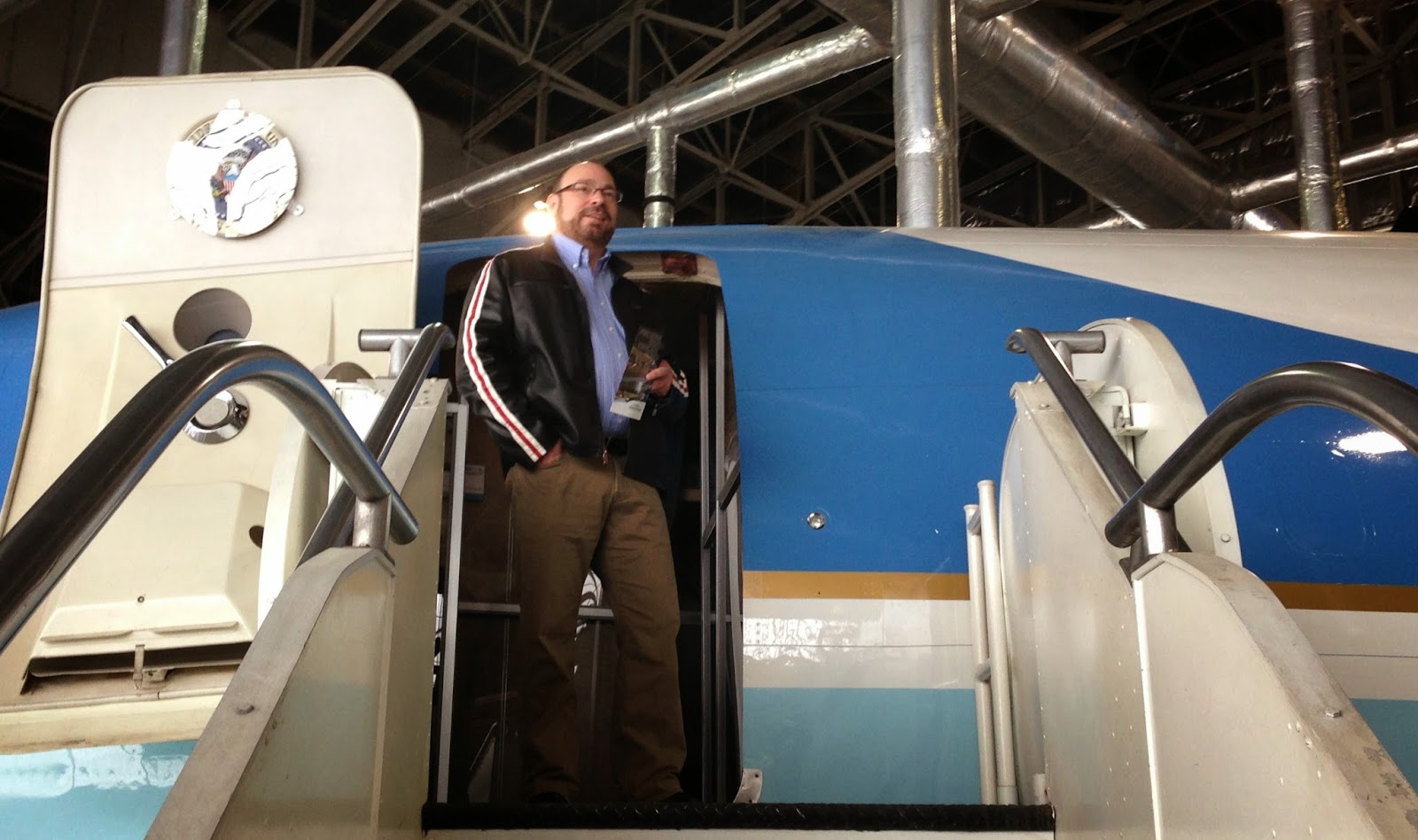
Viewing the Presidential Planes gallery from the entry to SAM26000. I could definitely get used to this view.

Just before 7:00 AM Sunday, Dan & I bundled into the Element for a quick trip to Dayton. (Mason was boarded in a home provided by FlipFlop dogs, a wonderful service which I heartily recommend to dog owners.)

We arrived at the National Museum of the United States Air Force around 10:00 AM, giving us some time to look around before boarding a bus to another section of Wright-Patterson Air Force base.

The World War II hangar displays planes and other artifacts from the war. Not just American planes, including the Bockscar, which dropped the atomic bomb on Nagasaki, but German and Japanese planes are included as well.
Plane nomenclature was not politically correct in the 1940s.

After about an hour, we headed out to view the Presidential Plane and Research & Development hangars. Billed as the Presidential Airlift, the former contains several prominent planes used by Presidents from Franklin Roosevelt to Bill Clinton.

The Sacred Cow was a modified Douglas C-54 Skymaster which carried FDR to the Yalta conference in 1945. (The aircraft which took him to Casablanca in 1943 was a modified Boeing 314 flying boat, but the Secret Service was leery of that model’s poor safety record and mandated a better plane for further Presidential flights.) The entry way to the Sacred Cow was short and I banged my head as I entered it. That was not something FDR would have had to deal with as there is an elevator that lifted him, in his wheelchair, from ground level to the flight level. As I walked through the fuselage, I was struck by how modest the interior was. The CEO of even a mid-size company would have more luxurious accommodations today.
The entryway to the Sacred Cow. Watch your head.

FDR's accommodations on the Sacred Cow were very modest by today's standards.

As the presidency grew, the Sacred Cow was outgrown and Harry Truman commissioned a C-118 Liftmaster, which he christened the Independence and outfitted with a color scheme which presaged today’s Air Force One. The plane had better accommodations, including a multi-line intercom.

The Presidential plane continued to grow as Eisenhower commissioned a Lockheed C121 Constellation, named the Columbine III by his wife Mamie, after the official state flower of Colorado. I suspect Mamie Eisenhower had a hand in decorating the interior of the plans as well, outfitted with chintz sofas and drab colors – no style at all. (I didn't bother taking a picture.) 

SAM26000, a modified Boeing 707, is arguably the most famous of the Presidential Planes. Jacqueline Kennedy recommended the designer who came up with details including the font on the exterior (based on the font used on the Declaration of Independence), along with the exterior and interior color scheme – both of which have been carried over into the present day Air Force One. First used in 1962, SAM26000 was seared into our national memory in archival films of President and Mrs. Kennedy exiting the plane to a cheering Dallas crowd On November 22, 1963 - with his coffin being carried onto the plane a scant three hours later. Members of President Kennedy’s staff had to remove four of the seats and saw away part of the bulkhead to accommodate his coffin.


I found the R&D hangar to be less interesting. Most of the aircraft were one-offs which never got put into actual production – and probably shouldn’t have made it past the drawing board. Viewing some of the bizarre looking planes, I could only muse at the huge tax expenditures for the military-industrial complex. It served as a reminder that while the United States spends more on the military than the next ten nations combined, we still can’t provide full health care for those who serve – to say nothing of countless uninsured civilians.

From the museum, Dan & I went to a concert with the Dayton Philharmonic, led by Neal Gittelman, at the Masonic Temple - a beautiful building containing a lovely hall with fine acoustics. The music included Mozart’s Marriage of Figaro overture, the Piano Concerto in C minor, K. 491 - with my friend Zsolt Bognár as soloist - and Beethoven’s Fifth Symphony.

In my opinion, the C minor is the greatest of all Mozart’s piano concertos. It’s highly innovative, with an opening theme which covers all twelve notes of the chromatic scale. The central Larghetto is one of the few slow movements in a Mozart piano concerto which doesn’t need embellishment. The finale, a theme and variations, is among the darkest movements Mozart ever wrote, and the minor key ending is a rarity in a piano concerto. The whole work carries an emotional resonance that most of the other piano concertos, beautiful and finely written as they are, lack. Zsolt played the cadenza by Hummel, which Rubinstein also used – although the elder pianist trimmed a few bars toward the end. Zsolt’s performance was very fine, exquisitely scaled and balanced, with just the right amount of dramatic tension and pointed phrasing. The Dayton Philharmonic is a fine regional orchestra, with a surprisingly strong string section.

If there’s any piece of classical music one can refer to as overplayed, it’s Beethoven’s 5th. Not merely is the 5th overplayed in terms of frequency, but often it’s over-interpreted. For example, there is a phrase in the third movement where Beethoven indicates a ritardando toward the end. In too many performances led by too many conductors (who shall remain nameless), the pulse starts to slow early on in the phrase, well before the spot in the score where the composer placed the ritardando indication. In effect, the conductor is telegraphing Beethoven’s punches! I was relieved to hear that Maestro Gittleman interpreted the work as indicated, as did Toscanini before him. The work on the whole was briskly paced, with a riveting finale.
Zsolt signing copies of his CD after the concert.

After a relaxing evening and good night’s sleep, Dan & I headed to the Book Loft in Columbus. This is the kind of book store I’d have loved to work in, rather than the purgatorial chain store where I wasted four years of my professional life. The set of historic pre-Civil war buildings, with its 32 rooms of books and cubby holes, is the ideal place to browse away one’s day. After shopping there and leaving with an armful of literary booty, we strolled the German Village neighborhood. It’s ironic that, even as I have embarked upon more distant travel recently, there are nearby regions I have not explored. My parents used to regularly take the family to Columbus when I was a young child to visit my great aunt and her husband. But I can count the number of times I’ve been to Columbus as an adult on the fingers of one hand. It’s a lovely, ideally sized city, which I intend to visit more often. Indeed, from what I’ve seen were it not for my job and the Cleveland Orchestra, I could well envision myself living in Columbus.

We arrived home in South Euclid a few minutes before 3:00 pm, St. Patrick’s Day. A whirlwind trip!

Wednesday, February 19, 2014

Is 2014 the year for marriage equality in Ohio?

My spouse and I just filed our tax returns. Thanks to the 2013 Supreme Court ruling, for the first time, we were able to file our federal return as a married couple. Because of Ohio’s retrograde restrictions on same sex marriage, we had to file separately in Ohio - along with a special form advising why. Without delving into too much personal detail, the process was far more costly and time consuming than in the past. But it was worth the time and money involved, knowing that our 2010 Vermont marriage is recognized by the Federal government. It’s also worth the effort we’re putting into getting our end-of-life documents in order – something opposite sex married couples don’t necessarily need to do.

One group, FreedomOhio, has been collecting signatures to get the Freedom to Marry amendment on the ballot this year. FreedomOhio has received a great deal of pushback from state and national LGBT organizations, including Equality Ohio, the Human Rights Campaign, and even the American Civil Liberties Union. These groups contend that there are problems with the ballot language and the timing, and prefer to wait until 2016 to push their own amendment.

 As is often the case, there are valid arguments on both sides.

The verbiage of the proposed amendment IS poor. The religious exemption could be used in ways that are harmful to the LGBT community, particularly given the growing prevalence in religiously affiliated hospitals here. On the other hand, HRC and the other big money gay groups have lawyers on hand who could have hammered out the correct language before the petition drive began. Why didn’t they? That’s open to speculation, and I have my own opinion - which I will expand upon below.

 The argument that one can get married in another state and have it recognized Federally, or that 2016 is only two more years, gives little comfort to those with a dying loved one or otherwise going through a life changing event.

 I believe if Ohio voters had a chance to vote on the issue this year, 2004’s Issue 1 would be repealed and same sex marriage legalized – so long as the ballot issue received adequate support from the larger LGBT organizations. This isn’t based on some Pollyanna notion that all of Ohio has suddenly become enlightened, but on hard data from numerous polls. Indeed, as Ohio is a microcosm of the country as a whole, there are parts of the state that are shockingly backwards, as well as more progressive areas. But the tide has shifted in Ohio as it has in much of the country.

The last few years have seen tremendous progress for the LGBT community: Hate Crimes Legislation, two historic Supreme Court rulings, and the repeal of Don’t Ask, Don’t Tell. In all cases, it took the activists to get the ball rolling, often with HRC and the other high profile groups cautioning that it wasn’t time yet before finally being dragged into the party. When HRC’s Joe Solomonese was replaced by Chad Griffin, I had faint hopes that HRC would start to push more – but thus far that hasn’t been the case. They continue to take the “wait for the perfect time” approach, hunker down in their $16 million headquarters, and plan their next black-tie fundraiser. But there is seldom a perfect time in politics – and we oughtn’t let the perfect become the enemy of the good. The optimal time could sneak up on us when we least expect it, even in Ohio. Like it or not, Ohio is a bellwether state. If SSM passes in Ohio (specifically by vote, rather than a judicial ruling), it would have a huge impact on the national marriage debate. The dominoes would start to fall very quickly. 

Essentially, there are two pieces of unfinished business remaining on the LGBT political agenda (as opposed to social issues, like bullying and teen suicide, where we still have a long way to go): nationwide marriage equality, and equal accommodations in employment, housing, credit, and the like. Once these political hurdles are jumped, there will be little reason for groups like HRC to exist. And I think they fear that even more than anti-gay discrimination.

Saturday, February 8, 2014

Telling Mansion update

The 2nd lawsuit filed by the Save the Mansion Library group has been dismissed. The deed has been transferred and the Mansion is now owned by the Richard A. Barone charitable trust. According to this article, the SML group is considering a 3rd lawsuit – although it’s not specified what the lawsuit intends to accomplish since the Mansion has been sold. Meanwhile, the case against the SML leader who allegedly assaulted a Cuyahoga County Public Library board member goes to trial March 4.

 I understand and share people’s frustrations with the way the CCPL handled the library move – especially with regard to those in Lyndhurst. The fact remains, the CCPL is an independent entity (per the State and County charters), and elected officials can’t decide where the library builds any more than they can decide which books the library carries. When certain members of the SML group state the South Euclid city council and/or Planning Commission can stop the new Library from being built, they are lying.

With yet another lawsuit under consideration by the SML group, one has to ask: What part of “NO” don’t they understand? How can their leaders, in good conscience, continue to solicit donations for legal actions which have no chance of success? A member of the SML group boasted that they have several thousand dollars bankrolled – all of which is apparently going to lawyer’s fees. Wouldn’t what money be put to better use keeping the Mansion opened as a cultural and arts center? Those of us who love the Telling Mansion have a choice: Continue to exploit people’s anger over the way CCPL handled the deal, or move forward with a constructive plan for the Mansion.

Friday, January 17, 2014

An Open Letter to South Euclid's Mayfield Road Commercial Property Owners


Dear Mayfield Road Commercial Property Owner,

I am writing to you today as a concerned resident of my city of South Euclid, whose parents moved here in 1971.  In my experience, South Euclid is a community of engaged and friendly people who take pride in their property and care about the future of their neighborhoods and city.

A recurring disappointment, however, is the Mayfield Road business corridor, our ‘downtown’, which no longer reflects the dynamic vitality of our global residential community.

The condition of the commercial buildings along Mayfield Road has deteriorated to the point where I suspect the properties do not attract the types of businesses our community desires and deserves.  I’d love to be able to patronize more local, independently owned business.  Sadly, with a few exceptions like the Better Occasions Shop, and Chef’s Ingredient Outlet, many businesses moving in over the last few years represent the “lowest common denominator” and serve to harm the community’s image.  Part of the cause of this problem is poorly maintained, unsightly structures which do not appeal to either the kinds of business we’d like to attract, or to customers.  While your buildings may satisfy the legal standards for occupancy, the minimum legal standard is by no means acceptable in a community like South Euclid.  

As expressed many times in the public meetings held to develop the City of South Euclid’s Comprehensive Master Plan, a primary concern for the future of our community is the condition of our central business district, the Mayfield Road Corridor. The Master Plan makes many recommendations for improving the corridor, some of which will be implemented next year through a streetscape project at Mayfield & Green.  As a member of the Master Plan Citizens’ Steering Committee, I have blogged on this very subject.

Our residential neighborhoods also continue to recover from the foreclosure crises as more and more young families and members of the “creative class” are calling South Euclid home. This is in no small part due to engaged residents who have worked to install and maintain “pocket parks” and support the city’s Heritage Home program.  Our large core companies and institutions are growing, and we have seen new retail developments on the south side of the city. Cedar Center is an example of positive change in a previously blighted area.

Therefore, it is time for you, as a commercial property owner in the Mayfield Corridor, to make the investment to your property which will attract high-quality businesses.  A business that truly benefits the people of South Euclid, rather than exploiting our poorest citizens, will likely be in a position to pay higher rent. 

We as residents stand ready to patronize local businesses, and the City is willing to assist in finding those new businesses which will be attracted to a modern, attractive, and revitalized downtown.

For this to happen, it will require a partnership between residents, city officials, and you the property owners making an investment in our community. I stand ready to assist, just let me know how I can help. Improving our central business district is a necessity.

Sincerely,
Hank Drake


Friday, January 3, 2014

2013 in review


For much of the world, 2013 was a difficult, strife ridden year: domestic and international terrorism, government abuse and suspicion thereof, and the anniversary of an American tragedy.  Yet the economy improved despite continued government sequestration and a protracted shutdown, and Congress did something it hadn’t done in two years – passed a budget.

I’ve made no secret that the most important domestic political issue to me is LGBT rights.  On that front, the community witnessed a series of judicial and political victories, so that by the end of this year, 17 states with a population of over 123 million people now have same-sex marriage.  It is my hope that in 2014, Ohio will join the ranks of those states.  The comings out of a number of celebrities, from Jodie Foster and Wentworth Miller, to Robbie Rogers and Tom Daley, contributed to the mainstreaming of LGBT people – much to the consternation of religious extremists and radical LGBT separatists. 

The big story in South Euclid this year was the purchase of South Euclid’s Telling Mansion by investor Richard A. Barone.  While the Cuyahoga County Public Library Board’s decision to move the branch to a new location and sell the Mansion has been unpopular, it now appears to be a fait accompli – despite a new lawsuit recently filed to prevent the sale from “closing”.  I believe that Mr. Barone’s proposal to use part of the Mansion as a porcelain art museum, and his welcoming of the TellingMansion Preservation Organization’s assistance represent the best way forward in guiding the Telling site into the future.

I went to more concerts this year than I can remember - Severance Hall is always a joy to visit (Blossom, not so much).  Of particular note was Jean-Yves Thibaudet’s spectacular performance of Liszt’s Todtentanz in the aftermath of a driving thunderstorm at Blossom.  But the most memorable event for me was the exploration of Sony’s 41 CD (plus 1 DVD) boxed set of Vladimir Horowitz at Carnegie Hall – performances spanning 1943-1978.  The term “astonishing” simply does not do justice to a series of performances that demonstrate that virtuosity and musicality are not opposing virtues.  Also on the piano front, my friend Zsolt Bognár’s recording was issued to widespread acclaim.

I seldom go to movies anymore – unless the item is either unique, or spectacular enough to warrant the cost of a ticket.  Two movies: Star Trek Into Darkness, and Man of Steel, were profoundly disappointing entries in franchises I’ve known and loved over the decades.

For me, the year was busy, with both difficulty and success on the personal front. 

My quest to get myself into better shape was stymied by chronic back troubles and a pinched nerve.  Yet I continued a basic routine of 30 minutes on the elliptical machine – five times per week – to promote cardiovascular health – and that combined with my diet prevented me from gaining weight. 

Toward the end of the year, I received some good news: a substantial promotion at work.  The flip side is that this will make even more demands on my time – which has already resulted in a falloff of my blog entries.  But I’ll still post from time to time.