Saturday, December 31, 2022

2022 in Review

2022 saw a continuation of the return to normalcy that began in 2021.  I continued my quest to get into better shape that began with my COVID vaccination and return to working out in 2021.  Since May of that year, I have lost over 30 pounds through a combination of diet and exercise – mostly the former.  I didn’t do anything radical: just reduced carbohydrates and sugar, which in turn reduced cravings for food.  That, along with just 30 minutes of exercise six times a week brought my weight down to its lowest point since 2006.  Although I remain overweight, I feel much better and, without wanting to boast, I look better as well.  Being able to work from home, only occasionally going to my employer’s campus, has been a great help to me in my fitness quest: not having to commute saves me over 40 minutes of each day.

Daniel and I continued our travel adventures with an autumn trip to Canada and New England in place of an originally planned trip to Europe.  Travelling by car enabled us to avoid the air travel meltdown that continues to plague North America and Europe, and we saw much that we would have missed. 

On the musical front, after tentatively dipping our toes back into the musical waters of Cleveland in 2021, Daniel and I began regularly attending concerts again.  There were too many concerts to mention comprehensively, but standouts were  Behzod Abduraimov’s fearless performance of Prokofiev’s Second Piano Concerto and Igor Levit’s effervescent Brahms Second Concerto. 


Aside from that, my musical activities have mostly been focused on composing several short works for piano and administrating my Vladimir Horowitz Facebook group.


Speaking of COVID, I experienced it in late-May.  At first, it seemed like an ordinary sinus infection, which is common for me as summer approaches.  Then my palms and the soles of my feet turned beet red, prompting me to get tested.  As I had been vaccinated, the symptoms were mild and I lost only one day of work – although it would have been more if I didn’t work from home.  I felt better in short order, but two weeks later the skin on my palms and feet suddenly began peeling off – evidently rejected by my immune system.   


In the wider world, Vladimir Putin’s chest-thumping led to Russian’s brutal and illegal occupation of the sovereign nation of Ukraine.  The war has not gone as Putin has expected, thanks to fearless Ukrainian soldiers assisted by weapons from the West, especially the United States.  Further, Western sanctions have nearly crippled the Russian economy, leading to domestic unrest.  I’ve been doing my small part to help but won’t disclose exactly how on this blog.


Democrats performed better than expected in the 2022 midterm elections.  They would have held the House if not for aggressive gerrymandering in Republican led states, including Ohio.  Also, too many Americans have become spoiled, entitled brats who decided to whine about inflation while forgetting that the economy was at a dead standstill just two short years ago.  The inflation of the last year is not the result of Democratic or Biden Administration policies, it’s due to the law of supply and demand which is the centerpiece of capitalism: coming out of COVID, there was a sharp increase in demand without the resources to meet those demands due, in part, to a lack of imports from China.  The increased desire for both road and air travel drove fuel prices, which drove up prices for everything else.  Instead of taking logical actions, like driving less or getting more fuel efficient cars, too many Americans decided to crab about it while ignoring our own history: The economic situation in 2021-22 has a parallel with that of 1946-1947, where the conversion from a wartime to a peacetime economy and a generation of servicemen returning home to start families drove not only inflation but a housing shortage.  But while countries like China and Russia are struggling economically, and while Europe and the UK struggle with inflation far more serious than occurred in the United States, the American economy remains relatively sturdy and resistant to attempts by the Federal Reserve Bank to slow it down.  At this point, it’s an open question as to whether President Biden should run again.  Personally, I think he should not.  Biden can decline another nomination and go down in history as among the most successful one-term Presidents, and having done his duty, retire like Cincinnatus, clearing the way for a new generation of leadership.  But anyone who doubts that we’re much better off than we were two years ago needs a reminder of the lockdowns, how hospitals were overrun, and stores and restaurants were closed – and President Biden’s steady leadership is a major factor in changing that. 


On a very personal note, 2022 saw the blossoming of a friendship with a person whom I’d known peripherally for years.  The result has been a new perspective on the arc of my life, a renewed sense of purpose, and the slow opening of a heart that’s closed for all but those truly close to me.  My greatest hope is that this friendship continues for as long as I do. 


Sunday, December 4, 2022

Petrenko and Abduraimov at Severance

This past Thursday I received the first of two doses of the Shingrix vaccine.  Although I experienced some unpleasant side effects Friday, by Saturday they were mostly resolved so, despite a slightly sore shoulder, I was able to attend the Cleveland Orchestra’s concert of 20th Century music at Severance Hall featuring guest conductor Vasily Petrenko.  Unfortunately, Daniel has been fighting an annoying sinus infection, so he was unable to join me. 


The first work on the program was Edward Elgar’s concert overture, Cockaigne “In London Town,” a musical tribute to Edwardian era London and a reminder to this listener that he needs to book his flight for a planned spring trip there.  The work’s jaunty rhythms were delivered with crispness and a lack of pomposity, its massive orchestration never overpowering.

Petrenko was joined by pianist Behzod Abduraimov for the concert’s next work: Prokofiev’s Piano Concerto No. 2, Op. 16.  Originally premiered in 1913, the work’s score was lost in the aftermath of the Russian Revolution, reconstructed and revised by the composer, and received a second premiere in 1924.  The work is easily the most demanding of Prokofiev’s five piano concertos:  Four sprawling movements, harmonically pungent, truly knuckle-busting in terms of dexterity and stamina required.  The work has grown in popularity over the last few decades, although the contrarian composer seems to have had mixed feelings about it (he advised Vladimir Horowitz to not bother learning the piece, saying “it has too many notes and I don’t like it myself”).

Within two minutes of the work’s quiet, brooding opening, Abduraimov was demonstrating that he was the work’s master, not the other way around.  One must always remember that, despite the pseudo-servile statements made by numerous musicians, one must truly master the music to serve the composer’s vision.  Abduraimov’s technique was truly stunning, not merely in dexterity but in the balancing of notes and lines so that Prokofiev’s dense piano writing was more than merely loud, but made musical sense – thus, the technique served musical ends.  This was combined with a narrative sweep usually lacking in performances of this monster of a concerto – which too often ends up sounding like a jumble of scrambled notes.  Of the many performances, both recorded and live, I’ve heard of this work, this was the most memorable, and far more convincing than the one I heard in here four years ago. 

It has become commonplace to describe staggering feats of virtuosity such as what was heard last night as “effortless”, a term that can devalue the achievement and allow the audience to forget that the marvel came at the expense of countless hours of arduous work.  Last night’s performance was certainly not “effortless”, as witnessed by the pianist mopping his brow with a handkerchief during the rare moments of rest that the concerto allowed.  Abduraimov gave the last ounce of himself and the virtuosity was earned. 

In the end, it was a fearless, convincing, and compelling performance which did more than bring the audience to its feet, but also remained in the mind’s ear for hours afterward.  Petrenko and the orchestra matched the pianist note for note.  Despite the concerto’s exhausting demands, Abduraimov gave a charming encore: an arrangement of the Neapolitan Dance from Tchaikovsky's Swan Lake.


The concert’s second half was devoted to William Walton’s Symphony No. 1, a work that the composer struggled to complete.  Walton was a more eclectic composer than Elgar, his music less obviously British, and it’s clear he was a strong influence on the film compositions of John Williams, both harmonically and in orchestration.  Petrenko and the orchestra delivered the work with brisk tempos, transparent balances, and a lack of unnecessary rhetoric.  But it seemed a bit anti-climactic.  Not that the work itself or the performance were lacking, simply that the Prokofiev was so astonishing.  The audience awarded Petrenko and the orchestra with a hearty ovation, but it was the Prokofiev which lingered for the rest of the evening, as attested by several conversations I overheard while leaving Severance Hall. 

Saturday, December 3, 2022

Vladimir Horowitz's approach to concert programming

Vladimir Horowitz was a canny program builder.  He once compared building a great program to planning a fine meal: a light appetizer, a heavier main course, a sweet dessert.  The notion of programming the last three Beethoven Sonatas or the last two Schubert Sonatas was anathema to him.  In fact, single-composer programs were a rare occurrence for Horowitz, with exceptions such as the May 1978 international concert at Carnegie Hall where fans the world over were enticed to hear Horowitz as part of a tourist package.  

Horowitz’s programs demonstrate his desire to thread the needle between musical profundity and entertainment.  The latter principle has taken on a dirty meaning over the decades, but it’s worth noting that the word “entertainment” derives from the Greek word “entrata” which means “to hold” – in this case, the audience’s attention.  But Horowitz would never have stooped to recording an album of Disney tunes, and angrily rejected RCA’s proposal that he record Gershwin’s Rhapsody in Blue or an album of marches.  He wanted to do things his own way, a principle which extended to his concert programs. 

Almost invariably, Horowitz programmed his concerts around one or two larger works, and with rare exceptions (Rachmaninoff’s Sonata in B-flat minor, Op. 36 or his own arrangement of Mussorgsky’s Pictures at an Exhibition) the large works were performed during the first half of the concert. 

Three concerts played within two months at Carnegie Hall in 1946.  

After his 1965 comeback, Horowitz generally had one program that he mostly stuck with for an entire season, sometimes having additional pieces at the ready in case he played twice in the same city.  For example, during the 1985-1986 season, he alternated between Schumann’s Kreisleriana, Op. 16 and Mozart’s Sonata in C major, K. 330 (with a few additional works to balance out the timing). 

Driven by a dual desire to keep himself musically fresh and give his audiences something new, his programs generally feature at least one work either entirely new to his repertoire or something he had not played in many years.   Here is a partial listing of new/revived solo works, starting in 1951, with (n) indicating a work new to his public repertoire and (t) indicating a work he hadn’t performed publicly in over ten years.  Shorter works including Etudes, Mazurkas, Songs without Words, and the like are not included here.

1951: Mozart: Sonata in B-flat minor, K. 333 (n)

1952-1953: Schubert: Sonata in B-flat major, D.960 (n); Scriabin: Sonata No.9, Op.68 (n);  Liszt/Horowitz: Hungarian Rhapsody No.2 in C-sharp minor (n)

1965: As this was Horowitz’s first concert since 1953, none of the works had been performed within the previous ten years.

1966: Haydn: Sonata in F major, Hob. XVI:23 (n); Schumann: Blumenstück, Op.19 (t); Chopin: Sonata No.2 in B-flat minor, Op.35 (t); Debussy: Preludes & L'Isle Joyeuse (t); Liszt: Vallée d'Obermann (t); Scriabin: Sonata No.10, Op.70 (n)

1967-1968: Scarlatti: Various Sonatas (n); Beethoven: Sonata in A major, Op.101 (t); Chopin: Barcarolle in F-sharp major, Op.60 (t); Polonaise in F-sharp minor, Op.44 (n)

1968: Haydn: Sonata in C major, Hob. XVI:48 (n); Schumann: Kreisleriana, Op. 16 (n); Rachmaninoff: Sonata in B-flat minor, Op. 35 (t)

1969: Scriabin: selected Etudes (r & t); Liszt: Hungarian Rhapsody No. 13 (arr. Horowitz) (n)

1974: Clementi: Sonata in F-sharp minor, Op.26 No.2 (n); Schumann: Kinderszenen, Op.15 (t); Chopin: Introduction & Rondo, Op.16 (n)

1975-1976: Schumann: Sonata in F minor, Op. 14 (Concerto without Orchestra) (n)

1976-1977: Clementi: Sonata in C major, Op.33 No.3 (n); Liszt: Sonata in B minor (t)

1977-1978: Mozart: Sonata in C major, K.330 (n)

Fauré: Nocturne in B minor, Op.119;  Fauré: Impromptu in F-sharp minor, Op.102 (n)

1978-1979: Schumann: Humoreske, Op.20 (t) (VH had played selections from this work in the 1934-1935 season.)

1979-1980: Rachmaninoff/Horowitz: Sonata No.2 in B-flat minor, Op.36 (t)

1981-1982: Scarlatti: Various Sonatas (n); Liszt: Ballade in B minor

1982-1983: Schumann: Carnaval, Op. 9 (t)

1985-1986: Schumann: Kreisleriana, Op. 16 (t); Liszt: Soirees de Vienne No. 6 (after Schubert) (n)

1987: Mozart: Sonata in B-flat major, K. 333 (t)


Visit the Vladimir Horowitz appreciation society on Facebook for curated discussion and tributes to the Maestro.


Sunday, November 27, 2022

Britten and Stravinsky at Severance


A source informed me there were only about 800 tickets sold to last night’s concert at Severance Hall, but that did not prevent a hearty wave of applause when guest conductor Thomas Søndergård and violinist Stefan Jackiw walked onstage to begin the performance.

The concert began with Benjamin Britten’s Violin Concerto, completed in 1940 but not performed in Cleveland for the first time until 2014.  This is significant because the Cleveland Orchestra has long been known for championing newer music.  Despite the occasional haunting melody, the simple truth is the work has not been performed more often because it is neither appealing nor particularly interesting – it lacks the dramatic unity of Britten’s better works like the War Requiem, Billy Budd, Peter Grimes, or even the Young Person’s Guide to the Orchestra.  It dates from a time when the composer and his partner, Peter Pears - both pacifists - fled to North America as World War II loomed on the horizon in Europe.  The work’s limitations did not prevent soloist Stefan Jackiw from turning in some bewitching playing that featured striking nuances and vibrato. 

Following intermission Søndergård returned to the stage for a complete performance of Stravinsky’s ballet score to The Firebird in the original orchestration.  While appropriately thrilling and colorful, the performance was largely stripped of the cheap effects one often hears in over-engineered recordings.  For example, the violin upper-register glissandi were not highlighted but kept in sotto voce perspective.  Even the famous Infernal dance of King Kashchei, which featured spectacular xylophone playing from the Cleveland percussion, was kept under tight control – but was pretty exciting for all that.


Sunday, October 30, 2022

Gardner and Gerstein at Severance

An alarmingly small audience greeted guest conductor Edward Gardner as he walked onstage at Severance Hall last night – the house was approximately half-full.  Why the small audience was a bit of a mystery: Both Schumann and Dvořák are relatively popular composers.  Perhaps people were cautious about attending a live event due to the recent surge of flu and RSV cases.  I’d hate to think that Cleveland’s music lovers only turn out for big-name guests like Michael Tilson Thomas.  For those who missed out, it was their own loss. 

As has been customary recently, the concert included a work by a living composer, Ringed by the Flat Horizon by George Benjamin – composed in 1980 and receiving its first performances in Cleveland this weekend. The piece featured several dissonances made interesting by the juxtaposition of contrasting instruments.  The woodwinds and percussion were effectively used here, and there was an impressive cello solo by principal Mark Kosower.  Unfortunately, an elderly couple seated in our row (W) distracted us with their conversation.

Musically and pianistically speaking, Kirill Gerstein is one of today’s most versatile performers.  He has technique to burn (but never shows off), and his taste in repertoire has led him to music as diverse as Rachmaninoff, Gershwin’s Rhapsody in Blue, and tonight’s offering, Schumann’s only Piano Concerto.  A number of well-known pianists, including renowned performers of Schumann’s solo output, never bothered with this concerto – and it has never been my favorite.  The work, too often drowned by pianists in mawkish sentimentality, was given an especially fine performance last night, with crisp tempos, sustained phrasing, judicious mixing of inner voices, and a sense of structure that is often overlooked in Schumann.  Gardner and the orchestra provided a collaboration that belied the notion that Schumann’s orchestration is weak.  The audience leapt to its collective feet and provided a sustained and loud ovation that was in contradiction to its small numbers.  Gerstein gifted the audience with an encore: Busoni’s arrangement of J. S. Bach’s “Rejoice, beloved Christians,” delivered at a tempo that left Horowitz in the shade.   

Like Gerstein, the Cleveland Orchestra has long been known for versatile musicianship.  But it would be anti-historical to deny that the orchestra has long been prized for its performances and recordings of the music of Antonín Dvořák.  The recordings of the composer’s last three symphonies and Slavonic Dances with George Szell and Christoph von Dohnányi are rightfully legendary, and even the old 78rpm recording of Dvořák’s Sixth Symphony with Erich Leinsdorf is praiseworthy.  While the composer’s Ninth Symphony (“From the New World”) remains the composer’s most popular, the Seventh takes the prize when it comes to traditional symphonic structure.  The tunes aren’t as catchy as in the later work, but Dvořák’s treatment of them is in the best tradition and worthy of Beethoven and Brahms (the later of whom had a bit of a bromance with his Czech colleague).  Gardner’s spare, straightforward approach, which emphasized clear textures and utilized sensible tempi with rubato only when warranted, supported the assertion that the work is a true masterpiece.  Again, the audience responded enthusiastically, and I remarked to Daniel that Gardner should be put under consideration when it comes time to select Franz Welser-Möst’s successor.   

It was heartwarming to see an assistance dog at Severance – from whom not a peep was heard during the concert.


Sunday, October 23, 2022

Widmann and Strauss at Severance

Conductor Daniel Harding and violist Antoine Tamestit were the featured guests at Severance Hall this weekend.  But Harding strode on stage without the soloist to begin the concert’s first work, Jörg Widmann’s Viola Concerto, as Tamestit was already seated in a concealed area of the stage from which he emerged shortly after the work began.  The Concerto, finished in 2015, relies heavily on choreography as the soloist makes his way to musically converse and combat with other instruments (placed unconventionally) during the course of the work’s 25 minutes.  The problem for this listener, or perhaps I should state observer, was that the on-stage antics, which included the Tamestit brandishing his viola bow like a sword and even shouting, became more memorable than the music itself.  This was less a concerto than performance art in search of a genuine musical idea.  As the performance progressed, I noticed several audience members playing with their phones and, surprisingly, it was those same members who I observed applauding the most enthusiastically at the work’s conclusion.  An encore was not offered. 

The audience was noticeably larger for the concert’s post-intermission work, Richard Strauss’s An Alpine Symphony. The Strauss work dates to 1915, 100 years earlier than the Widmann, but seems timeless.  Harding and the orchestra presented the work in all its awe-inspiring majesty, from the mystery of Nacht to the terror of Gefahrvolle Augenblicke, everything was heard with a multi-layered clarity and burnished tone that marked the antithesis of the flabby sogginess that marks too much Strauss playing.      


Thursday, October 20, 2022

Ontario, Quebec, New England in October

Dan and I had originally planned to travel to Europe for our October vacation, including stops in London, Paris (where our friend Gerardo Teissonnière gave a recital), and Berlin.  Various factors made that trip impractical, so we decided to remain within driving distance.  Our trip took us into Ontario, Quebec, and New England before we headed home.

We began our journey on Sunday so I could complete some quick regrouting of our shower stall on Saturday, allowing it to dry while we were away. Sunday was a quick drive to Niagara Falls, Ontario, during which my GPS routed us off the toll roads and onto US-20, allowing us to drive through some attractive wine country.  We also drove through Fredonia, New York, where my maternal grandfather and his parents are buried.  I first saw Niagara Falls from the New York side during the 1980s, and the Canadian side was the site of my first trip with Daniel back in 2006.  The Falls themselves haven’t perceptibly changed, but the town is as touristy and vulgar as ever.  As medicinal and recreational Cannabis are now legal in Canada, the scent of marijuana wafted into our nostrils as we walked along Clifton Hill.  The crowds were denser than we expected and we learned Sunday evening that the next day was Canadian Thanksgiving.  Learning of this, we decided to change our drive to Toronto the next day, avoiding the highway and taking the smaller roads that wrapped around Lake Ontario. 

The obligatory Niagara Falls panorama

The obligatory Niagara Falls selfie

Clever juxtaposition of Cannabis and food

Don't even try to bring it over the border.

Fortunately, there were numerous restaurants open in Toronto that night and we settled on Si Lom Thai where we had an enjoyable dinner.  Our one full day in Canada’s largest city was spent at the Art Gallery of Toronto, snapping pictures at the Toronto sign, and bar-hopping in the Church and Wellesley neighborhood, which is sadly becoming encroached by developers.  Still, we had a fun time at Woody’s where bartender Chris poured the drinks, regaled us with stories, and even gave Dan & me a pair of souvenir t-shirts.  Cannabis use in Toronto was even more prevalent than in Niagara Falls.  One could simply not escape the smell of reefer.

The obligatory foodie pic

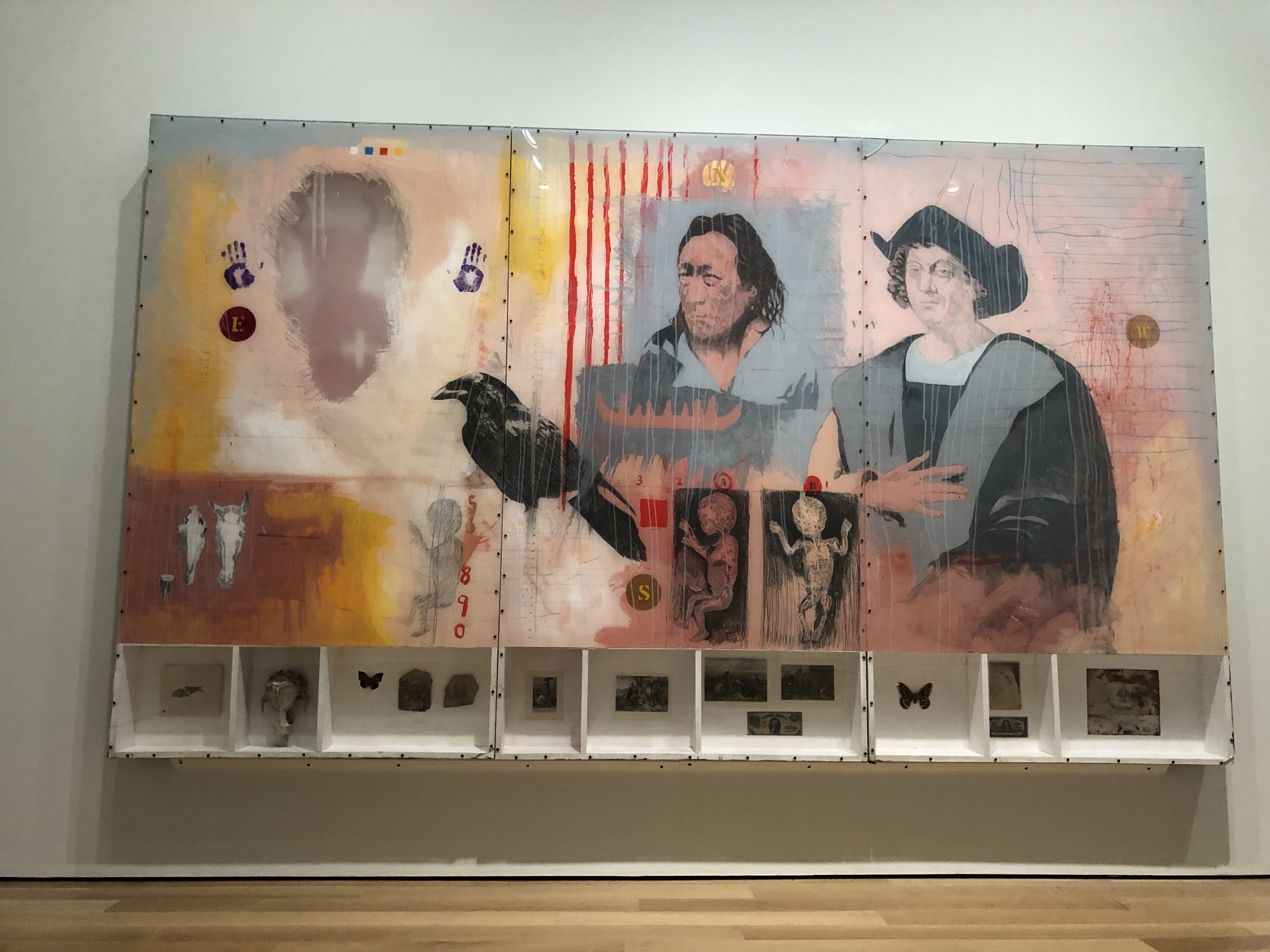
Thought provocation at the Art Gallery of Toronto

It's Toronto!

It's really Toronto, eh?

Public art in Toronto

Neither an endorsement nor a condemnation.

On Wednesday we departed Toronto for the five-hour drive to Montreal.  Here is where it became obvious that Canadian highways are better maintained than their US counterparts.  There wasn’t a pothole to be found on the whole stretch of our journey.  Rest areas were in plentiful supply, and the lower speed limit (100 kilometers, or 62 miles per hour), made for a pleasant drive and better mileage. Normally I am a bit of a lead-foot on highways, much to Dan’s consternation, but I wasn’t about to speed as a foreigner. 

Montreal is in Quebec, which uses French as a primary language.  Dan spent months learning French on the Duolingo app, but whenever he uttered a phrase in French, whoever he was speaking with would immediately reply in English, rendering his studies superfluous.  We spent much of Thursday strolling through the Port, the Latin Quarter, and the Gay Village.  That evening we treated ourselves to poutine at Emilia and spent as much of our Canadian cash as we could at Bar Le Stud. 

Arrête, au nom de l'amour

No explanation required.


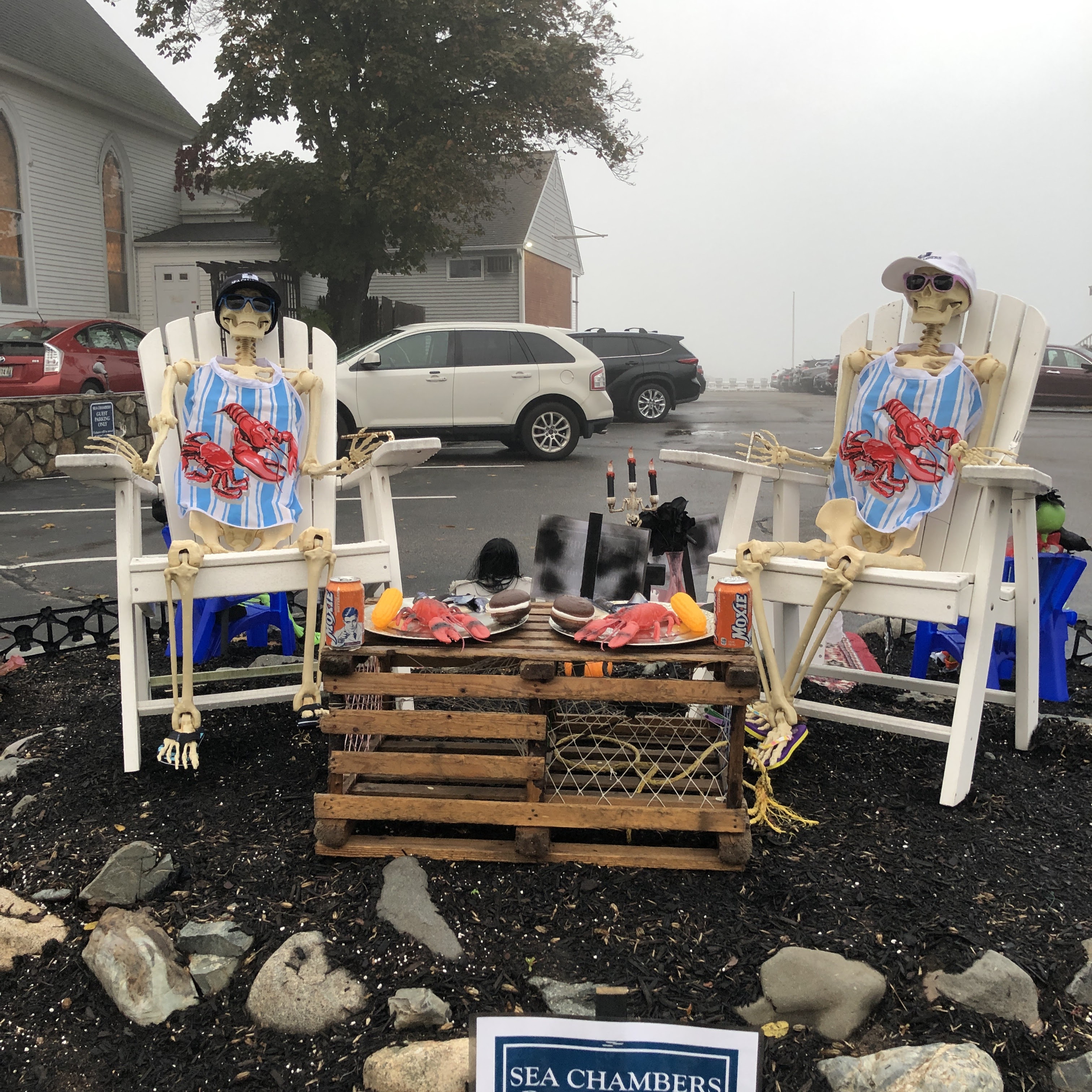
Friday morning we packed the car and headed to Ogunquit, Maine, which I hadn’t visited since 1994.  Since moving back to Ohio that year, I’ve returned to New England several times, including four visits to Provincetown.  Both Ogunquit and P-town have reputations as gay-friendly destinations.  But while P-town has become synonymous with parties and circuit queens, Ogunquit is far less “in your face” while still obviously being an LGBT+ destination for those seeking relaxing fun.  Rainbow flags were everywhere to be seen even though the tourist season was mostly over.  Halloween decorations of every kind were to be displayed outside private homes, restaurants, and hotels/B&Bs.  Dan & I had some fine meals, enjoyable drinks, and walked them off on the town’s beachside Marginal Way. We also took a few hours off at the local cinema to see a dark film entitled “Don’t Worry, Darling.”  By the end of that day Dan & I were mostly travelled out and ready to return to home and hearth.  Be it ever so humble… 

Obligatory pano #2

Drinks at the bar

Dan & I after too much food & drink