Saturday, February 24, 2024

Haydn & Beethoven with Queyras and Herreweghe at Severance

Largely comfortable and familiar classics were on the menu at tonight’s Cleveland Orchestra concert at Severance, featuring guest conductor Philippe Herreweghe and, in the Haydn, cellist Jean-Guihen Queyras.

In 1950, Leopold Stokowski traveled to Cleveland for his overdue debut here.  At the first rehearsal, as recalled by assistant conductor Louis Lane, a few comments from Stokowski about bowing and attack were sufficient that, after 15 minutes, the orchestra’s sonority was transformed to sound like the Philadelphia Orchestra, circa 1936.  74 years later, Herreweghe has managed to do the same – in the opposite direction: I have never heard the Cleveland Orchestra play with such inexpressivity. 

The concert began with a rushed, dynamically constricted rendition of Beethoven’s “Egmont” Overture.  The reduced string section here robbed dynamic climaxes of what Beethoven certainly intended as a dramatic effect, and the lack of string vibrato left much of the work sounding uncharacteristically anemic.  It almost seemed as if I was listening to an overly filtered, old mono recording of the orchestra.  Egmont was composed as incidental music for a play by Goethe about Lamoral, Count of Egmont, whose rhetoric and subsequent execution helped rouse his countrymen to overthrow Spanish invaders and form an independent Netherlands.  A heroic tale.  But in Herreweghe’s hands, the overture was more incidental than heroic.   

Haydn’s Cello Concerto in C major, composed in the 1760s, then lost until its rediscovery in 1961, proved the high point of the evening.  One could take the cellist’s technique for granted, particularly his navigation of the finale’s rapid passagework in the instrument’s treacherous upper range.  Then there was his tone, which was lean yet full, lyrical yet not syrupy.  Best of all, Queyras brought tasteful expressivity and a joyous sense of communicativeness to the solo part – while always blending with the ensemble.  This performance received the warmest applause of the evening, and Queyras responded with a double encore: a Bach prelude preceded by a brief Ukrainian folk song – a poignant reminder that Russia’s brutal invasion of Ukraine began two years ago today.      

Queyras after the performance.

Beethoven’s Sixth Symphony, was subtitled by the composer himself: "Pastoral Symphony, or Recollections of Country Life."  It is in five movements instead of the customary four.  I’ve loved this work since the first time I heard it, at the age of 14.  The opening movement, depicting the “awakening of cheerful feelings on arrival in the countryside”, was brisk – as if the composer was in a hurry to get out of Vienna.  The second movement, titled “Scene by the brook,” fared better – the reduced strings making it easier to hear contributions from the winds – particularly the nightingale, quail, and cuckoo that Beethoven ingeniously wrote into the music.  This was followed by the villagers’ dance, which resounded with merriment – the high point of the performance.  The fourth movement’s storm was not cataclysmic, just some rain and a few minor flashes of lightning, followed by a noncommittal song of Thanksgiving.  The main floor of the hall appeared to be at about two-thirds capacity, with a few people leaving during the final movement, and many more not bothering to join in the applause after the Symphony’s conclusion. 

Saturday, February 17, 2024

Ammann, Benjamin, Knussen, and Ravel at Severance

Saturday night’s concert at Severance, featuring guest conductor and composer George Benjamin, yielded consistently strong performances of music that varied widely in quality. 

The concert began with a proverbial bang in Dieter Ammann’s glut.  This is one of those pieces that takes the “everything but the kitchen sink” approach to orchestration, with the stage crowded by every conceivable instrument, especially percussion.  As for the quality of the work itself, it was a collection of gimmicks in search of an idea.  There were plenty of sonorities to be heard, but little in the way of actual composition.  My concert companion remarked that it sounded like "cartoon music on Crack."

The second work was Benjamin’s own Dream of the Song, where the orchestra was joined by countertenor Tim Mead and the Cleveland Orchestra Chorus.  The work, consisting of six songs set to texts by various authors, contains moments of searing lyricism.  Mead was more than up to the task of both navigating some treacherously high notes and providing emotional heft.

Counter Tim Mead and conductor George Benjamin 
following Dream of the Song

Both works on the first half of the program were local premieres.

Following intermission, Benjamin led the orchestra in Oliver Knussen’s The Way to Castle Yonder, a suite of orchestral interludes from his opera Higglety Pigglety Pop!. Knussen, who died in 2018, was no stranger to Cleveland, and led the local premiere of this work in 1993.  Here, orchestral color was mixed with a sense of dramatic through-line, and the complex orchestration served to highlight the work’s themes. 

The final work, Ravel’s Ma mère l’oye, was likely the main draw – although it’s far from a classical top-40 hit like his Bolero.  The performance was resplendent with color and texture, more clarity than one usually hears in this work – and a dash of poetry.  It also provided a chance for me to observe Benjamin’s economical, unobtrusive conducting technique – not a movement was wasted, and every gesture was for the benefit of the orchestra, not the audience. 

Saturday, February 10, 2024

Schubert and Beethoven with Saraste at Severance

The musicians were well behaved but the audience was not at Saturday’s performance of The Cleveland Orchestra at Severance.  The guest conductor was Jukka-Pekka Saraste, substituting for Herbert Blomstedt. 

Schubert

The concert opened with Schubert’s Symphony No. 6 in C major, D. 589 – the so-called “Little” C major.  This is to distinguish it from the “Great” C major Symphony No. 9, which is nearly double in length as the Sixth.  Unfortunately, I was too frequently distracted by misbehaving audience members to fully immerse myself in the work or the performance.  In all the years I’ve been attending concerts at Severance, I’ve never heard more coughs, more electronic beeps, more applause between movements, nor seen more people milling about than during the Schubert.  From what I could hear of the performance, it was a beige if polished rendition of a rather beige Symphony. 

Beethoven

The main floor of the hall was about three-quarters full for the Schubert.  During intermission more people milled in and appeared to be at near capacity for Beethoven’s Symphony No. 5 in C major, Op. 67.  Beethoven’s Fifth is, of course, a repertoire staple which needs no introduction.  It’s fair to say that the work has been performed to death.  Yet Saraste and the orchestra brought a noteworthy sense of proportion, balance, and clarity to the work.  Even the loudest passages of the outer movements avoided any harshness of tone, and the work held the audience’s attention sufficiently so that there were none of the distractions that marred the Schubert.  The work’s conclusion was met with enthusiastic applause and cheers. 

Friday, February 2, 2024

Eugene Ormandy's stereo Philadelphia recordings - 1958-1963

Sony has reissued Eugene Ormandy's stereo Columbia Masterworks recordings made from 1958-1963.  This is the third of a projected five (at least) Ormandy boxes to be released.  Click here to read my review. 


Sunday, December 31, 2023

2023 in review

2023 was an active year which included adventures, challenges, and triumphs.

I continued with my quest for fitness and, although I still have a bit of a belly, my weight is at its lowest level since the late 1990s and my waist is six inches smaller than in 2020.   I've also become a bit more muscular although I have no desire to become overly pumped.  

Since 2020, my life has been increasingly centered at home, as I’ve been a remote worker since then.  Daniel and I celebrated 17 years as a couple and 15 years in our South Euclid home.  What we’ve learned in the last decade and a half is that the work on our 83-year-old house never ends.  This year we had new storm windows installed – the previous ones were probably about 50 years old and rattled whenever a large truck or music blasting car drove by.  Our primary reason for replacing the storm windows was for better protection from the extremes of hot and cold one encounters in our region.  It will take several more months before we can gauge the impact on our utility bills, but the reduction in street noise was immediately noticeable and most welcome.

A new storm window being installed.

The storm windows held up well against the massive storm that struck in August, which left us without electricity for 86 hours.    

No review of 2023 in Northeast Ohio is complete without the state’s voters resounding endorsement of Issues 1 and 2, which guaranteed reproductive rights and allowed recreational cannabis, respectively.  Although Issue 1 is a constitutional amendment, Issue 2 was a ballot issue and state Republicans have been trying to restrict its impact.  It will be interesting to see how Ohio voters react to political interference in 2024.    

Sadly, 2023 also saw the resurgence of the odious Donald Trump, to which I can only respond: Have the American people forgotten the non-stop issuance of virtual diarrhea during the four years he was in the White House?  Have they forgotten how badly he mishandled COVID?  How the economy suffered?  How the Federal deficit exploded?  How he enabled and even encouraged the most flagrant racism and even insurrection?  How many times must people hit their own heads with a hammer before they realize that they’d feel better if they stopped?  Sure, the last two years have had a few challenges, mostly due to the emergence from the COVID crisis and the revival of our supply lines.  The biggest challenge was inflation, which slowed throughout 2023.  The economy is strong, unemployment is low, and the Fed has indicated they are about to start cutting interest rates.  Life is not perfect, but it’s arguably better.  Even the problems at our Southern border are largely because America is the land of hope and opportunity – and it would be even better if right-wing obstructionists would just get out of the way.  

Cleveland’s Classical music scene has now fully recovered from COVID, and in some ways is even stronger than before 2020.  The Cleveland Orchestra continued with its savvy programming approach which included plenty of newer and unfamiliar older music alongside Classical favorites.  I went to too many concerts to go into detail here, but a highlight included Michael Sachs playing Wynton Marsalis’ new Concerto for Trumpet.   

Local business developments included the long overdue demolition of the Richmond Mall, to be replaced by Belle Oaks, a mixed-use development. 

Danny and I traveled to Palm Springs in the winter and New Mexico in the autumn, along with quick trips to Saugatuck in the spring and New England over Labor Day weekend.  The New Mexico trip was in part to scope out a potential winter home for when we retire, but the more I travel, the more I feel centered in Cleveland.  Life is so affordable here; everything we need – high culture, sports, cuisine, medical care – is within easy access; even the winters are becoming easier to manage.

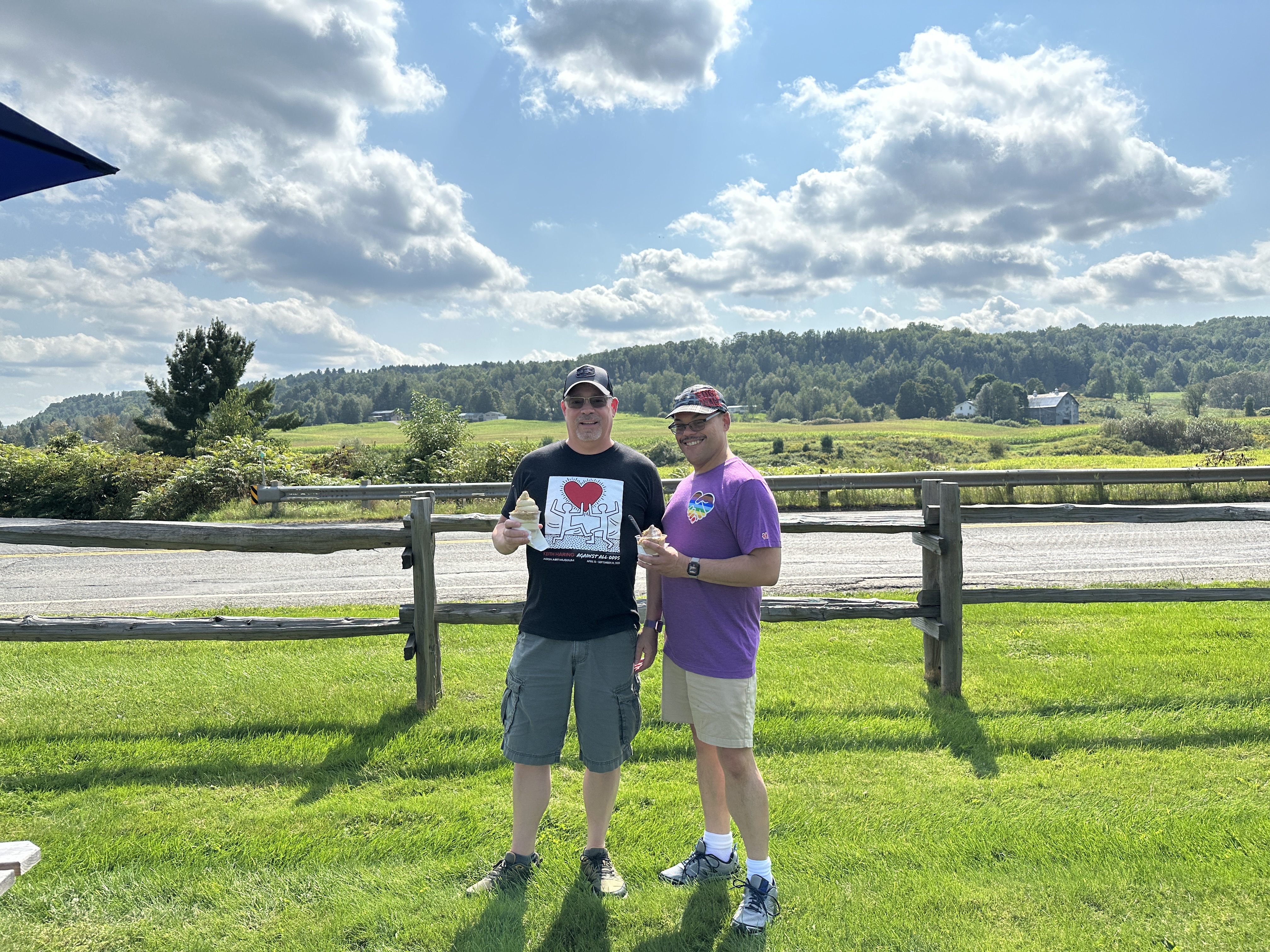
Enjoying Maple Creemees in Vermont

I also made four solo trips: one trip to London which was, to be honest, not very enjoyable; and three trips to see family members from which I brought home happy memories.

In Florida with my niece and her son

With my sister and her husband.


This year also saw the continued evolution of a meaningful relationship with someone who had been in the periphery of my life until about two years ago.  We had some ups and downs in 2023, but the year ended on a high note and my friendship with this person has had a profound impact on my life 
– and I hope it has a positive impact on this person’s life.

On to 2024!


Thursday, December 28, 2023

My review of Cleveland Quartet - the Complete RCA Album Collection

 Amazon has published my latest review, of the Cleveland Quartet's complete RCA recordings - which includes a very fine performance of Beethoven's complete String Quartets.  Click here to read it. 


Monday, December 11, 2023

My review of Artur Rodziński's Cleveland Orchestra recordings

My review of Artur Rodziński & The Cleveland Orchestra - The Complete Columbia Album Collection has been published.  The 13CD set provides much musical food for thought for those interested in the history of The Cleveland Orchestra.  Click here to read the complete review.