Wednesday, August 9, 2023

Why I still have hope for Ohio

As I had hoped and advocated for, Ohio’s Issue 1 was defeated at the polls.  In the end, the margin was more than a landslide, it was an earthquake: 57% against to 43% in favor


My own vote was cast at my local polling place just after it opened at 6:30 am.  Since my driveway is currently under construction, I decided to forego the arduous task of maneuvering my car over the lawn to get onto the road and walked to the polls.  It was a beautiful morning and made for a nice start to the day.  There was a line of people waiting outside, not as large as in Presidential or Gubernatorial elections, but substantial enough to buoy my hopes for the Issue’s defeat.

The obligatory post-vote selfie.


I was recently speaking with a younger friend who, like me, despises Ohio’s politics.  But he has never lived in Ohio, only visited.  So, I had to explain a few nuances: Ohio is really two states: the larger cities of Cleveland, Columbus, Cincinnati, and their suburbs - along with smaller cities like Toledo, Dayton, and Youngstown, which are reliably blue; then there are the outer ring suburbs and the country, which are reliably red.  But the voters who really hold the cards in Ohio are neither Republican nor Democrat – they are unaffiliated and tend toward the fiscally conservative and socially moderate.  Social perceptions change with time.  While Ohio’s voters in 2004 were comfortable passing a Constitutional amendment to outlaw marriage equality (subsequently overturned by the Supreme Court), it’s doubtful they would do so today.

Ohio has long had a reputation as a swing state and a reflection of America’s politics in general.  It’s not so much a leader as a follower – about a decade behind the national trend.  During the height of the Reagan era, Ohio’s governor and both Senators were Democrats.  Today, the state leans red, while previous red states, including Virginia, North Carolina, and Georgia, have become purple and even lean to the blue.  Ohio’s Presidential vote matched the electoral vote in every election after 1960 and before 2020. 

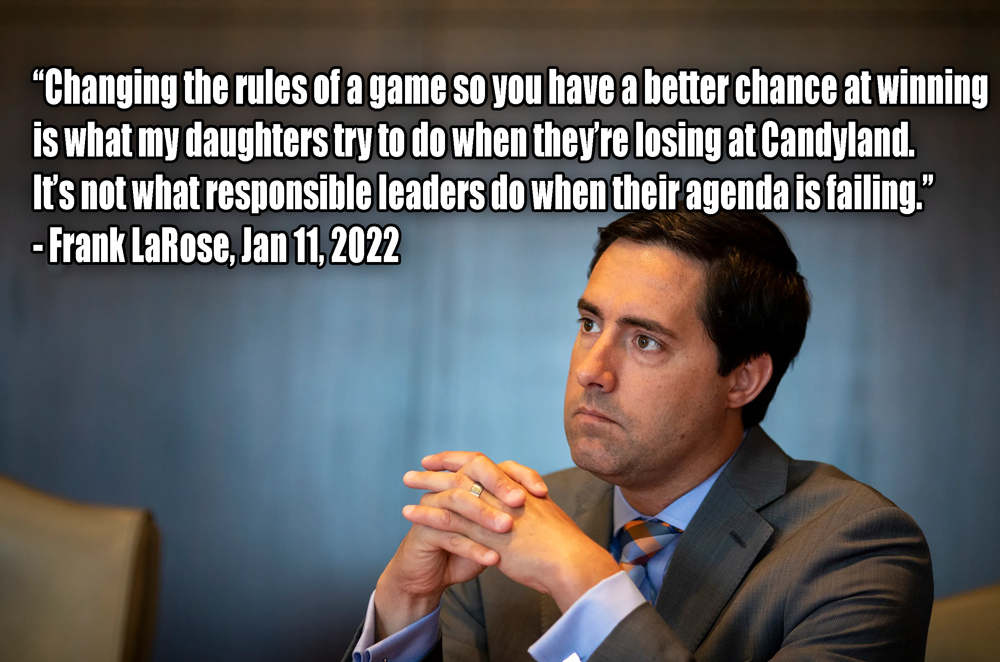
Ohio’s Secretary of State, Frank LaRose, pushed this issue and worked to put it onto the ballot in August – despite a recent law forbidding such one-off elections.  LaRose and fellow Republicans did so hoping that low turnout would help their cause.  In doing so, LaRose exposed his own hypocrisy for all to see.

"Changing the rules of a game so you have a better chance at winning is what my daughters try to do when they are losing Candyland.  It is not what responsible leaders do when their Agenda is failing."  -  Frank LaRose January 11, 2022

Ohio’s Secretary of State now has egg on his face, as does Governor Mike DeWine – who has styled himself as a moderate-conservative, but is substantively a right-winger.  DeWine is term limited and will likely retire from public life after his term expires. 

The winners: First, the women of Ohio, who now have a fighting chance to control their own bodies.  Second, those in Ohio who support the principle of one person, one vote.  Third, those active in Ohio politics – whether officeholders or not, Republican, Democrat, and unaffiliated – who opposed this Issue, including former Cuyahoga County commissioner Lee Weingart, former governors Bob Taft and John Kasich, and two former Ohio attorneys general.  Those listed here are all Republicans, battling to pull the state party toward sanity.  Whether they will emerge victorious in the war for their party’s soul remains to be seen – but last night they won a significant battle, and in doing so all of Ohio’s women won.

I have no illusions: Ohio leans Republican, despite having a Democratic Senator in Sherrod Brown – who is up for reelection next year with LaRose trying for the Republican nomination to oppose him.  But the redness of Ohio is exaggerated by gerrymandering, which has continued despite numerous court rulings and citizen initiatives.  The defeat of Issue 1 is a good step in preventing Ohio’s redness from becoming all but permanent. 

The work continues.  A proposed Constitutional amendment protecting women’s health choices will be on the ballot in November – now eligible for passage with a simple majority.  Another amendment, not yet approved for the ballot as signatures are being authenticated, would have Ohio join states including Michigan in allowing recreational cannabis.  More on these amendments in a future post.  

Wednesday, July 19, 2023

Vote NO on Ohio Issue 1

August 8th will mark Ohio’s most important election in recent memory.  There are no federal or state candidates on the ballot.  Instead, there is only one item: Issue 1, a proposed Constitutional Amendment which would do the following:

  • Raise the bar for getting an amendment on the ballot from 5% of voters in the last general election in 44 Ohio counties to 5% in all 88 counties. 
  • Eliminate the 10-day time period to correct petition signatures deemed faulty from the Secretary of State’s office.  In other words, signatures deemed faulty by the Secretary of State (a partisan, elected office) will be thrown out with no opportunity for redress – forcing petitioners to begin the entire process again.
  • If an issue gets on the ballot, the threshold to pass will be raised from 50% plus 1 to 60%.

In simplest terms, Issue 1, if passed, would make future Conditional amendments a virtual impossibility. 

The hypocrisy of those pushing this amendment is stunning.  Extremist Republicans were content with majority rule when it came to passing a Constitutional amendment outlawing marriage equality – which was later overturned by the U. S. Supreme Court.  They’re also fine with a simple majority to pass this amendment.  But with the prospect of an amendment protecting women’s reproductive rights looming, Ohio’s right wingers, funded by out of state interests, want to raise the bar.  It’s understandable why the pro-Issue 1 cadre is wary of an amendment protecting choice: most Ohioans are pro-Choice, as is the majority of Americans.  Issue 1’s backers are resorting to the usual odious scaremongering: they are claiming Issue 1’s opponents are trying to “destroy the family unit”, and they're airing ads claiming Issue 1’s defeat will lead to forced gender reassignment of children and “post-birth” abortions – whatever those are.  This is a classic case of the uber-religious trying to drum up hysteria to impose their values on everybody, regardless of one's religious choice. 

The pro-Issue 1 people have the gall to suggest that Issue 1 is really about protecting Democracy, while touting an amendment that violates the sacred democratic principle of “one person, one vote.”  Secretary of State Frank LaRose, who pushed to get this amendment on the ballot, has been caught in his own lie. 


The pro-Issue 1 campaign has become so odious that numerous Ohio Republicans, including former Cuyahoga County commissioner Lee Weingart, former governors Bob Taft and John Kasich, and two former Ohio attorneys general have come out against it.  In addition, a broad coalition of groups from across the political spectrum oppose Issue 1.

This issue will not be decided, however, by card carrying Republicans or Democrats.  It will be decided by unaffiliated voters, which constitutes the largest voting bloc in Ohio.  It is up to them to show up and vote NO on Issue 1. 


Sunday, July 16, 2023

Rachmaninoff at Blossom with Kochanovsky and Lugansky


Daniel and I didn't follow our normal summer concert routine yesterday.  Instead of a leisurely pre-concert dinner at Mexibachi Grill near Blossom Music Center, we joined his family in Lorain for a lovely birthday party before racing to Cuyahoga Falls for last night’s concert.  It's fun to mix things up.  Several weeks ago, as I booked tickets for the concert, I fretted over which seats to get – forgetting the giant video screens that now make such considerations superfluous.  As the concert proceeded, Daniel and I found ourselves looking at the screens more than the stage. 

The Cleveland Orchestra was never considered to be a “Rachmaninoff” orchestra, in contrast to the Philadelphia Orchestra which the composer considered to be the world’s finest.  But Sergei Rachmaninoff had worked with the Cleveland’s first two conductors, Nikolai Sokoloff and Artur Rodziński – and when the former was preparing to make the first-ever recording of Rachmaninoff’s Second Symphony, the composer collaborated with Sokoloff over cuts to the music to fit the work onto the allotted number of 78rpm discs.  Despite dated sonics, the 1928 recording holds up very well.

Fortunately, recording technology and the music world have evolved so that Rachmaninoff’s works are generally performed intact these days.  The opening work on the program, his Third Concerto, was performed complete – as it should be.  Soloist Nikolai Lugansky, making his Cleveland Orchestra debut, delivered a cohesive, well-nigh technically flawless performance – “like butter,” as some would say.  Conceptually, his approach to the work was very much like the composer’s own recording, but a tad more relaxed and, as mentioned, without any disfiguring cuts.  As with the composer and his chosen successor, Vladimir Horowitz, Lugansky chose the faster, quicksilver cadenza.   Conductor Stanislav Kochanovsky, also making his Cleveland Orchestra debut, was with the soloist for every step of the journey – urging the orchestra toward more extroverted playing than is usually heard from them.  At the work’s conclusion, they received an immediate ovation and were recalled several times, with Lugansky furnishing an encore: Rachmaninoff’s Prelude in C minor, Op. 23, No. 7.

The Symphony No. 1, which followed intermission, was not as successful.  The heart of the problem lay with the work itself – it’s easily the weakest of the composer’s three Symphonies.  Indeed, the merciless laceration the work received following its premiere in 1897 – with critic César Cui denouncing it as suited to a “conservatory in Hell” and likening it to “the Ten Plagues of Egypt” – sent the composer into a depression so severe that he suffered from a three-year writer’s block which could only be resolved by hypnotherapy.  The work lay forgotten, its score believed to be lost until surfacing in 1945, two years after the composer’s death.  Listening with modern ears and having heard the work numerous times in recordings, it’s obvious it owes much to Tchaikovsky and Borodin in orchestration.  The Dies Irae theme, which is referenced in numerous of Rachmaninoff’s work, is heard constantly throughout – transformed from minor to major – to the point of over-repetition.   Kochanovsky and the orchestra delivered a polished rendition of the work, but audience members were seen leaving the pavilion as it proceeded. 

Yours truly before the concert.


Tuesday, July 4, 2023

Further thoughts on Independence Day


I dislike the modern, intellectually lazy practice of referring to Independence Day as “the fourth of July.”  I suspect it may have originated with people having trouble spelling the word “Independence.”  Whatever the root cause, it weakens the significance of the day and ignores the fact that our nation’s birthday was nearly July 2, not July 4, 1776.  This is precisely why John Adams, in a letter to his wife Abigail, stated:

“The second day of July 1776, will be the most memorable epoch in the history of America. I am apt to believe that it will be celebrated by succeeding generations as the great anniversary festival. It ought to be commemorated as the day of deliverance, by solemn acts of devotion to God Almighty. It ought to be solemnized with pomp and parade, with shows, games, sports, guns, bells, bonfires, and illuminations, from one end of this continent to the other, from this time forward forever more.”

Years ago, I wrote a blog post about Independence Day.  It was confined to the history of the holiday and how, over the years, it had been militarized – when in fact our nation’s founders were not only trying to overthrow a brutal occupying military force, but that after they were victorious the founders were loath to even have a standing military (the reason for the groups like the Minutemen and our Constitution’s Second Amendment, which has been twisted by specious court rulings). 

Independence Day is therefore celebrated as the decision by a group of Caucasian males, many of whom owned other human beings, to break ties with the nation that ruled over them.  As imperfect as individual Founders were, let us celebrate our nation’s rejection of unhealthy encumbrances while also advocating for the independence of all human beings. 

Independence from what? 

From outmoded and oppressive cultural traditions like arranged marriages, honor killings, and the presumption that one’s children will grow up to be heterosexual. 

From the expectation that your child’s religious beliefs will be the same as yours. 

From endless cycles of generational wealth and generational poverty. 

From debt to higher educational institutions for obtaining something which is better seen as an investment in our nation as a whole – because an educated populace, able to compete for the best jobs, benefits us all. 

From having to make the agonizing choice between receiving necessary health care and putting food on the table.

From a sanitized version of our history that leaves us blameless for the mistakes of our predecessors, including the treatment of Native Americans, slavery and its aftermath, the internment of Japanese-Americans, and many other wrongs. 

From the mindless worship of historical figures who, though they should be remembered, should not be celebrated.

From the sins of our parents.  Just as our nation does not recognize inherited nobility, nor should children be held responsible for the personal or financial shortcomings of their parents.

These things signify true Independence.


Saturday, May 20, 2023

The American Dream at Severance

As part of its season ending series The American Dream, the Cleveland Orchestra last night presented works by either American composers or those focused on an aspect of American life.  The concert was led by Assistant Conductor Daniel Reith, substituting for an indisposed Franz Welser-Möst.

The concert opened with the overture to Scott Joplin’s opera Treemonisha. That’s right, Scott Joplin, the composer best known for his melodic (and very pianistic) rags, composed a full-scale opera in 1911. It was never performed during his lifetime, receiving a tragically belated premiere in 1972.  I was fortunate to see a concert performance of the work in Andover, Massachusetts during the early 1990s, and my immediate reaction was that it was worthy of more frequent performances.  Having heard recordings of it several times since then, I would amplify my statement thusly: Treemonisha ought to be presented at least as often as George Gershwin’s Porgy and Bess. 

The next composer on the program, Julia Perry, has an Ohio connection: she moved to Akron with her family when she was a child, and died there in 1979.  Short Piece for Orchestra, however, was composed in 1952 while she was living in Paris.  There are insinuations of Schoenberg in the stark, unsentimental harmonies, with skillful and colorful orchestration that would do any composer proud. 

William Grant Still’s Darker America, composed in 1924, was more broadly phrased, and mixed the kind of American sound that Aaron Copland would explore a decade later, with uniquely African-American tones.

Reith then led the orchestra in three selections from Bernard Herrmann’s score to Alfred Hitchcock’s Vertigo: The Prelude, Nightmare, and Love Scene.  Herrmann’s work, in particular this score, has been hugely influential on my own compositions – to the extent that I composed a 20-minute set of variations on the Portrait of Carlotta theme about 25 years ago.  I’ve collected numerous recordings of Herrmann’s scores over the decades and have no less than three of Vertigo.  Yet I’ve never heard Herrmann’s score to this film performed with such exquisite balance, virtuosity, transparency, or burnished tone as presented by Reith and the orchestra last night.

I have the fortune or misfortune of having a highly visual memory – to the extent that I never forget the face of someone who I like or dislike.  So imagine my amusement at seeing one of the ringleaders of the opposition to South Euclid’s LGBT+  inclusive non-discrimination ordinance at Severance with, of course, a same-sex companion.  In fact, I saw several Catholic priests at the concert, a stroke of supreme irony as one of the works presented was Voiceless Mass, by Raven Chacon – who is of Native American ancestry.  The work, premiered in 2021, is a reflection on and reaction to the forced assimilation of Native Americans by, among others, the Catholic Church.  The sparse, static dissonance of Voiceless Mass, which often hovered near the barrier between silence and sound, brought to mind images of a vast and empty desert.  The small ensemble (including electronic organ) was scattered around the hall so that the conductor was facing the audience.  Reith’s leadership was an example of astonishing concentration and control – earning a standing ovation. 

The evening’s final work, Edgard Varèse’s Amériques, had been presented by the orchestra in 2017, a performance that was recorded and released on the orchestra’s home label.  The work depicts the chaos of life in New York circa 1920, from the vantage point of someone who grew up in a small town in France.  Reith’s interpretation was harsher around the edges than that led by Welser-Möst six years ago.  Yet today’s world, in the aftermath of COVID, an attempted insurrection, and Russia’s invasion of Ukraine, is harsher than it was before, so the performance was fitting. 

It’s doubtless reaction to the strife of the past decade that has led the Cleveland Orchestra to recently present so many works by composers who don’t fit into the “dead white male” category.  What they have demonstrated is that this music is worthy of multiple hearings.  I hope this trend continues.  After all, there is musical life beyond the endless repetition of Beethoven, Brahms, Bruckner, and Mahler cycles.    


Sunday, May 7, 2023

Loggins-Hull, Barber, and Prokofiev at Severance


The lack of repertoire staples at this week’s Cleveland Orchestra concert, led by music director Franz Welser-Möst, did nothing to detract from the compelling performances or the audience’s enthusiasm.  

The opening piece was Can You See?, by Allison Loggins-Hull.  The short work is a contemplation on The Star-Spangled Banner - both the lyrics and the music, which was originally composed as To Anacreon in Heaven by British composer John Stafford Smith.  (I will interject that I don’t feel The Star-Spangled Banner is the best of all possible anthems for our nation, given that it commemorates a battle that was part of what was essentially a pissing-match with the nation that is today our closest ally, has lyrics that include “the hireling and the slave” and is needlessly militaristic.  America the Beautiful seems like a better symbol of our aspirations, but that’s just me.)  It begins with distant percussion which seems to recall the defense of Fort McHenry during the War of 1812 which inspired Francis Scott Key’s poem.  From there the music is freely associated and the listener hears harmonies that recall Smith’s original, without directly quoting it.  The music was enthusiastically received, and the composer was invited to the stage to share in the ovation.  

Cellist Alisa Weilerstein then joined the orchestra for a captivating performance of Barber’s Cello Concerto.  The work’s opening movement contrasted a syncopated drive and searing lyricism, with thematic material that was challenging to present and to hear.  One can sense the composer flirting with the twelve-tone rows that he employed in his Piano Sonata, composed just a few years later.  Weilerstein’s phrasing of the contemplative central movement was something to behold.  The dancing third movement featured some stunning passagework in the cello’s treacherous upper register.  This is a work that should be presented more often (premiered in 1945, the Cleveland Orchestra didn’t perform it until 2013).  Weilerstein received a well-deserved standing ovation.


Prokofiev’s Fourth Symphony, which drew inspiration from his ballet score The Prodigal Son, premiered in 1930, then was extensively revised 20 years later, was equally riveting.  The revised version was performed this weekend.  For decades, Prokofiev was subjected to harsh sounding performances in an apparent attempt to drive home his music’s modernism.  Prokofiev, judging by his extant recordings, was not that kind of performer himself.  Welser-Möst and the orchestra, who have given compelling performances of Prokofiev’s Second, Third, and Fifth Symphonies (all recorded and available), delivered a convincing performance that proved that strongly rhythmic, even percussive music, need not be ugly.  The slow opening, almost as if a 20th Century version of a Haydn symphony, is suddenly pushed aside for a series of rapid-fire string passages that propel the music headlong into conflict – only to be interrupted by a pastoral mood, then plunging forward again.  The second movement, with its clock-like episodes, again reminds the listener of Haydn, in this case the slow movement of his Symphony No. 101.  The third movement was classic Prokofiev, with motifs that sounded inspired by parts of his Romeo & Juliet ballet score.  The celebratory, slightly satirical finale, with its bouncing rhythm, led to a declamatory coda.  During the extended applause, percussionist Paul Yancich was brought forth for a separate bow and was cheered to the rafters.  As with the Barber Concerto, this work deserves to be heard more often. 

Tuesday, May 2, 2023

Two days in Saugatuck & Douglas, Michigan

Ever since we first met in 2006, Daniel and I have been searching for the perfect driving-distance summer vacation getaway.  Our quest has taken us to the East Coast, New England, and Canada.  Each location has its advantages and drawbacks.  Maine and Vermont are lovely in the summer and fall, but an eleven-hour drive makes getting there a chore.  Provincetown is even farther at thirteen hours, but in recent years has become crowded and crassly commercial, and as we age the summer party scene has become less appealing.  The East Coast in general is expensive and the further south we go, the longer our drive and the higher the summer heat.  Canada is closer but the smell of Cannabis can become overwhelming in touristy destinations like Niagara Falls, Toronto, or Montreal.  I could have scarcely imagined that an ideal place was not only under six hours away by car but was somewhere I’d been before.

Some of my earliest memories are climbing the sand dunes of Saugatuck with my family when I was little.  During those years, we used to regularly travel to Grand Rapids to visit family on both my mother’s and father’s side and Saugatuck was just a short drive from GR.  My Michigan memories are fond ones and fortunately I am free of the prejudice against Michigan, driven by hysteria for American football (a sport I don’t care for), that many Ohioans suffer from.  This is partly because my father grew up in Constantine and that my maternal grandmother spent many of her formative years in Grand Rapids.  Even more enticing was learning only recently that the Saugatuck-Douglas area has become an increasingly popular summer destination for LGBTQ+ travelers.  Based on that and a desire to keep our trips a bit closer to home, Daniel and I decided to pay the area a visit.  Our stay was short as we were only giving the area a “look-see”, but we liked what we saw.   

The charming downtowns of Saugatuck and Douglas are on the west coast of Michigan and within walking distance of each other on opposite sides of the Kalamazoo river.  Daniel and I arrived around 5:00 pm Thursday and checked in to The Dunes Resort.  The Dunes consists of several free-standing buildings including the King and Standard Buildings, one- and two-bedroom cottages, and an additional house a short walk from the main property.  It also has an on-site shop, bar, outside swimming pool and friendly, helpful staff – Taylor and Drew were standouts.  We found our recently renovated King room to have a casual, mid-century modern vibe and a very spacious bathroom.  High season runs from roughly from Memorial Day to Labor Day, so rooms during this time should be booked well in advance.  Based on the parking lot there were relatively few guests when we were there – we may have been the only couple in the King building Thursday night.

Danny enjoying the chair at The Dunes Resort.

After checking in we decided to grab dinner at Guardian Brewing Company.  Each table features a battery driven light which changes colors when touched.  When the light is green, it means you’re all set.  You can change it to red to call the wait staff.  The food menu is eclectic and their own selection of beers, ales, and ciders means there’s something for everyone who cares to partake.  I had a Red Dragon Cider made from Michigan apples and Danny had the Clurichaun, a dry stout with notes of coffee and dark chocolate.  As I’d had a rather heavy lunch, I ordered a Caesar salad.  (Not to worry, I sabotaged myself later by getting ice cream. In fact, we stopped off for sweets several times during our journey, the highlight of which was Chocolate Chip Cookie Dough ice cream at the Blue Star Café which put Ben & Jerry’s to shame.  They also serve a very fine breakfast, and the interior has an appealing 1950s diner vibe.)

Drinks at Guardian Brewing Company

After dinner we had our first walk through the Saugatuck downtown district, finding most of the shops had already closed – and many others hadn’t yet opened for the season.  Still, we were able to get a good feel for the area and when we returned the next day, we found a surprising array of goods for sale at competitive prices, from the usual touristy stuff to a very fine selection of Michigan Wines at the Fenn Valley tasting room.  They offer a competitive wine flight – five samples for five dollars, and we bought four reasonably priced bottles.  California, drink your heart out.  We also visited Uncommon Coffee Roasters in the morning, and had dinner at Pumpernickels – we highly recommend both.

A selection of Michigan wine

Art in downtown Saugatuck

The Saugatuck philosophy in a nutshell.

In between meals and shopping we enjoyed nature.  Saturday morning was spent climbing Mount Baldhead, a challenge for two middle aged guys who’ve struggled with their weight – but we made it to the top.  Then we spent an hour exploring Oval Beach and enjoyed the quiet of the off season. 

Saugatuck from Mt. Baldhead

The obligatory selfie

Our two days in Saugatuck-Douglas ended too soon.  We found plenty to do and a relaxed vibe.  To top things off, every person we encountered, whether merchant, local, or fellow tourist, was cheerful and friendly.   This Ohioan loves Michigan and can’t wait to return.