Saturday, February 22, 2025

One week in Spain

Daniel and I recently undertook a one-week trip to Spain.  Owing t0 some unanticipated and expensive home repairs, this will be our only major trip this year.  We spent several days in Barcelona, with a trip via high-speed rail to Madrid for the remainder of our time there. 

Based on scheduling and layovers, it made more sense to use different airlines for our departing and return flights.  We took United Airlines to Barcelona, connecting in Newark.  As the overnight flight is seven hours long, I booked United’s Premiere Plus seats so we would have enough room to sleep.  All was not as expected.  Along with several other travelers, our in-seat monitors wouldn’t play any entertainment despite the crew rebooting the whole system.  We could only view the flight map.  Fortunately, the plane’s Wi-Fi worked, and I watched “Saturday Night” on my phone.  When the time came for our meal, they only had one chicken dinner left, so I let Danny have it while I had the vegetarian meal - a cauliflower dish that was quite good.  This proved to be fortuitous for me as I ate a lot of meat during the following week. 

View from our in-flight monitor...

Our flight landed in Barcelona on time.  Border control at BCN is very efficient and professional.  The airport is clean, modern, and well laid out.  Wanting to avoid the expense of a taxi, we took the Aerobus to Plaça de Catalunya, which was just a few short blocks from our hotel.  We had no agenda for that day.  So, after dropping off our luggage at the hotel, we decided to wander freely. 

Barcelona is mostly laid out on a grid pattern and very walkable.  Although we did purchase passes for the local Metro, we only used them a few times.  On that first day, our wanderings took us to the Banksy museum; his work runs the gamut from amusing, to witty, to thought-provoking.

At the Banksy museum...

Later that afternoon, we returned to Hotel Indigo and were delighted to learn that our room had been upgraded to a larger space with a patio.  Our Spain trip marks the third and fourth times I’ve stayed at Indigo properties and I have never been less than pleased. 

Appropriately for a Sunday, our morning trip took us to Sagrada Familia, architect Antoni Gaudi’s crowning masterpiece – finally nearing completion some 142 years after ground was broken and a century after the architect’s death.  Words simply fail me in describing this structure, so I will let the photos below speak for themselves.


That afternoon we traveled to Park Guell via bus where we chatted with some American students before walking through the park. 


Monday we saw two more of Gaudi’s well-known works: Casa Batlló, and La pedrera (Casa Milà).  The former of these was a single-family home, the other an apartment building.

On Tuesday we did more free association as we walked La Rambla all the way through the Gothic Quarter to the waterfront and back, stopping into various shops along the way.  That evening, we attended a flamenco show which was a highlight of the trip.  The intoxicating melodies, sensuous harmonies, and bracing rhythms left me mesmerized and inspired.  I’ve spent the week since our return noodling Spanish flavored melodies at the piano.

At the Rambla's southern point...

In both Barcelona and Madrid, we enjoyed numerous and varied culinary delights.  Tapas is the thing in Spain and none of our selections were less than very good.  Even fast-food staples like McDonald’s and Burger King were on a higher level than in the US.

McDonald's in Spain is superior to its American 
counterpart, but no match for Tapas.

Wednesday morning, we took a short Metro ride to Barcelona Sants railway station for the high-speed rail trip to Madrid on IRYO.  This was our first experience with high-speed rail – although I used the commuter rail when living near Boston.  Rail in Europe is the superior alternative to air travel when travelling moderate distances – say, under 500 miles.  Think of it this way: if you’re in a city and want to fly somewhere, you need to go to the airport – which is usually in the outskirts of town; then there’s security which can take an hour; you board the plane about a ½ hour before departure; then you fly and land in your destination, get your luggage, and commute to your destination city.  But with our trip via rail, the train stations were right in the middle of town, security was quick, we were on the train and off in a flash – plus the seating options are far more affordable and comfortable than when flying.  We look forward to more inter-Europe travel via rail.    


Our high speed meal on IRYO.
 

Barcelona and Madrid have similarities but many differences as well.  In both cities, we saw same-sex couples holding hands or walking arm in arm without being harassed or even particularly noticed.  Both cities are dog friendly – although people in Barcelona are more diligent about picking up after their dogs than in Madrid.  While both cities are highly walkable, Barcelona is more easily navigable due to the grid pattern layout as opposed to Madrid’s winding alleys.  Madrid, being Spain’s political capitol and financial center, has a busier atmosphere and the kind of bustling city crowds one associates with New York. 


Both cities have airports that put their American counterparts to shame.  Border control at Barcelona airport was efficient and the border personnel were friendly.  Madrid’s airport is beautifully designed, with many restaurants and duty-free shops. 

Terminal 4 at Madrid's gorgeous airport

As with our flight to Barcelona, our return on American Airlines was in that carrier’s Premium Economy section.  The experience was comparable and our in-seat monitors worked this time. 

Arriving in Charlotte after our eight-hour flight was an exercise in exasperation:  It took over 45 minutes to retrieve our luggage because the conveyor that carries baggage from the plane to the truck was broken.  By the time we had it, we undertook a mad rush to recheck it, go through security, and get to our gate.  By the time we landed in Cleveland, we were exhausted and more than ready for bed.    


Monday, January 20, 2025

One term

There have been 14 Presidents who have served exactly one term.  They were John Adams, John Quincy Adams, Martin Van Buren, James Polk, Franklin Pierce, James Buchanan, Rutherford B. Hayes, Benjamin Harrison, William Howard Taft, Herbert Hoover, Jimmy Carter, George H. W. Bush, Donald J. Trump (who has inexplicably been elected to another term which will likely be at least as disastrous as his first), and Joe Biden.  

I have no doubt that Joe Biden will be judged by future historians as among the greatest of these.

This is not based on sentiment, but on objective reality. None of the above listed one-termers inherited the disaster that Biden had to face. 

Lincoln faced a massive crisis when he took office, the collapse of the union and rise of the Confederacy.  He ended the Confederacy with the bloodiest war in our history, and he ended slavery.  He was elected to a second term, but was assassinated only six weeks into his second term.

Franklin Roosevelt took office at the depth of the Great Depression, and led the nation through a halting, uneven recovery.  Then he rose to the occasion and led the US to the brink of victory in World War II – tragically dying twelve weeks into his fourth term, and a mere three weeks before Germany surrendered.

Barack Obama inherited the worst economic downturn since the Great Recession.  His policies rescued two of the big three automakers and turned the economy around.  He also passed comprehensive health care reform, something which had eluded FDR, Harry Truman, and Bill Clinton.

Joe Biden faced not one, not two, but three crises when he took office: Pandemic, Recession, and Insurrection.  He slew them all.  That fight, along with the other battles and tragedies of his life, took a lot out of him.  Though it took some prodding, ultimately he showed the wisdom to pass the torch to a new generation – something which Franklin Roosevelt was unwilling to do. 

Joe Biden is a true public servant who will be fondly remembered by those of us who have actually studied American history.  

Americans would do well to heed the warnings 
President Biden made in his Farewell address.


Saturday, January 11, 2025

French and American music with Denève and Banks at Severance

Guest conductor Stéphane Denève led The Cleveland Orchestra in a program of 20th and 21st Century music which highlighted the cross-pollination between the French and American musical scenes.

The concert began with Darius Milhaud’s ballet La création du monde (The Creation of the World), Op. 81, written after the composer traveled to the United States and encountered Harlem Jazz.  The work was written for a small ensemble, heavy on winds, brass, and percussion – with very few strings.  In six brief sections, the work evokes a variety of moods, including not merely jazz but a Cakewalk, and even a military march by Schubert. 

Saxophonist Steven Banks joined the Denève and the orchestra for A Kind of Trane (Concerto for Saxophone and Orchestra) by Guillaume Connesson.  The work, in three movements, fuses not only jazz, but minimalism, techno, popular elements and brief moments that recall film noir scores.  Banks, using both soprano and alto saxophones, put forth a stunning virtuoso performance that captured each musical strand and mood – however fleeting.  Denève and the orchestra furnished more than an accompaniment, but a seamless collaboration so polished that it belied the fact that this week’s performances constituted the Cleveland premiere of the work.  The audience leapt to its collective feet at the work’s conclusion, and Banks performed Malotte’s “The Lord’s Prayer” as an encore.


Banks and Denève after the Concerto.

 Following intermission Denève returned to conduct the Suite from Francis Poulenc’s 1924 ballet “Les biches” (The Does).  It has long seemed to me that Poulenc was the early 20th Century’s answer to Franz Josef Haydn – wit, surprise, and quicksilver moods concealing subtle depths.  Although the composer had not yet visited the United States when this ballet score was composed, there are still hints of America in the work – not least in the work’s central Rag-Mazurka which, despite the dance form implied, doesn’t sound the least bit Polish.  Astonishingly, this weekend marks the first time The Cleveland Orchestra has performed all but the first movement of the suite.

George Gershwin’s An American in Paris has become so popular over the near century since it was composed that too many performances tend to sound alike and routine.  This performance was anything but.  Denève brought a marked sense of rhythmic freedom which served as a reminder that Gershwin once described the work as a rhapsody.  Each section segued seamlessly into the next with lilting freedom – with the exception of the “Charleston” section which sounded appropriately lock-stepped. 

Tonight’s concert was a magnificent reminder that just as there is Fusion cuisine, so can there be music which fuses different styles including classical, jazz, and popular.  None of these styles suffer when mixed – rather they are enhanced.  In music, as in much of life, overweening puritanism is a dead end.

Wednesday, December 18, 2024

A cruise to Cozumel and Progreso

Northeast Ohio winters aren’t as severe as they used to be.  Indeed, over the past few years, our worst weather events have occurred during the summer – including two extended blackouts.  I’ve never minded the snow that much.  But the cold and dry air are hard on my sinuses and skin.  So, Daniel and I are always eager to get a break from the weather.  We avoid travel during holidays – too much price gouging by airlines and hotels, along with overcrowded airports and roads.  But the first two weeks of December have worked out well for us.     

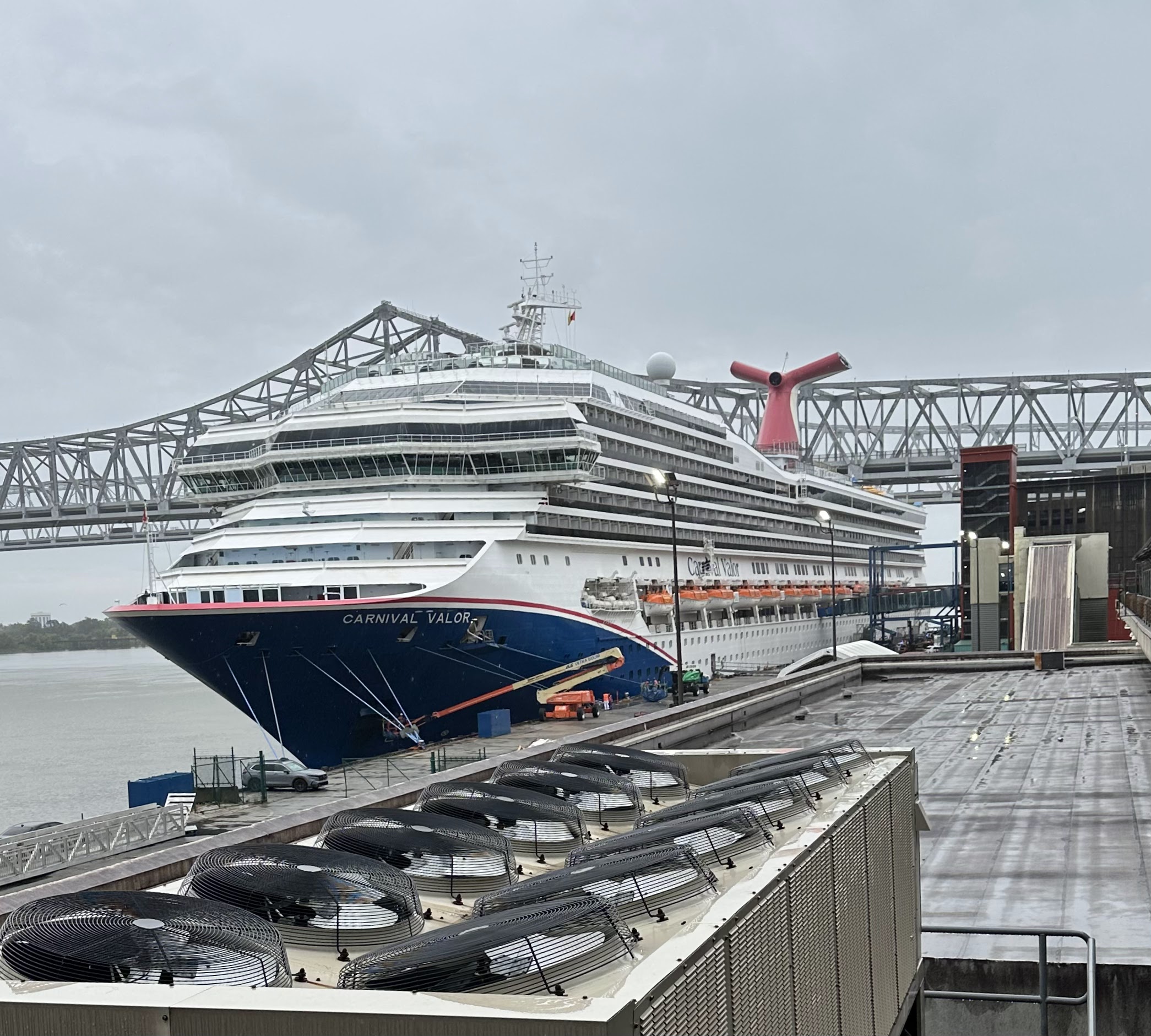
Daniel and I had previously been on two other cruises: a west coast Princess Cruise in 2017, and a Royal Caribbean cruise to Key West and Havana the following year.  Both cruises and lines had their benefits and drawbacks.  COVID put the kibosh on more cruising, plus there were more landlocked areas we wanted to see.  So, it wasn’t until last week that we returned to cruising, out of New Orleans visiting Cozumel and Progreso Mexico on the Carnival Valor. 

As we’d never been to New Orleans before, Daniel and I decided to fly in a day early and explore the area.  Louis Armstrong New Orleans International Airport has been extensively renovated over the past decade and I found myself wishing once again that Cleveland had a better, more connected airport.  I found a hotel that was convenient to both the French Quarter and the cruise terminal – both were within walking distance.  We greatly enjoyed walking the French Quarter and stopping in the various shops and watering holes there.  Being on a Sunday evening, the scene there was quieter than one would see on Mardi Gras.  But we observed several people in striking costumes, and no one seemed to pay them much mind.  I found the genteel decadence of the place to be surprisingly appealing.

Daniel in the French Quarter.

The next morning, Daniel and I walked from our hotel to the cruise terminal via the Riverwalk outlets – probably the weakest mall of its kind I’ve ever seen. 


Each cruise line has its own brand identity, even if the line is owned by a larger parent corporation.  For example, Carnival, Princess, and Cunard are all subsidiaries of Carnival Corporation and plc – yet the experience of cruising on each varies widely.  When we cruised on the Grand Princess, I was in the midst of the usual angst about turning 50.  I discovered I was younger than most of the passengers and decided to forego further cruises on that line until I was a bit older.  Carnival is the opposite.  Somewhat like Walmart, Carnival is all about price point, emphasizing shipboard parties, and promoting itself as the “fun” cruise line.  Cabin prices for two, which of course include meals in the “free” restaurants, can be astonishingly low.  Thus, one sees more variety in age and ethnicity among the passengers than one would see on Princess or Cunard.  The vast majority were American, but we also met with two British brothers.  One of the unofficial rules of cruising relates to something my grandmother used to say, “Never speak of sex, religion, or politics with casual acquaintances.”  I heard no mention of the recent election during the cruise, or politics of any sort.  In that respect, this cruise was a welcome escape.      

As with movie theaters, most cruise line profit is not made on the rooms themselves but on the extras they constantly try to sell you.  The extras range from taking a meal in one of the “premium” restaurants, to purchasing pictures of your and your loved one(s) taken by the ship’s photographer, to buying accoutrements like cologne and jewelry onboard ship.  Then there are the drinks, which are expensive.  I will say Carnival was a bit less in my face about these perks than Royal Caribbean was.

Valor is a Conquest class ship, 20 years old and due for a major refurbishment next year.  American design motifs are seen throughout: bas-reliefs of Washington, Lincoln, and Theodore Roosevelt; sculpted bald eagles; wallpaper featuring figures like Eleanor Roosevelt and Neil Armstrong.  Depending on whether you select “fixed time” or “anytime” dining, you will be seated in either the Washington or Lincoln dining rooms.  The food in Lincoln was good but not outstanding, the service was mostly on-point; Blue Iguana and Guy’s burgers are also good – the former had an excellent breakfast burrito; Rosie’s buffet had standard buffet food; there was also a BBQ place with the blandest sides imaginable – although the meat itself was good.  Daniel & I only dined at one premium restaurant: Scarlett’s Steakhouse, which was very fine indeed.

Carnival Valor, our home for five days.

A very fine steak and cheesecake at Scarlett's.


Everything, from dinner reservations to excursions to texting with your travel companion is handled via Carnival’s Hub app.  All the scheduled events for the day were listed which made it easy for us to select things to do and get reminders.

We experienced rough weather Wednesday and our excursion in Cozumel was subsequently canceled (a refund was promptly posted to our account).  Daniel and I did some local shopping, then went to Fat Tuesday near the pier and began drinking at 11:00am – something of a record for me.  The nachos there were on a lower level than Taco Bell.  But at least we got some commemorative cups. 

Getting our morning drink on in Cozumel.

The rough weather continued Wednesday night as we sailed into Progreso.  By the time we docked, the skies had started to clear and we were on our way to Hacienda Sotuta de Peón for some horseback riding, swimming in a local cenote, and lunch.  Daniel was lucky enough to get a nice tranquil mare named Cielo, whereas I was given a slightly feisty Napoleon.  The water in the cenote (itself a likely remnant of the asteroid that caused the extinction of the dinosaurs) was unexpectedly warm – when our tour guide told us the temperature was 64°, I momentarily forgot that he was measuring in Celsius.  The tour also included a rope making demonstration which I found fascinating.


Some snaps from our excursion in Progreso.

We flew home Saturday, connecting at Houston’s George Bush Intercontinental Airport.  Our flight from Houston to Cleveland boarded from the recently renovated C terminal, which simply has the best gates I’ve seen at any airport, anywhere.  Instead of rows of seats with the occasional outlet, there are sets of desks with outlets aplenty, from which you can charge your devices while enjoying a meal or getting some work done.  Cleveland should take notice.

There was another aspect to this trip that we haven’t had to deal with since our dog Mason died in 2020 – boarding our pet.  Brownie has been to visit Camp Bow Wow several times and we’ve been able to observe him enjoying himself with his canine companions.  He’s come to anticipate his trips there so much that as we dropped him off the day before our flight, he began pulling on his leash to get in.  Brownie was there for the duration of our trip and we picked him up the morning after our return bathed and ready to go home. 

After the activity of the last few weeks, we’re looking forward to a quiet Christmas.


Saturday, November 30, 2024

American music with Robertson and Hamelin at Severance

Guest conductor David Robertson led the Cleveland Orchestra in a program of 20th Century American music at Severance Hall this weekend.

The concert began with Aaron Copland’s 1945 version of his suite from  Appalachian Spring.”  Personally, I prefer the complete ballet in its original version for chamber orchestra, but the performance was so striking this was a minor quibble.  Gone was the orchestra’s typical burnished, European sound – replaced with a clean tone that was quintessentially American.  As a conductor, Robertson is engaging without being ostentatious – a nice contrast from the stodgy kapellmeisters and Intagram hotties who inflict themselves on too many orchestras. The performance was perfectly balanced and the pacing was perfect for a ballet score.  It was well received by the audience, especially an elderly patron behind me who hummed throughout the Simple Gifts section.    

Guest pianist Marc-André Hamelin then took to the stage for George Gershwin’s Rhapsody in Blue, an instantly popular work since its premiere 100 years ago.  Hamelin is, without question, one of the finest pianists in the world today – and quite probably in possession of the finest technique among living pianists.  This performance featured the original orchestration for jazz band by Ferde Grofé.  Clarinetist Daniel McKelway kicked things off with a sexily flirtatious wind up, then pitched things over to trumpetist Michael Sachs for an equally sassy reply.  Hamelin’s contribution included rippling passages seamlessly blended in with the band, while allowing himself more freedom during the work’s solos.  The romantic melody that enters two-thirds into the work was accompanied by the same audience member as in the Copland.  The performance was rapturously received, and Hamelin gave an encore: a beautifully rendered The Single Petal of a Rose by Duke Ellington, which featured some gorgeous pianissimos.

Following intermission, Robertson and Hamlin returned, this time with the full orchestra, for Duke Ellington’s New World A-Comin’, composed in 1943.  Like Rhapsody in Blue, it’s difficult to pigeonhole this work as being in the Classical or Jazz genre, and is best to simply enjoy as fine music.  Perhaps because the piece was unfamiliar to me, I found this performance even more engaging than the Gershwin.  Ellington's piano writing was a bit more colorful and sophisticated than Gershwin's.

The final work of the evening returned the audience to Copland: the suite from his opera “The Tender Land.”  The work, originally composed for television broadcast, had the plug pulled by the NBC network – possibly due to the right-wing interference that was common during the McCarthy era.  As with Appalachian Spring, The Tender Land has the open, rural quality that is considered by many to exemplify American music – even incorporating bird calls in the woodwinds.  Outside of the Party Scene, the piece is primarily contemplative – and despite the work’s quiet ending, was enthusiastically received. 


Saturday, November 16, 2024

Beethoven Piano Concertos at Severance – a potpourri of pianists

For months, Cleveland area classical music lovers had been looking forward to a cycle of Beethoven’s five piano concertos, plus the Triple concerto – all featuring pianist Igor Levit and under the direction of Music Director Franz Welser-Möst.  Speculation was that the cycle was to be recorded for later release. 

A few weeks ago, Cleveland Orchestra patrons received this message from Franz Welser-Möst, who has been undergoing treatment for cancer: "I am terribly sorry that I can’t be with you for the upcoming concerts in November. The side effects of the immunotherapy don’t allow me to travel right now. But, I know you will never-the-less, with or without me, enjoy the wonderful playing of your Orchestra. I look forward immensely to return to make great music for you in 2025. I miss you. Thank you!"

We wish Franz a speedy and complete recovery.  Cleveland Orchestra Associate Conductor Daniel Reith stepped up to lead all the programs.

Shortly after Welser-Möst’s announcement, Igor Levit withdrew from the series.

Five pianists stepped in to perform the piano concertos: Orion Weiss, in the Triple Concerto alongside violinist Augustin Hadelich and cellist Julia Hagen; Sir Stephen Hough, Garrick Ohlsson, Minsoo Sohn, and Yunchan Lim in the remaining concertos. 

Orion Weiss is a Cleveland area native – in fact he grew up just a few blocks from my grandmother’s home in Lyndhurst.  I’ve seen him perform several times dating back to when he was a student at the Cleveland Institute of Music.  I’ve also seen Augustin Hadelich perform several times, including a staggeringly brilliant performance of Tchaikovsky’s Violin Concerto last year.  Beethoven’s Triple Concerto is not a showpiece – it was written for one of the composer’s royal piano pupils who was probably not very advanced.  The greatest technical challenges are reserved for the cellist, who must play in the instrument’s upper registers – which Julia Hagan did with accuracy, aplomb, and musicality.  Hadelich’s joy in performing this concerto – which contains chamber music within it – was palpable.  Weiss brought sparks to the piano part, and all three soloists performed with a sense of communing – something much needed after a difficult and divisive week.  Daniel Reith and the orchestra provided an appropriately scaled accompaniment. 

Soloists and orchestra following the Triple Concerto.

Following intermission pianist Sir Stephen Hough took to the stage to perform Beethoven’s Piano Concerto No. 3 in C minor, Op. 37.  I must confess that this is far from my favorite piano concerto, even among Beethoven’s concerti.  After hearing Mozart’s concerto in the same key, Beethoven exclaimed to a friend “We shall never have an idea such as that!”  Aside from key signature, there is nothing comparable about the two works.  But Hough brought something special to the piece, a defiant quality that most pianists too often filter out, which hints at the Beethoven that is to come.  The pianist was creative in his deployment of inner voices, with some daring pedaling in the slow movement which allowed harmonies to blend in the way that the composer intended – but which many pianists in their never-ending quest for clarity are loath to allow.  Hough immediately launched from the hushed Largo to the final Rondo so abruptly that it startled some in the audience – which would no doubt have delighted Beethoven.  The orchestra’s contribution was equally bold and decisive. 

Hough and the orchestra acknowledging applause.

Garrick Ohlsson was the soloist for Beethoven’s even numbered concertos.  Unfortunately, near-constant coughing from one audience member behind and to my left (I was in Row T, keyboard side) disrupted my concentration.  The Second Concerto (which was actually written first but published second) was given a lovely, chamber-like quality by Reith and the orchestra.  Despite a minor kerfuffle in the opening movement, Ohlsson’s performance was one of bounce, poetry, and wit.  Despite its mostly lyrical nature, pianists will tell you the Fourth concerto is a beast to play.  I would swear I heard Ohlsson play it at Severance about 20 years ago.  The performance was a model of poise, clarity, and musicality by both pianist and orchestra.  One feature I noticed was Ohlsson’s careful attention to trills and ornaments – each integrated into the piece.  Both performances were enthusiastically received, and the pianist gifted the audience with an appropriate encore: the slow movement from Beethoven’s Pathetique Sonata.

Ohlsson after the G major Concerto

The cycle was rounded out with Beethoven’s First Concerto (which was actually composed after the second) and the Fifth Concerto – the so-called “Emperor.”

Beethoven’s First Concerto must have been quite shocking the first time it was heard in Vienna toward the end of the 18th Century.  In terms of pianism, it goes far beyond anything Mozart dared – with rapid passagework, arpeggios, constant pianistic gear-shifting, and even a glissando.  Minsoo Sohn, who I’d never heard of, was the soloist.  The outer movements were brisk and propulsive, with the pianist employing a wider dynamic range than would have been possible on the pianos of the time.  In the opening movement, Sohn chose the most extroverted of the composer’s three cadenzas, said to be in the spirit of the Beethoven’s own famed improvisations.  The central movement was given chamber music clarity.  The performance was very warmly received, and the pianist played a lovely encore: the Aria from J. S. Bach’s Goldberg Variations – with a rare sense of repose and tasteful embellishments in the repeats.

Sohn’s pupil, Yunchan Lim – who won the Van Cliburn competition last year – was soloist in the “Emperor” concerto.  It hardly needs pointing out that Beethoven did not choose the imperial name for this concerto – simply referring to it as a Concerto in E-flat major for piano and orchestra.  Unfortunately, the name has led to an interpretive approach which too often brings to the work a sense of pomposity and portentousness – as if it was intended for Henry VIII in the late stages of his life.  Lim had none of that.  His treatment of the work was within the classical mode, with an opening movement notable for its lean, lithe approach and brisk tempos.  The central movement was, by contrast, a bit heavier than it needed to be; but this was forgotten when Lim gracefully segued into the final Rondo – delivered with an almost balletic sense of rhythm.  Technically, Lim’s performance was unimpeachable, although some purists may have been offended by the pianist’s penchant for moving several ground bass notes an octave lower than written – beyond the limits of Beethoven’s own keyboard.  The bulk of the audience was highly enthusiastic – myself included.  For his encore, perhaps as a tribute to his teacher, Lim returned to the Goldberg Variations, turning in a reflective rendition of the work’s 13th Variation.  At a time when much of the country – and the world – is on edge, it was a welcome moment of shared relaxation.

Lim and company following the “Emperor” Concerto.

In conclusion, the substitute pianists were all wonderful.  But Levit’s cancellation irks me.  I can't imagine Arthur Rubinstein would have ever cancelled a concert because the conductor had to withdraw.  In fact, in over 70 years as a pianist, Rubinstein almost never canceled - he even played two concerts in one day when his manager accidentally double-booked him.  The only exception was when he was in his 80s and came down with Shingles.  As for the past two weeks, the loss was Levit’s – not the audience’s.

Sorry, couldn't resist.


Saturday, November 2, 2024

Fire and Water at Severance Hall

This weekend Guest conductor Tan Dun led the Cleveland Orchestra in a compelling program of 20th and 21st Century music – including two compositions by the conductor himself.

Igor Stravinsky was one of the most eclectic of Classical composers.  Take, for example, his 1908 composition Fireworks.  It was composed as a wedding present for the daughter of his early supporter and advocate, Nikolai Rimsky-Korsakov – and almost sounds as if it could have been composed by Stravinsky’s elder compatriot.  Brilliantly orchestrated, there are sections which are reminiscent of Dukas’ The Sorcerer’s Apprentice.  Tan Dun kept the tempo relatively measured and fussiness to a minimum in his no-nonsense presentation of the work. 

Then the conductor led the orchestra in his own Water Concerto, featuring percussionist Mark Damoulakis, assisted by Thomas Sherwood and Tanner Tanyeri.  Tan Dun’s compositions are of the type that my old music professor would have sneeringly called “sonority music,” meaning the focus was not on thematic development and structure but rather on sound itself.  The work began strikingly, with Damoulakis making his entrance from the back of the hall, while playing a waterphone.  As the composer’s imaginative orchestral accompaniment – which included sounds reminiscent of whale song – proceeded, the percussive trio’s instrumentation was expanded to include water basins, water drums, water gongs and tubes, and a sieve.  The water basins were lit from below, which created intoxicating shimmering effects along the sides and ceiling of the stage.  Whatever my professor would have thought, the audience was raptly attentive and highly enthusiastic.

Applause following the Water Concerto;
Lowering of the state extension.


Following intermission, the concert continued with Britten’s 
Four Sea Interludes from Peter Grimes.  While the opera these derive from isn’t performed as often as those of Mozart, Wagner, or Verdi, the Sea Interludes, composed to cover scene changes, turn up on concert programs with some regularity.  The opening Dawn interlude was darkly atmospheric, but the Sunday Morning interlude was marred by some rough playing from the brass and balances that didn’t sound right from my seat in Row H.  Things settled down in the Moonlight interlude, before the Storm interlude which sounded appropriately chaotic even though the playing was anything but.   

The evening’s final work was Tan Dun’s Concerto for Orchestra, preceded by remarks from the conductor.  When one thinks of a Concerto for Orchestra, Bela Bartok’s masterpiece comes to mind – in which particular instruments or groups thereof are highlighted.  Tan Dun’s Concerto reminds us that the original meaning of “concert” was to plan together; devise; arrange; to act in harmony.  As with the Water Concerto, the composer’s orchestration pushed the concept of symphonic music to the limit as the Concerto evoked an Eastern Bazaar, Indian raga, and China’s Forbidden city.  A most interesting work that bears further hearing.