Friday, March 24, 2023

One week in London

Ever since Daniel and I returned from our first trip to the UK in 2015, we’ve wanted to return. Various factors led to us putting off a return trip, but it wasn’t until last week that I was able to make it happen. Unfortunately, Dan was not able to join me, so this was a solo trip from Wednesday March 15 to Wednesday March 22.

As British Airways now offers a nonstop between Pittsburgh and London, that was my departing airport -well worth the two-hour drive from home to avoid a layover. I’ve had a fear of being late since my school days - which occasionally surfaces in my dreams. So, I arrived at Pittsburgh International Airport well in advance of the “three hours before departure” recommendation. But I didn’t have to wait long for the BA desk to open and get me checked in. From there it was a quick trip through security and onto the train that whisked me to the air terminal. PIT has four concourses shaped like a giant X with restaurants and shops where the concourses meet. I was pleased to see a Bar Symon so I dropped in for a drink and snack. I was still very early but a lengthy FaceTime chat with a dear friend helped me pass the time. Soon enough I boarded the Boeing 787-9 and took my seat in World Traveler Plus. The overnight flight itself was rather uneventful.

Surprisingly there were no available air bridges available when we landed at London Heathrow Airport, so we disembarked via air stairs onto a bus that took us to border control, which has changed since we were last there in 2015. Now it’s largely automated and I was quickly through and on my way to baggage reclaim, and from there to the underground station to take me to Soho via the Piccadilly line. I recommend all visitors to London download the Transport for London app and get an Oyster card.

When planning this trip, I selected Hotel Indigo in Leicester Square and I couldn’t have been happier with that choice. Sofia and Cindy at the front desk not only checked me in early (before noon) at no extra cost, they gave me two drink vouchers for the rooftop bar/restaurant and provided me with an umbrella for use while walking the streets of London.
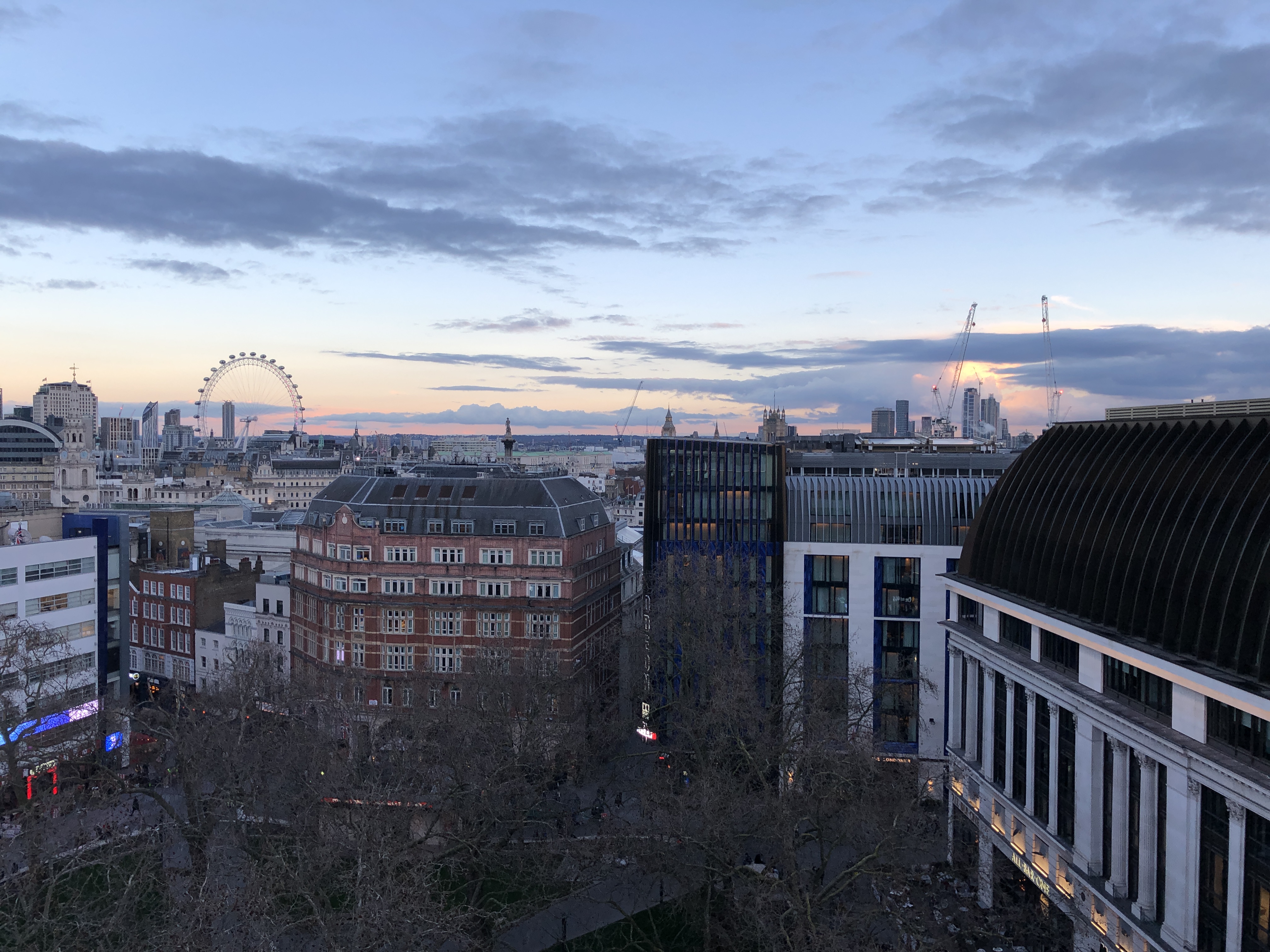
Leicester Square from Hotel Indigo's restaurant

I took it easy that first day there. My sole tourist destination was the London Transport Museum in Covent Garden. Truly London’s public transport network is a model to be followed - efficient, clean, cost effective, and as safe as possible given the multitudes who use it. Given London’s high population density and the organic way the city evolved, it’s also necessary. The US has nothing on this level - only New York’s relatively dirty and dangerous system comes close. The London Transport Museum shows how London went from horse drawn carriages to early rail, to double decker buses and more modern options. It’s appropriate for all ages.

An old-school fashionably appointed train.

Friday was the busiest day. It started with a walk to Buckingham Palace for the Changing of the Guard - which was unfortunately canceled at the last moment due to the weather. Then I headed back to Soho to try fish & chips at Poppie’s. Despite the hip 1960s vibe of the place, I found the food itself disappointing: the fish batter was soggy and the fries devoid of flavor. Arthur Treacher’s in Ohio wins by a country mile - and they offer Hush Puppies. Then I hopped the tube to the London Bridge station to see the replica of Sir Francis Drake’s Golden Hinde. I remember as a child I helped my father build a model of this ship - meaning my dad built it and I watched. The British Drake apparently had no children, although he had several collateral descendants. I’ve no idea if we’re related but my family has a history of service in the Military. Although Drake is an important figure in navigational, seafaring, and world history, we must face up to the fact that his record is not untarnished. He engaged in the trade of human beings. But he also circumnavigated the Earth in an incredibly small ship, an act of daring which cannot be ignored.

Interior of the Golden Hinde

I considered this as I walked the South Bank of the Thames past the replica of Shakespeare’s Globe theatre and Royal Festival Hall (infamous for its mediocre acoustics). By now I was back in Westminster and couldn’t resist watching Big Ben strike three, followed by a walk through the statue garden outside the Houses of Parliament and past the Royal Horseguards. In all I walked over ten miles that day.

An obligatory selfie


When Dan & I went to London in 2015, some family members were disappointed we didn’t visit Abbey Road’s famous crosswalk. Saturday, I hopped bus route 139 and was there in less than half an hour. Honestly, it’s not all that and a bag of crisps but I did the obligatory walk, then hopped the return bus. After Friday’s long walk, I decided to take it easy. I stopped at a cinema and saw the new Shazam film, then headed St. Pancras for a quick walk to the Queer Britain Museum at Granary Square. Then a bit of bar hopping for some interesting conversations with nice people. It was here I realized many Brits have misconceptions about life in America that that they are often as ignorant of our geography as we are of theirs. Many had no idea where Ohio is and thought the entire US had undrinkable water. I gently explained that that truth was more nuanced but didn’t make a big deal of things.

On Sunday I returned to Buckingham Palace for the Changing of the Guard. Quite an impressive display. Unfortunately, by the end of the day I felt a cold coming on. By Monday I felt terrible. Although I did several miles of walking, I had to abandon plans to see George Takei’s Allegiance at Charing Cross Theatre out of consideration to fellow audience members.

By Tuesday I felt well enough to hop the route 24 bus and head to Hampstead Heath, where I walked over five miles while staying at a safe distance from other people. The rest of the day I took it easy, seeing 65 (weak execution of an interesting concept); then it was dinner and drinks at the hotel restaurant.

Wednesday I checked out and headed back to Heathrow for my return flight home. Despite negative publicity last year about operations there, my experience at Heathrow was orderly and pleasant, despite the fact that my flight’s departure gate was not announced until less than an hour before boarding.  I was home before midnight local time.  While I’d enjoyed the trip, it lacked the spark that comes with experiencing new places with a loved one, and I resolved never to travel alone again unless it was to see family/friends or for business.

Sunday, March 5, 2023

Farrenc, Ravel, and Mussorgsky at Severance


Severance Hall last night

The Cleveland Orchestra continued its practice of commingling the familiar with the unfamiliar in this weekend’s program featuring music director Franz Welser-Möst and guest pianist Víkingur Ólafsson.

The opening work was the Symphony No. 3 in G minor by French composer Louise Farrenc, completed in 1847 receiving its Cleveland Orchestra debut.  The work has seldom been performed since its premiere 1849.  The program notes unequivocally pins the reason for this work’s neglect on “the systemic sexism and misogyny long upheld by the classical music establishment.”  That may well be part of the reason.  Another cause may be the Symphony’s highly conservative, one might even say old-fashioned construction.  One could easily pass this off as an undiscovered early symphony by Mendelssohn, and there were passages that reminded me of that composer’s incidental music to A Midsummer Night’s Dream.  The orchestration and architecture of the piece were excellent, but there was nothing in the way of innovation.  Thus, it was interesting to hear, but only once.  

After a quick stage change, orchestra and conductor were joined by Ólafsson for Ravel’s Piano Concerto in G major.  This concert marked the first time I’d heard this pianist in the flesh, and it was a fine experience.  Ólafsson brought exceptionally free metrics in the first movement, yet the structure of the work emerged clearly, along with the jazz influences brought to the fore by Welser-Möst.  In the second movement the soloist was exceptionally attentive to inner voices and phrased the ¾ melody with a soulfulness seldom heard by all too many pianists who simply plunk it out.  The finale was not merely thrilling, but coherent from a structural perspective.  Ólafsson’s seemingly effortless technique, including perfect use of the pedals, was matched with solid musicality.  Of the 15 or so live and recorded performances I’ve heard of this concerto, this ranked very near the top.  The audience gave the pianist a standing ovation and he gave a lovely encore: the Bach-Siloti Prelude in B minor, in a poetic rendition with sensitive control of the lower dynamic levels. 

Ólafsson following the performance

Following intermission Welser-Möst returned to lead the orchestra in Mussorgsky’s Pictures at an Exhibition.  As is well known, Pictures was originally written (rather clumsily) for piano solo in tribute to the composer’s friend, painter and architect Viktor Hartmann.  There have been several orchestrations, with Ravel’s being the most popular.  Personally, I’ve always found Ravel’s approach insufficiently Russian, and I prefer Stokowski’s and Ashkenazy’s orchestrations.  But the problem here was not the orchestration, nor the technical quality of the playing, but the conception.  Despite a fine opening Trumpet solo from Michael Sachs, Welser-Möst’s rushed, metronomic, colorless approach left this repertoire staple wanting.  Passages which benefit from a bit of freedom were rhythmically straightjacketed, phrasing was flat throughout.  It was as if poor Mussorgsky was being rushed from picture to picture at his own exhibition.  I was far from the only listener to feel this way, and several boos were clearly audible afterward – the first time I’ve ever heard them at a Cleveland Orchestra concert.  Welser-Möst can be a convincing interpreter in the right repertoire – this wasn’t an example of that.  


Sunday, February 19, 2023

Mozart and Beethoven with Ax and Blomstedt


The outside of Severance Hall was lit red for Valentine’s Day and the auditorium very well filled for last night’s concert with The Cleveland Orchestra and guest conductor Herbert Blomstedt and pianist Emanuel Ax.  Blomstedt, now 95, is no longer the sprightly figure he was just a few years ago and held onto Ax’s arm as he slowly walked on stage.

The opening work was Mozart’s Piano Concerto No. 18 in B-flat major K. 456, thought by some to have been written for his friend Maria Theresia von Paradis.  Ax brought his usual polish along with keenly sensitive treatment of the lower levels of dynamics. Playing soft, softer, softest is among the most difficult challenges for even the greatest pianists (there are numerous well-known pianists who never mastered it).  The soloist was perfectly matched in dynamics and interpretation by the orchestra and Blomstedt.  The near capacity audience was so enthused that applause was heard after the opening movement, with a sustained ovation following the finale.  Ax played an encore, Chopin’s Nocturne in F minor, Op. 55, No. 1, given in an unfussy manner.

Following intermission, Blomstedt was assisted onto the stage by First Associate Concertmaster Peter Otto, and sat on a piano bench placed on the conductor’s rostrum.  Beethoven’s Seventh Symphony is one of my five favorite works in that genre (the others being Mozart 41, Schubert 9, Brahms 4, and Rachmaninoff 2).  Blomstedt’s interpretation included all the repeats, which were most welcome.  The performance overall was noteworthy for balance between the sections, natural phrasing, and sensible tempos.  Everything was heard in proportion as it should be in Beethoven’s most perfectly structured symphony.  The second movement unfolded with logical inevitability.  The Scherzo featured a Trio that was, for a change, not turned into an Adagio but rather played “much less fast” as Beethoven indicated.  The finale was a marvel of controlled dynamism, given at a tempo brimming with life but not at warp speed.  The audience leapt to its collective feet and gave a prolonged and richly deserved ovation.  Blomstedt may be slowing down physically, but he has lost nothing in musicality, interpretive power, or the ability to project his ideas through the orchestra to the audience.


Tuesday, February 14, 2023

Four Days in Palm Springs


Daniel recently surprised me by announcing he’d accrued far more paid time off than he originally thought.  A fringe benefit of this is that we’re planning to travel more extensively in the coming year than we’d previously envisioned.  In late 2021 we abandoned tentative plans to visit Palm Springs (PS) in favor of more economical destinations.  Although one such trip was beneficial in its own way, we kept PS on the back burner as a future option.  We were able to revive those plans late last year and set the ball in motion to visit PS and get away from the Cleveland winter. 

This was Daniel’s first visit to Palm Springs and my second – the first having been with my stepmother’s parents when I was about 14 years old and too young to really appreciate it. 

Palm Springs (by which I mean, of course, the location in California, not Florida) is known these days as a popular LGBTQ+ travel destination, ranking alongside Puerto Vallarta and San Francisco.  But there is much that anyone can appreciate here: nature, architecture, art.  We decided early on to avoid some of the more decadent guest houses and instead chose the local Hyatt hotel – conveniently located downtown and within walking distance of countless restaurants and vibrant nightlife: gay, straight, and mixed. 

The first day of our trip was a comedy of errors as, just a mile into our drive, we found ourselves with a flat tire.  Instead of changing it in the pouring rain, we headed back home to the thumpa-thumpa accompaniment of said tire.  Daniel then switched our luggage from one car to the other as I grabbed the other car key and we restarted our journey to the airport.  The flight to Palm Springs was uneventful, including a layover in San Francisco where I spotted a United Airlines plane with retro livery.  Once landed at Palm Springs’ charming airport, we found ourselves at the back of a long line at the Budget Rental Car stand.  All told we waited two hours, which did afford us some amusing conversations and commiserations with fellow standees but was highly annoying.  Eventually we got our car and, as we turned from the airport onto East Tahquitz Canyon Way, we encountered a breathtaking view of the San Jacinto Mountains which made the entire hassle of getting there worth it.  We arrived at the hotel just an hour before North Palm Canyon Drive was set to be closed to traffic for the weekly Village Fest.  After settling in, we got the lay of the land as we walked among the vendors and found a Mexican restaurant where we laughed over the mishaps of the day.  We were in Palm Springs where the weather was dry and mild, the moment was all that mattered.  After a dinner that was too generous to allow for dessert, we walked to East Arenas Road, home to several gay clubs including Quadz, Streetbar, and Hunters.  Most of these clubs are pretty much the same: video screens accompanied by loud music that reminded me of the thumpa-thumpa of our flat tire, amplified.  Indeed, of the several gay clubs we visited during our trip, none had the relaxed type of ambience that Garbo’s piano bar in Puerto Vallarta had.  This is a niche waiting to be filled in PS, unless such a place exists and we missed it.  By the time we’d finished our first drink, jet lag was taking effect, so we made an early night of it.  Both that day and for the rest of the trip, Daniel and I were struck by the easy-going charm and politeness of nearly everyone we encountered there.  Never did we once sense that we were being rushed in favor of the next customer. 


Spotted at SFO: 
United Airlines vintage Friend Ship livery

Jet-lag catches up with me in Palm Springs.

View from our hotel room.

We awakened Friday morning and were treated to a lovely view of San Jacinto from our balcony.  If selecting this particular hotel, we recommend opting for a mountain view room, as Palm Canyon Drive is active and loud into the wee hours.  That morning brought us one of the highlights of our trip as we drove up the steep hill leading to the Palm Springs Aerial Tramway.  The Valley Station had some interesting exhibits on the construction and history of the Tramway, but nothing compared to the 10-minute tram ride itself where, despite multiple ear pops, we enjoyed a breathtaking ride over Chino Canyon to the Mountain Station.  From there, we took in spectacular views of Palm Springs and the Coachella Valley before lunch at Peaks Restaurant, followed by a descent, accompanied by more ear pops. 

View from Mountain Station

Saturday morning was set aside for shopping, first at the Desert Hills Premium Outlets and then the nearby Cabazon Outlets.  Then we returned to PS and took a driving tour of the Movie Colony and Warm Sands neighborhoods, populated by gorgeous but not overwhelming mid-Century modern homes, one of my favorite styles.  To commemorate the 114th anniversary of my grandmother’s birth, Daniel and I headed to Lulu’s and drank a toast in her honor with her favorite drink: a Vodka Martini with olives - interspersed with dinner and people watching.  We took it easy the rest of the night, saving our strength for Sunday’s adventure.

A fairly early breakfast at Pinocchio’s was enough to prepare us for a morning hike in Palm Canyon, Native land run by the Agua Caliente Band of Cahuilla Indians.  As we hiked the canyons and crossed over streams, I felt an intangible sense of something beyond the physical.  It was a special moment and we determined to make it part of our future trips to Palm Springs, which we hope won’t be too far off.  After the hike we did a bit of bar hopping before heading back to downtown PS and to Tommy Bahama’s restaurant and store for dinner and a pair of matching shirts.  Neither Daniel nor I are football fans, so we ignored the shouts and groans as patrons watched the Super Bowl.  By then we were pretty tuckered out and ready to start preparing for the journey home. 


Solitude...

A hike without sweat is not a hike.

Daniel is none the worse for wear.

We awakened early Monday and headed to the nearby Starbucks Reserve.  On the way back, we learned a fire alarm at our hotel had gone off, but there was no fire.  Our return home, connecting through DFW, was uneventful save for spotting a plane with vintage American Airlines livery and a British Airways A380 – the first of that model I’d ever seen “in the flesh.” 

Fire truck in front of our hotel

American Airlines in vintage livery - 
preferable to today's version.

British Airways A380 

Monday, February 6, 2023

Walter Gieseking's complete Warner recordings

 Warner Classics, the successor company to Angel/EMI, has released their complete Walter Gieseking holdings on 48 CDs.  Click here to read my review.


Sunday, February 5, 2023

Norman, Debussy, Ravel, and a last-minute substitution at Severance

As last night’s concert at Severance Hall was about to begin, Cleveland Orchestra manager André Gremillet walked onstage and announced that guest conductor Klaus Mäkelä was unable to conduct due to illness and that Assistant Conductor Daniel Reith would substitute.  Though there were murmurs of disappointment from the audience Reith was warmly greeted when he strode onstage to begin the concert. 

Reith’s steady command of the orchestra and music was firmly established in the opening bars of Andrew Norman’s 2018 composition Sustain, receiving its Cleveland premiere this weekend.  The work began slowly, with high, descending slow notes from the strings, joined by the brass, giving me the impression of slowly walking in a dark room while passing through suspended veils.  Then the piece gained momentum and descended into what another patron called “pots and pans” music.  I couldn’t entirely disagree with her remark.  Yet there were numerous unique sonorities to be heard, not least from two pianos, tuned a quarter-tone apart, and Sustain bears further listening. 

 Unfortunately, my concentration was disrupted: first by a man behind the audience speaking quite audibly; then, by a woman’s personal alarm sounding and continuing as she left the auditorium.  The concert was filmed for future streaming on the Adella app, but I suspect Sustain will have to be left out or patched due to the off-stage noises.  One characteristic of the main auditorium at Severance is that the faintest sounds carry to all parts within the hall.

Unfortunately, at least one person's
electronic device was not silenced.


Following intermission, the concert continued with a complete performance of Debussy’s Images.  It seems odd to note that the orchestra didn’t present the complete work, completed in 1912, until 1951 when Pierre Monteux led it here.  Debussy’s music has become generally popular, yet of the work, only the Iberia portion is frequently performed.   Gigues opened with a sense of mystery as the high-notes in the winds sounded and the strings insinuated themselves, then the piece picked up tempo as it quoted the then-popular tune Let’s Dance the Jig by Charles Bordes.  From England, we were transported to Spain for the work’s second part – in three sections.  Here, Reith demonstrated his master of orchestra balance, particularly in The Fragrances of the Night, but the final Spanish part, The Morning of a Festival Day, lacked the vibrancy usually heard in this work.  But the rousing nature of the piece brought a burst of spontaneous applause from the audience (no doubt, some applauders thought the work was over).  After things settled down, the orchestra continued with the work’s conclusion, Spring Rounds.  

In some ways Ravel’s ever popular Boléro is like an extended, slow-motion Rossini crescendo: to be properly brought off, the tempo has to be strictly maintained and the orchestra sections perfectly balanced as they increase in volume.  Reith established a slow tempo in Boléro’s opening bars, very much like that heard on Ravel’s own 1930 recording.  Each repetition of the binary theme brought a bit more volume and excitement until, as the piece suddenly switched from C major to E major, I noticed an expression of joyful surprise on a young person’s face.  Naturally the work's conclusion brought down the house.

Whether because Bolero was on the program or people feeling more comfortable with attending live events, the hall was filled to at least 80% capacity, the most I’ve seen since before the pandemic began – three long years ago. 


Monday, January 2, 2023

Disinformation and Misinformation at History of Music


Since 2019 I have been administering a Facebook group dedicated to Vladimir Horowitz.  We have grown to over 2,000 members even though I carefully screen applicants for entry and turn down nearly as many applications as I approve. The reasons I am so cautious about how I administrate this group has as much to do with Facebook’s privacy settings as with Horowitz.  As to Facebook’s group settings, I’ll leave it to a tech expert to explain how putting the group on a global setting where anyone can join leaves legitimate members vulnerable to such niceties as identity theft and fraud.  As to Horowitz, I’ll merely state that there’s a lot of bullshit within the Classical music field and the pianist’s story is not immune to it. 

Hardly a week goes by where I don’t read something nonsensical about Horowitz, either ham-handed, half-informed opinions about his musical and pianistic abilities, or blatant factual errors.  As for the former, as Horowitz himself said, “It’s just opinion, it doesn’t matter!”  But factual misinformation and disinformation must be called out, else it obtains the patina of fact.  Thus we come to an article on Horowitz that was published at History of Music.  I know nothing about this site, except that links from it pop up on my Facebook feed with some regularity.  A quick perusal indicates it’s not well maintained, unlike, say, Classics Today.  The article in question is an example of that.  It fails to shed any new light on the Horowitz phenomenon, and contains numerous statements that are vague at best and worse, blatantly false.  

First, it’s obvious that the article in question was not written in English, but so poorly translated from another language as to be almost unreadable.  As there is no author listed, one can only guess as to the language of origin but I suspect a Russian author.

The article states that life in the Horowitz household was upended by political chaos in 1914.  First, the Russian Revolution began in 1917, when Horowitz was 14, not 1914, when Horowitz was 11.  Second, the 1914 date is in direct contradiction to Horowitz’s own recollection, who stated that the early months of the Revolution were actually a boon to Kiev: “The Revolution started in the north, and the best forces in music came down from Petersburg and Moscow to escape the bolshevism and because we had food and there they had famine.  So, in our Conservatory I played four hands with the teacher of Gilels and Richter.  Glazunov was there.  Gliére was there.”  (Quote is from a 1977 interview with Helen Epstein, originally for the New York Times and later published in Music Talks.)

But that benefit was short lived, as Soviet forces entered Ukraine and invaded Kiev in early 1918.  Nevertheless, Horowitz was still able to continue as a student and did not perform publicly until 1920. 

The pianist’s initial successes in Russia are recounted, along with his early post-Russian career.  No new information is presented to the reader.   

The article glosses over Horowitz’s sexual conflicts and presents the fairy-tale version of his courtship with Wanda Toscanini.  The author appears to blame American audiences for Horowitz’s 1936 breakdown.  This is patent nonsense as Horowitz’s most recent concerts in North America had been in the Spring of 1935, followed by a full year’s worth of concerts in Europe (including England).  Horowitz’s last concert in 1936 took place in Trieste on May 2, 1936.  But it wasn’t until September that Horowitz, aware that his mother had died from peritonitis following a delayed appendectomy, began to complain of severe intestinal pains and demanded that his appendix be removed.  Post-surgical complications, in particular phlebitis, and the stultifying presence of the Toscaninis were contributory factors in Horowitz’s subsequent breakdown.  Contradictory to the article’s assertion, it was not Toscanini but rather Rachmaninoff who helped get Horowitz back on track to the concert stage, enlisting the help of Dr. Nikolai Dahl, who had used hypnosis to help Rachmaninoff himself overcome depression following the disastrous premiere of his First Symphony.  Toscanini’s main contribution to Horowitz’s recovery was limited to looking askance at Horowitz and proclaiming, “He’s crazy!” to anyone within earshot, including the pianist himself.

Speaking of Rachmaninoff, the article perpetuates the myth, addressed in this very blog, that the composer abandoned his Third Concerto after hearing Horowitz play it.  Again, blatantly untrue.  Additionally, the author mislocates the story of Rachmaninoff mounting the stage to congratulate Horowitz after a triumphant performance of said concerto: the incident took place not at Carnegie Hall, but at the Hollywood Bowl, just a few months before the composer’s death.

Further, the author seems quite confused about the dates of both Horowitz’s retirement and Toscanini’s death – facts which are easily verified.  Horowitz and Toscanini last performed together in October, 1948.  Horowitz’s second breakdown took place in Minneapolis in March, 1953, where the pianist was scheduled to play a concert.  At that point, Toscanini was not only still alive, but still active as a conductor (his final concert was on April 4, 1954).  Toscanini died in January 1957, by which time Horowitz had returned to recording for RCA, continuing his association with the label until 1959.  In 1962, he switched his affiliation to Columbia Masterworks but, contrary to the author’s assertion, he never recorded    “Cherny [sic] sonatas” – in fact, the only Czerny work recorded by Horowitz was from 1944, the Variations on Rode's La Ricordanza, Op.33, for RCA. (The pianist considered this his favorite amongst his own recordings.)

Finally, the article seems to despair that Horowitz is often described as an “American pianist.”  Well, that was according to the pianist’s own wishes – not just in the period immediately after he became a United States citizen, but for decades afterwards.  Indeed, when Horowitz announced his intention to return to the Soviet Union in 1986 to perform a pair of concerts, he cautioned media to refer to him as an American “I’ve lived here for 50 years, far longer than in Russia.  This is my home.”

The question remains: Is this article an example of sloppy research, or is it deliberate misinformation, or a mix of both?  This is something only the anonymous author knows.