Showing posts with label cleveland. Show all posts

Saturday, May 16, 2026

Beethoven’s Fidelio at Severance

Franz Welser-Möst and the Cleveland Orchestra are wrapping up the 2025-2026 Season this month, and this weekend featured the orchestra’s annual opera production: Beethoven’s only work in the genre, Fidelio.

Let’s put the obvious up front, as an opera, Fidelio has strengths and glaring weaknesses.  It went through two failed productions in 1805 and 1806 before it was heavily revised and successfully mounted in 1814.  Beethoven was never a great writer for the voice, and this opera puts that limitation front and center. The libretto, which was based on two previous operas, centers around a woman who disguises herself as a man to get a job as a prison guard and free her husband from captivity.  Beethoven’s pacing is uneven and things don’t really get moving until the second act.  Yet what matters most is not the details of the plot, but the thematic context: the durability of love and freedom from oppression.

This was my first time seeing Fidelio.  Though it was presented without staging, several things came through that aren’t that apparent on recordings: the humor when Marzelline snarkily resists Jaquino’s advances in the first act; or the absurdity when Rocco notes of Leonore/Fidelio “this woman was about to become my son-in-law!”

As usual, the orchestra played spotlessly and with superb balance, so the singers were never overpowered.  Welser-Möst’s pacing was masterful.  Tony F. Sias presented the narrative sections in English which helped clarify the plot.  The singers were consistently on a high level; but special mention must be made of David Butt Philip’s performance as Florestan, whose opening “GOTT!” was simply astonishing.


In today’s era, particularly in the United States, when LGBTQ people find their rights being threatened, and when trans and non-binary people are subject to increasing hostility, the Cleveland Orchestra’s production of Fidelio can be legitimately seen as having more than musical context.  The past few years have demonstrated that this valued and venerable Cleveland institution is unafraid to make statements that go beyond pure music. 

Saturday, September 27, 2025

Deutsch, Richard Strauss, and Ravel at Severance Hall

Music director Franz Welser-Möst opened The Cleveland Orchestra’s 2025-2026 season with works from the 20th and 21st centuries.

The concert began with the United States premiere of Bernd Richard Deutsch’s work for chorus and orchestra, Urworte (Primal Words), co-commissioned by The Cleveland Orchestra.  Cleveland is no stranger to Deutsch’s works, as his work for organ and orchestra, Okeanos, was premiered here in 2019.  This new work is about 55 minutes in length and uses poems from Goethe’s late cycle, Orphic.  As with Okeanos, Deutsch creates vast expanses of sound, using every instrument imaginable – not just the standard orchestral complement of strings, winds and brass, but also wind machine, flexatone, and bamboo wind chimes.  Each of the work’s five movements – Demon, The Accidental, Eros, Necessity, and Hope – had its own flavor.  The orchestra played the work with a polish and commitment that could lead one to believe they had been playing it for many seasons.  In particular, a sensual flute solo from Joshua Smith remains in my mind’s ear.

Composer and orchestra following the performance.


Following intermission Welser-Möst returned to conduct two shorter works.  The first was Dance of the Seven Veils from Richard Strauss’s opera, Salome.  I’ve long wished that the orchestra would present the complete opera; it’s relatively short and easy to stage.  As it was, Welser-Möst cannily held the orchestra in check, milking the rhythms and orchestral colors until the last minute when the piece becomes quite wild. 

The concert came to a resounding close with Ravel’s ever-popular Boléro.  One can question how much goes into interpreting a work which depends primarily on a steady tempo and dynamic control.  Neither on recordings nor in concert have I ever heard this piece begun so quietly – barely audible.  From there it steadily grew in a crescendo which never sacrificed balance or tonal beauty.  All three works on tonight’s program were well received, but the roar from the audience that erupted at the end of the Ravel was as enthusiastic as I’ve ever heard at a Classical music concert.


Friday, August 1, 2025

Liszt, Dohnányi, and Bartók at Severance

The Summers at Severance series continued with guest conductor Christoph Koncz leading The Cleveland Orchestra in music of Hungarian composers Franz Liszt, Ernő Dohnányi, and Bela Bartók.

The concert began with one of Liszt’s better-known orchestral works, Les préludes (Symphonic Poem No. 3).  Truth be told, I’ve never been a huge fan of this piece, nor any of Liszt’s works for orchestra.  It’s always sounded like rather pompous film-music to me.  But Koncz made a convincing case for the work, with a crisp presentation of the material, devoid of mawkishness, sentimentality, or phony swagger. 

Ernő Dohnányi (sometimes referred to as Ernst von Dohnányi) was the father of Hans von Dohnányi, who was murdered by the Nazi regime for his resistance to Hitler, and the grandfather of Christoph von Dohnányi, who was conductor of The Cleveland Orchestra from 1984-2002.  The Symphonic Minutes, Op. 36, from 1933, is an entirely new work to me.  The five short movements - with their very interesting use of rhythm, piquant harmonies, and orchestration - were a delight to hear.

Following intermission, the concert concluded with a surefire hit: Bartók’s Concerto for Orchestra.  Koncz led the orchestra in a performance which was well structured and proportioned, with clear balances, humor in the Interrupted Intermezzo (to the extent that I had to keep myself from laughing out loud at the parody of the theme from Shostakovich’s Seventh Symphony), and spectacular brass playing in the finale.

As a conductor, Christoph Koncz provides direction for the orchestra without needing to put on a balletic show for the audience.  One would like to hear him in more varied repertoire, but based on what I heard and saw last night, he should be on the short list as a possible successor to Franz Welser-Möst.

Despite the hall being only about half-full, the audience was attentive and highly enthusiastic.  


Sunday, May 11, 2025

Mozart, Loggins-Hull, and Prokofiev at Severance

The 2024-2025 Cleveland Orchestra season is nearing its end.  Music Director Franz Welser-Möst led the orchestra in a typical program which balanced an established older work with a brand-new piece, and an unfamiliar older work.

The concert began with Mozart’s Symphony No. 40 in G minor, K. 550.  Welser-Möst has led several Mozart symphonies over the past 23 years of his tenure here, but this is the first time I’ve heard him in K. 550, a work I know well.  Mozart is quietly revolutionary here: the piece opens not with the “sit up and pay attention” chord that was common with the time, but a quiet and very brief pulsing passage which leads directly to the main theme; in the finale, Mozart introduces a transitional passage which includes 11 of the 12-note chromatic scale, with the note of G (the home key of the work) left out – a technique which is prescient of Arnold Schoenberg.  Welser-Möst used a reduced complement of strings which made it easier for the winds to be heard.  The conductor’s tempi, phrasing, balance, and pacing were just right.  The only thing which detracted from my enjoyment was a small group of audience members who applauded after the first and second movements.  For years, I have considered Mozart’s last Symphony, No. 41 in C major, K. 551, as my favorite by that composer.  But Welser-Möst may have changed my mind and allegiance to K. 550. 

The next work was a new piece receiving its world premiere this weekend: Allison Loggins-Hull’s Grit. Grace. Glory.  This work is optimistic, broadly tonal, and filled with the spirit of, well, Cleveland.  The opening movement, titled Steel, pulsed with dynamic energy.  Shoreline Shadows, the second movement, stepped back a bit and had moments of reflection – I felt as if I was enjoying a tranquil day on the shores of Lake Erie.  The third movement, Quip, was self-deprecatingly playful in the way one often hears in a Haydn menuet or finale.  The finale, Ode, was suffused with the spirit of memories before segueing into a “Rock and Roll” section which concluded the piece.  It’s encouraging to hear music which leaves the audience enthused, as they were here, instead of baffled.

Allison Loggins-Hull acknowledges the ovation after the performance.

The last work on this weekend’s program was the revised version of Prokofiev’s Symphony No. 4, which, interestingly, was included on another program two years ago that also included a premiere of a work by Loggins-Hull.  Welser-Möst’s interpretation of the work appears to have changed a bit: the outer movements were broader last night than in 2023.  The central movements just seemed, well, uninteresting.  My conclusion leaving the concert was the exact opposite as two years ago – aside from the opening movement it’s one of the weakest works of Prokofiev I’ve ever encountered.  This may simply be a reflection of my status last night, as I was tired and recovering an exhausting week that included a recent vaccination.  However, the fact that the work has not crossed my mind over the past two years refutes that supposition.

We’re still deciding whether to attend next week’s concert presentation of Janáček’s opera Jenůfa.


Friday, July 26, 2024

Highs and lows - the Cleveland Orchestra experience

My initial plan was to write a simple review of last night’s Cleveland Orchestra concert at Severance Hall, but a litany of issues which have recurred with the concert planning and concertgoing experience over the last several months have led me to conclude that there are issues with the organization which must be addressed. 

First, the concert: Daniel and I attended last night’s Summers at Severance concert with a special guest, Daniel’s younger sibling Asareel.  This was Asareel’s first experience with a Classical music concert and it's always a thrill for me to introduce a young person to a more elevated cultural experience.  The concert featured guest conductor Petr Popelka and solo violinist James Ehnes.  The proceedings began about 15 minutes late due to a medical issue with a patron on the main floor.  Of course, such unfortunate events take place and once the EMT’s arrived, the patron was brought out on a stretcher and the concert began.  For an unknown reason, the EMT’s did not take the patron into the main foyer, but remained in the area behind the main floor where their work and chatter were plainly audible.  As a result, I was unable to gain much from Cesar Franck’s Le Chasseur maudit (The Accursed Hunstman) – a symphonic poem which was unfamiliar to me. 

After a quick stage change, the concert continued with Erich Wolfgang Korngold’s Violin Concerto, Op. 35.  I only know this work through the Heifetz recording.  Although it incorporates several themes that Korngold used in his film scores, it deserves to be heard more often.  There are fewer violin concertos in the active repertoire than there are of, say, piano concertos.  So why not include a 20th century concerto with such memorable tunes and virtuosic writing?  Ehnes’s performance was resplendent with soaring lyricism and musical virtuosity, receiving a deserved standing ovation.  Ehnes generously performed two encores, including a slow movement from a Bach Sonata. 

Following intermission, the concert concluded with the Symphony No. 6 in D major, Op. 69 by Antonín Dvorak – and here is where the real trouble began.  There were three unruly audience members in the center section of the last row on the main floor – right near our party.  (I did not see them during the opening half of the program.)  During the opening movement, they were chatting and giggling as they looked at videos on one person’s cell phone.  At one point, an usher intervened, whereupon they got up and went to the standing area behind the seats.  By the second movement, they were back in their seats and up to their hijinks again.  Once more, an usher appeared and they left – this time for good, I thought.  Then I saw one member of their party making her way to another seat in the far left near the front.  I was only able to marginally enjoy the remainder of the Symphony, including the Scherzo which is one of Dvořák’s most memorable movements.  As we left the concert, an astonished Asareel asked “what was up with those people?  How rude!”  There you have it: an 18-year-old who had never been to a Classical music concert knew more about appropriate behavior than the offending parties, who appeared to be in their 30s. 


Most of the ushers seen last night were unfamiliar to me.  Perhaps the regular ushers were on summer break.  I could plainly hear two of the ushers conversing during the Korngold Concerto.  Certainly, they should be advised by whoever trains them that sounds carry at Severance. 


Further, there is the orchestra's website.  It’s slow.  It times out – so that pages do not load or payments are not processed.  This happens about half the time I try to buy tickets online.  When it occurs, I receive a popup advising me to call the box office, during which I navigate through their 1990s style phone tree, and am invariably routed to a voicemail.  Eventually, I am called back and, if I’m not busy doing something else, can finally get my tickets.  Otherwise, we end up playing phone tag.  Cleveland is hardly short on IT resources who would be happy to assist the orchestra in improving the website performance (which is probably a question of server capacity) in exchange for some free tickets. 


The orchestra received a $50 million dollar donation from the Mandel family a few years ago.  Has it occurred to them to use some of that money to, say, fix the website, train the ushers (or replace them if necessary), and reopen the restaurant – which has been closed since COVID? 


It is incidents such as those above which leave me giving serious consideration to cancelling my Cleveland Orchestra subscription.  Anyone who knows me can affirm that one of the main reasons I stay in Ohio is due to the cultural amenities Cleveland has to offer – our orchestra is first among those amenities.  I certainly don’t stay in Ohio for the weather or the state’s backward politics.  I happen to work from home and could relocate to anywhere within the United States.  Daniel’s job means he is in great demand (he’s constantly being contacted by recruiters) and there are states where we be paid to move due to the demand for Daniel's skill set.  Over the last season, incidents such as those described above have led me to reevaluate whether it’s worth the time and expense to see live concerts or if I should just content myself with broadcasts and recordings – the latter of which I have plenty.  We still plan on attending numerous concerts in the upcoming season – but if the concertgoing experience does not improve, it may well be our last season doing so. 

Saturday, April 27, 2024

Chin, Rachmaninoff, and Bartók at Severance

Music of the 20th and 21st Centuries was on the program at tonight’s Cleveland Orchestra concert, featuring guest conductor David Afkham and pianist Beatrice Rana. 

The concert began with Unsuk Chin’s subito con forza, composed in 2020 and receiving its first Cleveland performances this weekend.  Creatively orchestrated, it’s a sort of brief fantasia on motifs by Beethoven, with references to the opening bars of that composer’s Coriolan Overture, as well as the dot-dot-dot-dash motif that featured in his Fifth Symphony, Fourth Piano Concerto, and “Appassionata” Sonata.

Rachmaninoff’s Piano Concerto No. 2 in C minor, Op. 18 followed.  This oft performed and recorded work is open to a variety of interpretations.  Rana’s approach took me back to an earlier era; one of luxuriant tone, reflective pace, and elastic tempi.  In some ways, her playing reminded me of Cliburn and Moiseiwitsch in their primes, yet her interpretation was her own.  Afkham was an ideal accompanist, coaxing an old-school romantic sonority from the orchestra but never letting them overshadow the soloist.  Wonderful to hear.  Rana earned an ovation and rewarded the audience with an encore in the form of a wonderfully pointed and witty rendition of Debussy’s Etude for Eight Fingers without Thumbs.


Following intermission Afkham returned to lead the orchestra in Bartok’s Concerto for Orchestra.  Afhkam’ conducting style, sans baton, is unobtrusive.  He brought to the work’s opening measures a sense of quiet mystery before leaping into the movement proper.  The second movement’s Game of Pairs perfectly highlighted each pair of instruments without allowing them to become garish – which is a problem with some recordings, while the third movement’s Elegy sang with eloquence.  The Interrupted Intermezzo’s highlight was the effortless segue between the Hungarian melody and the parody of the jingoistic tune from Shostakovich’s Seventh Symphony.  Afhkam then plunged headlong into the work’s finale, and whirlwind of orchestral tapestry.  Throughout the proceedings, no matter how loud the orchestra’s forte, every strand of music was kept in proportion.  In short, a marvelous performance from beginning to end.

There has been considerable discussion over the past several months as music director Franz Welser-Möst announced that he would not be renewing his contract with the orchestra in 2027.  Klaus Mäkelä was briefly speculated on as a possible successor.  He subsequently signed on to lead the Chicago Symphony Orchestra and, frankly, I think Chicago is a better fit for Mäkelä than Cleveland.  But Afkham should be considered by the board.  He has the qualities that would benefit our orchestra.

Saturday, March 2, 2024

Mälkki and Kanneh-Mason at Severance

After last week’s disappointing concert at Severance, it was doubly enjoyable to hear relatively rare classics superbly realized by guest conductor Susanna Mälkki and, making her Cleveland Orchestra debut, pianist Isata Kanneh-Mason.

The concert began with Anton Webern’s orchestration of J. S. Bach’s Ricercare from his Musical Offering, BWV 1079.  The original work, a six voiced fugue based on a bleak theme by King Frederick II of Prussia, did not specify which instrument(s) should be used.  Webern’s orchestration begins starkly and steadily builds to a magnificent ending that could have only come from Bach’s pen.  Mälkki’s conducting provided the steady hand – or perhaps I should state the steady baton – the work required.  

This was followed by the Concerto in A minor by Schumann – Clara Schumann.  Her husband’s Concerto in the same key, written some ten years after the wife’s piece, has always seemed a bit trite and overplayed to me – as beautiful as some of the melodies are.  This work, premiered in 1835, displays both its own influences and provides a look into the future of the concerto genre.  The pianistic influences mainly come from Chopin’s concertos, which were hot off the press when Clara Schumann, still a teenager, was composing this work.  The opening movement, in particular, was resplendent with finger-twisting filigree which could easily be mistaken as coming from the Polish master.  But the work also looks forward, particularly in the duet between piano and cello in the slow movement, which presages a similar approach by Brahms in his Second Piano Concerto – composed over four decades later.  Also, the three movements are joined, as Liszt would do in his Second Piano Concerto, which premiered five years after Schumann’s work.  Kanneh-Mason brought everything that was needed to the work: formidable technique, flowing phrasing, an unerring sense of balance - the best kind of virtuosity.  Mälkki and the orchestra provided the ideal accompaniment – especially the lovely cello playing from principal cellist Mark Kosower.  A very enthusiastic and sustained ovation followed, and Kaneh-Mason responded with a nicely contrasting encore, Gershwin’s Prelude No. 1.

Kanneh-Mason following the concerto

Following intermission, Mälkki returned to conduct Hindemith’s Symphony: Mathis der Maler, composed from material the Hindemith was putting together for an opera of the same name which premiered in 1938 – four years after the Symphony.  The work was composed under trying circumstances, as the composer, living in Germany, was being harassed by the Nazis.  He emigrated to Switzerland in 1938 and to the United States two years later.  The music, inspired by the painter Matthias Grünewald’s struggle for artistic freedom in 16th Century Germany, is in three movements, each in turn based on a painting by Grünewald: Angelic Concert, Entombment, and The Temptation of Saint Anthony.  What struck me about the music, which I’ve only heard infrequently, was that there was nothing in it to offend anyone in his right mind musically.  Mälkki brought to the performance everything that was missing from last week’s concert: broadness of conception, splendor of tone, a wide dynamic range, a sense of balance and pacing that were just so “right.”  There was spontaneous applause after the opening movement, and numerous curtain calls after the finale.  More important, the audience was the quietest I’ve witnessed since the return to concertizing after the COVID lockdown.    


The paintings by Grünewald


The thread that ran through this program was, simply, oppression.  Bach was virtually ordered to compose a six voice fugue by King Frederick II; Clara Schumann had to put her composing career aside to advocate for her husband’s works, to raise their eight children, and become her husband’s caregiver as he lost his grip on reality; and Hindemith had to flee Nazi persecution.   

Ever since music director Franz Welser-Möst announced he would not be renewing his contract in 2027, there has been much speculation as to his successor.  The orchestra could do much worse than to give Susanna Mälkki serious consideration.


Saturday, February 17, 2024

Ammann, Benjamin, Knussen, and Ravel at Severance

Saturday night’s concert at Severance, featuring guest conductor and composer George Benjamin, yielded consistently strong performances of music that varied widely in quality. 

The concert began with a proverbial bang in Dieter Ammann’s glut.  This is one of those pieces that takes the “everything but the kitchen sink” approach to orchestration, with the stage crowded by every conceivable instrument, especially percussion.  As for the quality of the work itself, it was a collection of gimmicks in search of an idea.  There were plenty of sonorities to be heard, but little in the way of actual composition.  My concert companion remarked that it sounded like "cartoon music on Crack."

The second work was Benjamin’s own Dream of the Song, where the orchestra was joined by countertenor Tim Mead and the Cleveland Orchestra Chorus.  The work, consisting of six songs set to texts by various authors, contains moments of searing lyricism.  Mead was more than up to the task of both navigating some treacherously high notes and providing emotional heft.

Counter Tim Mead and conductor George Benjamin 
following Dream of the Song

Both works on the first half of the program were local premieres.

Following intermission, Benjamin led the orchestra in Oliver Knussen’s The Way to Castle Yonder, a suite of orchestral interludes from his opera Higglety Pigglety Pop!. Knussen, who died in 2018, was no stranger to Cleveland, and led the local premiere of this work in 1993.  Here, orchestral color was mixed with a sense of dramatic through-line, and the complex orchestration served to highlight the work’s themes. 

The final work, Ravel’s Ma mère l’oye, was likely the main draw – although it’s far from a classical top-40 hit like his Bolero.  The performance was resplendent with color and texture, more clarity than one usually hears in this work – and a dash of poetry.  It also provided a chance for me to observe Benjamin’s economical, unobtrusive conducting technique – not a movement was wasted, and every gesture was for the benefit of the orchestra, not the audience. 

Sunday, December 31, 2023

2023 in review

2023 was an active year which included adventures, challenges, and triumphs.

I continued with my quest for fitness and, although I still have a bit of a belly, my weight is at its lowest level since the late 1990s and my waist is six inches smaller than in 2020.   I've also become a bit more muscular although I have no desire to become overly pumped.  

Since 2020, my life has been increasingly centered at home, as I’ve been a remote worker since then.  Daniel and I celebrated 17 years as a couple and 15 years in our South Euclid home.  What we’ve learned in the last decade and a half is that the work on our 83-year-old house never ends.  This year we had new storm windows installed – the previous ones were probably about 50 years old and rattled whenever a large truck or music blasting car drove by.  Our primary reason for replacing the storm windows was for better protection from the extremes of hot and cold one encounters in our region.  It will take several more months before we can gauge the impact on our utility bills, but the reduction in street noise was immediately noticeable and most welcome.

A new storm window being installed.

The storm windows held up well against the massive storm that struck in August, which left us without electricity for 86 hours.    

No review of 2023 in Northeast Ohio is complete without the state’s voters resounding endorsement of Issues 1 and 2, which guaranteed reproductive rights and allowed recreational cannabis, respectively.  Although Issue 1 is a constitutional amendment, Issue 2 was a ballot issue and state Republicans have been trying to restrict its impact.  It will be interesting to see how Ohio voters react to political interference in 2024.    

Sadly, 2023 also saw the resurgence of the odious Donald Trump, to which I can only respond: Have the American people forgotten the non-stop issuance of virtual diarrhea during the four years he was in the White House?  Have they forgotten how badly he mishandled COVID?  How the economy suffered?  How the Federal deficit exploded?  How he enabled and even encouraged the most flagrant racism and even insurrection?  How many times must people hit their own heads with a hammer before they realize that they’d feel better if they stopped?  Sure, the last two years have had a few challenges, mostly due to the emergence from the COVID crisis and the revival of our supply lines.  The biggest challenge was inflation, which slowed throughout 2023.  The economy is strong, unemployment is low, and the Fed has indicated they are about to start cutting interest rates.  Life is not perfect, but it’s arguably better.  Even the problems at our Southern border are largely because America is the land of hope and opportunity – and it would be even better if right-wing obstructionists would just get out of the way.  

Cleveland’s Classical music scene has now fully recovered from COVID, and in some ways is even stronger than before 2020.  The Cleveland Orchestra continued with its savvy programming approach which included plenty of newer and unfamiliar older music alongside Classical favorites.  I went to too many concerts to go into detail here, but a highlight included Michael Sachs playing Wynton Marsalis’ new Concerto for Trumpet.   

Local business developments included the long overdue demolition of the Richmond Mall, to be replaced by Belle Oaks, a mixed-use development. 

Danny and I traveled to Palm Springs in the winter and New Mexico in the autumn, along with quick trips to Saugatuck in the spring and New England over Labor Day weekend.  The New Mexico trip was in part to scope out a potential winter home for when we retire, but the more I travel, the more I feel centered in Cleveland.  Life is so affordable here; everything we need – high culture, sports, cuisine, medical care – is within easy access; even the winters are becoming easier to manage.

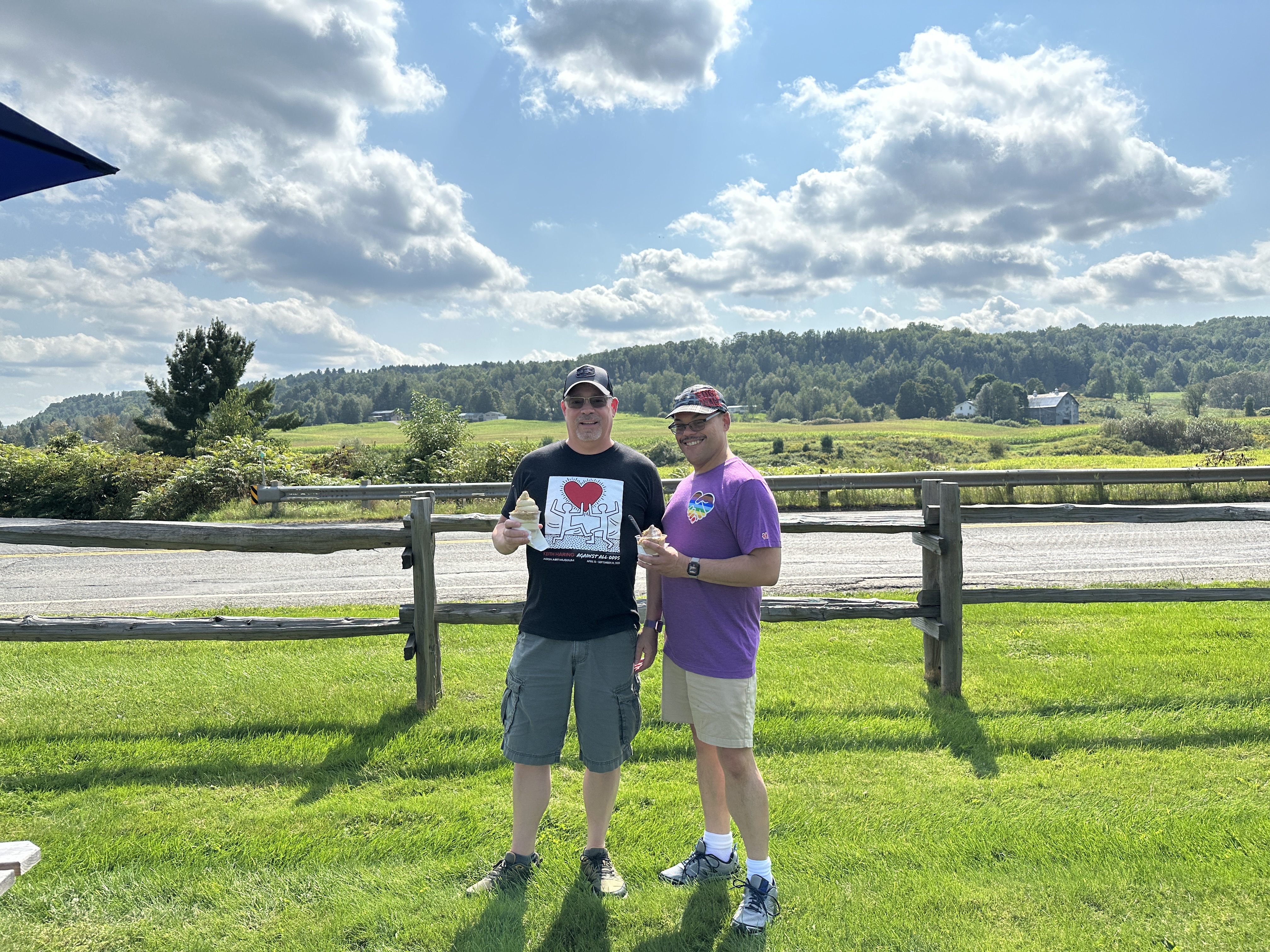
Enjoying Maple Creemees in Vermont

I also made four solo trips: one trip to London which was, to be honest, not very enjoyable; and three trips to see family members from which I brought home happy memories.

In Florida with my niece and her son

With my sister and her husband.


This year also saw the continued evolution of a meaningful relationship with someone who had been in the periphery of my life until about two years ago.  We had some ups and downs in 2023, but the year ended on a high note and my friendship with this person has had a profound impact on my life 
– and I hope it has a positive impact on this person’s life.

On to 2024!


Thursday, December 28, 2023

My review of Cleveland Quartet - the Complete RCA Album Collection

 Amazon has published my latest review, of the Cleveland Quartet's complete RCA recordings - which includes a very fine performance of Beethoven's complete String Quartets.  Click here to read it. 


Monday, December 11, 2023

My review of Artur Rodziński's Cleveland Orchestra recordings

My review of Artur Rodziński & The Cleveland Orchestra - The Complete Columbia Album Collection has been published.  The 13CD set provides much musical food for thought for those interested in the history of The Cleveland Orchestra.  Click here to read the complete review.


Tuesday, September 19, 2023

Farewell, Richmond Mall

Like many locals I have numerous memories of Richmond Mall.

The first was from not long after my family moved to the area in the early 1970s. My father and I went to Woolworth, which was near the center of the mall. I wanted to explore the toy area. My dad consented but warned me to stay there while he went to get whatever he was looking for. Soon I became bored and wandered Woolworth looking for my dad. Failing to see him there, I stepped outside the store and saw him, with his back to me, talking with someone else. I walked over to him and grabbed his hand. He turned around and asked me “How can I help you, little boy?” It was NOT my dad. I screamed bloody murder.  My dad, who had been looking for me, heard my scream and retrieved me.

Despite my misadventure, I made regular trips to the mall, with my parents or sister at first, and later on my own with my high school friends. Richmond Mall seemed to have everything. A small second level near the mall’s center included a magic shop which I found fascinating.  I saw King Kong at the theater there - the mural outside the theater was more memorable than the movie. My grandmother and I frequently dined at a fancy restaurant there. I bought my first suit at Diamond’s men’s store. Shortly before graduating high school, I got a job at the Waldenbooks there.

The central fountain at Richmond Mall


Until I was about ten, there were two local malls: Severance Center and Richmond Mall. They were separate and distinct entities with different stores, restaurants, and cinemas. Initially, Severance was the more upscale of the two, boasting Higbee’s and Halle’s as anchors, while Richmond Mall had Sears and JCPenney.  Severance was my mother’s mall of choice, Richmond Mall was my father’s preference.

The Geranium room at Halle's

From Severance I remember Halle’s, which had a restaurant called the Geranium Room where my mother would buy me lunch as a reward for not misbehaving as she did her clothes shopping. There was also a small deli near the mall’s center, where my mom would get us sandwiches, and we would sit near the fountain and watch the water show as we enjoyed our food. When I was ten, I saw Star Wars three times at one of the two theaters at Severance. After graduating from high school, I worked at The Music Box - a classical and jazz record store recently relocated from Shaker Square.  I left Cleveland shortly thereafter.  Returning in the mid-1990s, I was struck by the deterioration both at Severance and Richmond Mall.

The west entrance to Richmond Mall.  
This striking architectural feature was removed 
when Macy's was added as a third anchor in the 1990s.

Richmond Mall underwent a major remodel in the late 1990s, being rebranded as Richmond Town Square.  But the traffic never returned to the levels it enjoyed during its heyday of the 1960s and 70s and the stores became increasingly generic.  Mall rents were simply too high for the independent retailers that were there before.  Once the Barnes & Noble there closed, I had little reason to goto Richmond Mall.  B&N became a Planet Fitness which Daniel went to until a new branch opened at Cedar Center.  

Shortly before the turn of the millennium, Severance was essentially turned inside out and reopened as Severance Town Center, with entirely new stores: Borders, Home Depot, Walmart, a grocery store, a Bally’s gym.  Again, generic stuff you could find anywhere else.  Borders died during the Great Recession and the Bally’s location became another gym.  Walmart moved to Oakwood Commons in 2013.  Severance Town Center suffers from low occupancy, with some of the outlying buildings, including the former IHOP, shuttered.  Somehow, it continues to limp along despite poorly maintained and nearly empty parking areas.

A certain type of person will blame the demise of Richmond Mall as the result of “urban” culture ruining the shopping experience. Others will blame online shopping.  I won’t wallow in nostalgia for an era that was not objectively “better.”  Both Richmond and Severance both started going downhill after Randall Park Mall (claimed to be the world’s largest shopping mall when opened, now torn down and replaced by an Amazon warehouse) and Beachwood Place opened. By the 1980s, I noticed the carpeting along Richmond Mall’s long corridors was looking frayed.  This was, obviously, long before online shopping became an option.  Truth be told, there are only so many shopping centers that can be supported in an area with a declining population.

This begs the question: should older, out of date shopping centers like Severance and Richmond Mall be somehow protected when newer and arguably better shopping centers like Legacy Village and Pinecrest are serving the area’s consumers?  I believe not.

As Terence Mann (played by James Earl Jones) said in Field of Dreams: “America has rolled by like an army of steamrollers. It has been erased like a blackboard, rebuilt and erased again.”  That is what is happening near the northeast corner of Richmond and Wilson Mills Roads.  The new development, Belle Oaks, is arguably the best use for this parcel of land.  After years of delays, I look forward to seeing the finished product. 


*Photos courtesy Cleveland Historical Society and Cleveland Memory

Wednesday, August 30, 2023

86 hours without electricity

In August of 2003, while working as a piano store manager, I saw the lights dim for about 30 seconds, then flicker, finally failing entirely, unaware that I was experiencing the first moments of a blackout that covered much of the northeastern United States and parts of Canada.  The area on the west side of Cleveland where I was living and working saw its power restored within 24 hours.  Many others experienced a far longer period without electricity.

Almost exactly 20 years later, just after midnight on Friday, August 25, 2023, I was awakened by a howling noise outside our home in South Euclid, Ohio.  Noticing my electricity was out, I looked out my bedroom window and saw branches on the two large oak trees on our front lawn bending with the wind in a manner I did not know was possible.  Unaware that tornado warnings had been issued locally, I took no special precautions, but went back to bed, confident that power would be restored in short order. 

When I awoke again shortly before 5:00am, I looked out my window again and saw darkness.  Grabbing a flashlight and stepping outdoors, I spotted our recycling bin upended on my neighbor’s property.  I gathered the scattered recyclables, returned them to the bin, then returned the bin to its proper resting place.  Branches of varying sizes were scattered throughout the property.  I heard a work crew nearby.  Following the sounds, I saw they were dealing with a fallen tree one block over.  Walking back to my own street, I saw a tree leaning on a power line. 


Clearly, this was no ordinary storm. The Cleveland area received a record number of tornado warnings within a short space of time – with several touching down and one causing extensive damage in Cleveland’s Midtown district.  Our area is used to winter challenges, summer heat, and seasonal thunderstorms – multiple tornadoes, not so much.  As I wrote in an email to a young relative: Some people will just say “Oh, the climate has always been this way.”  But I am more and more inclined to believe that Mother Earth is pissed-off at us humans, and I don’t blame her.  Beyond a doubt, we are the primary cause of climate change.  Tornado warnings were almost unknown in our area – but we’ve had several in the last 10 years, last night’s caused a lot of damage, and the number of severe storms has increased exponentially.

After Dan left for his job, I headed to my employer’s campus to work (I’ve been largely working from home since the early days of COVID).  As information came in about the extent of the storm and blackouts, I decided to book a hotel for Friday night.  But I was hopeful, as the total number of customers lacking power had gone from over 224,000 without power at 8:00am to 160,000 by 4:00pm.  After work and before heading to the hotel, Dan & I spent about an hour cleaning up the yard.  Fortunately, there was no damage to the house – including to our new storm windows.  A few days before, a major rainstorm confirmed that our street’s newly refurbished water runoff inlets were functioning well, with none of the flooding on our street we’d become accustomed to after even small rainfalls. 

After awakening in our hotel room Saturday morning, Dan & I headed back home to see power was not restored, largely as I expected given that I was following the outages listed on First Energy’s website.  I took advantage of the relative quiet on our street to make some piano recordings – fortunately, my old Mason & Hamlin upright does not require electricity.  


Piano by candlelight

We spent the rest of the weekend seeking out places to go where we could pass the time in relative comfort: walking in some parks, dining at restaurants, seeing a film – while periodically checking to see if power was restored.  While driving around, we saw the damage in Midtown.

Damage at the Dunham Tavern Museum
  

I also perused social media, posting information where useful, and observing posts and comments from various people.  A long-held belief of mine was confirmed: An appallingly high percentage of people have no idea how the world around them works.  I saw posts blaming the mayor of my municipality and those of other municipalities for everything from the time they were without power to the presence of flooding.  In our area, the Northeast Ohio Regional Sewer District is responsible for maintaining the sewers; if your street floods, contact them.  If your local creek floods, well, that’s what creeks do when it rains, and if you made the decision to live next to a creek, that’s on you.  If your power hasn’t been restored yet, the mayor has no control over that.  For what it’s worth, I will comment that the South Euclid services department was at work clearing branches as soon as the weather had cleared; further, the city advised that people could come to city hall if they needed to charge their devices.   

I have no complaints about the line workers from First Energy who worked long hours to get power back online – to say nothing of the many workers who came from outside of Ohio to help.  They worked their butts off.  The problem, as it often is, stems with poor management, from the CEO on down – which puts profit over providing a service which people rely on.  They did not prepare, and their communications were poor.  For example, I signed up to their automated system so I could be informed when my power was restored.  Within a few hours, I received multiple communications giving conflicting information.  First, I received a text that power would be restored by 2:00pm Monday; a half hour later, another text stated the power would be restored by 8:00pm Wednesday – followed by an automated phone call stating the same; 40 minutes later a further text stated that power would be restored by 4:00pm Monday, followed by another text 20 minutes later that power had been restored.  It had been out for 86 hours.


Make up your mind.


Here are some lessons learned from the past week’s experience:

Northeast Ohio’s tree canopy needs to be better managed, especially in more densely populated communities.  Our tree canopy is a wonderful thing – relatives and friends who have moved out of state have told me how much they miss it.  The two oak trees on my property, which I spend plenty of money to keep trimmed, provide enough shade to keep my electric bills at a reasonable level.  But in communities such as South Euclid, trees should not be permitted to grow without a plan for management – especially those trees which are near homes or power structures.  The repair of our localized loss of power was delayed because a large tree fell onto an unoccupied house, taking down several power lines and a transformer with it.  

Tree damage at a nearby house

The other item is something I’ve believed for years: The United States should embark on program to upgrade, modernize, and protect our energy grid from hazards including weather events and hacking.  Wherever possible, utility lines should be moved underground.  A colleague of mine did not lose power, largely because her community is newer and their power lines are underground.  Those of us who live in older communities, and who pay the same for electricity, should enjoy the same reliability.  The nationwide migration of utilities underground would be a massive undertaking, but no more than the building of the Interstate Highway system or the infrastructure created during the New Deal.  It would require cooperative efforts from Federal, State, and Local governments along with utility providers.  The biggest obstacle is the lack of leadership in both parties to lower the hammer and make it happen – because an effort of this magnitude would require at least partial public funding, which would require a tax increase on the wealthy.  So, a project such as this, which would have the added benefit of greatly improving aesthetics in our neighborhoods and commercial districts, will likely not happen in my lifetime. 

As I said in the email to my young relative: Our climate is changing.  We’re not going to be able to conserve our way out of the climate crisis.  We need to be prepared.

Sunday, April 30, 2023

Eastman, Marsalis, and Dvořák at Severance

This weekend’s Cleveland Orchestra concerts, led by music director Franz Welser-Möst, included a Cleveland premier, a world premiere, alongside a standard repertoire favorite.  In a hopeful sign for both the orchestra and the thirst for unfamiliar music, the hall was filled to near capacity at Saturday’s concert.

An undated photo of Julius Eastman


The concert began with Julius Eastman’s Symphony No. 2, titled “The Faithful Friend: The Lover Friend’s Live for the Beloved.”  Provocative titles were commonly used by Eastman (1940-1990), an African-American and openly gay composer.  This work, dedicated and given to a former lover, was receiving only its second performance after being discovered and reconstructed in 2018.  The orchestration is ambitious enough to present a challenge to any ensemble:  six timpanists - each with four timpani, three bass clarinets, three contrabass clarinets, three bassoons, three contrabassoons, three trombones, three tubas, and a full complement of strings.  As it was, the orchestra was only able to fit 16 timpani on stage at Severance.  Despite the title, there is little in the work that would be thought of as romantic – the primary mood is one of mystery.  15 minutes long, it begins somberly with a sustained string motif; then quiet, dissonant soundings from the woodwinds – rising to a climax before sinking back into a disillusioned pianissimo.  The work received an enthusiastic response from the audience.

The second work on the program was the Concerto for Trumpet by Wynton Marsalis, receiving its world premiere.  As with the Eastman, the orchestration was ambitious and included police whistle and African hand drums, with the soloist needing two trumpets (C and B-flat).  The concerto is about 35 minutes long, easily eclipsing any trumpet concerto in the standard repertoire, and calls on the soloist to draw on every facet of his technique and use just about every type of mute available.  The six-movement work kicks off with an elephant’s call, taking the listener on a journey that includes a love ballad, Spanish and Mexican flavored motifs, American jazz, a French flavored waltz, two-step finale with an eclectic flavor ending with a return of the elephant call.  Michael Sachs, the orchestra’s principle trumpetist since 1988, was more than up to the task and delivered a performance which was technically and musically virtuous, marvelously accompanied by Welser-Möst and the orchestra.  My father, an amateur trumpetist of some ability, would have been enthralled by this work.  The audience was certainly absorbed, and the work received one of the most sustained ovations I’ve ever witnessed at Severance.

Applause following the Marsalis Concerto


The post-intermission work was Dvořák’s Symphony No. 9, titled by the composer “From the New World.”  This work is so well known that the story of its creation scarcely bears repeating: the composer, originally from what today is known as the Czech Republic, spent three years in the United States, during which he studied African-American and Native music.  The Symphony is one of several compositions from that era and has been a repertoire favorite for over a Century.  It can be argued that the Cleveland Orchestra is America’s premier Dvořák ensemble, having recorded his Symphonies from the time Erich Leinsdorf was music director onwards.  One can’t avoid mentioning George Szell, who recorded the complete Slavonic Dances, the Piano Concerto (with soloist Rudolf Firkusny), and the last three Symphonies – all of which are considered reference recordings.  Welser-Möst’s approach to the symphony was entirely his own.  He clearly sees the work as a classically structured symphony in the tradition of Brahms and Tchaikovsky, and his interpretation emphasized structure over the work’s tunefulness.  As is often the case with Welser-Möst, tempi favored the brisk end of the spectrum, with a minimum of rubato, careful attention to dynamics, and transparency between sections.  For those who mind such things, the first movement’s exposition repeat was observed.  A highlight for this listener was the second movement, offered free of schmaltz – which enhanced the work’s dignity. 

I can’t think of another non-specialist ensemble currently doing more to promote unfamiliar music.  Cleverly coupling lesser known works with repertoire staples like the Dvořák has helped to introduce these works to a larger audience and I hope they keep it up.  The concert was filmed and hopefully will be published in full on the Adella app – as well as being issued on the orchestra’s private label.