Sunday, October 23, 2022

Widmann and Strauss at Severance

Conductor Daniel Harding and violist Antoine Tamestit were the featured guests at Severance Hall this weekend.  But Harding strode on stage without the soloist to begin the concert’s first work, Jörg Widmann’s Viola Concerto, as Tamestit was already seated in a concealed area of the stage from which he emerged shortly after the work began.  The Concerto, finished in 2015, relies heavily on choreography as the soloist makes his way to musically converse and combat with other instruments (placed unconventionally) during the course of the work’s 25 minutes.  The problem for this listener, or perhaps I should state observer, was that the on-stage antics, which included the Tamestit brandishing his viola bow like a sword and even shouting, became more memorable than the music itself.  This was less a concerto than performance art in search of a genuine musical idea.  As the performance progressed, I noticed several audience members playing with their phones and, surprisingly, it was those same members who I observed applauding the most enthusiastically at the work’s conclusion.  An encore was not offered. 

The audience was noticeably larger for the concert’s post-intermission work, Richard Strauss’s An Alpine Symphony. The Strauss work dates to 1915, 100 years earlier than the Widmann, but seems timeless.  Harding and the orchestra presented the work in all its awe-inspiring majesty, from the mystery of Nacht to the terror of Gefahrvolle Augenblicke, everything was heard with a multi-layered clarity and burnished tone that marked the antithesis of the flabby sogginess that marks too much Strauss playing.      


Thursday, October 20, 2022

Ontario, Quebec, New England in October

Dan and I had originally planned to travel to Europe for our October vacation, including stops in London, Paris (where our friend Gerardo Teissonnière gave a recital), and Berlin.  Various factors made that trip impractical, so we decided to remain within driving distance.  Our trip took us into Ontario, Quebec, and New England before we headed home.

We began our journey on Sunday so I could complete some quick regrouting of our shower stall on Saturday, allowing it to dry while we were away. Sunday was a quick drive to Niagara Falls, Ontario, during which my GPS routed us off the toll roads and onto US-20, allowing us to drive through some attractive wine country.  We also drove through Fredonia, New York, where my maternal grandfather and his parents are buried.  I first saw Niagara Falls from the New York side during the 1980s, and the Canadian side was the site of my first trip with Daniel back in 2006.  The Falls themselves haven’t perceptibly changed, but the town is as touristy and vulgar as ever.  As medicinal and recreational Cannabis are now legal in Canada, the scent of marijuana wafted into our nostrils as we walked along Clifton Hill.  The crowds were denser than we expected and we learned Sunday evening that the next day was Canadian Thanksgiving.  Learning of this, we decided to change our drive to Toronto the next day, avoiding the highway and taking the smaller roads that wrapped around Lake Ontario. 

The obligatory Niagara Falls panorama

The obligatory Niagara Falls selfie

Clever juxtaposition of Cannabis and food

Don't even try to bring it over the border.

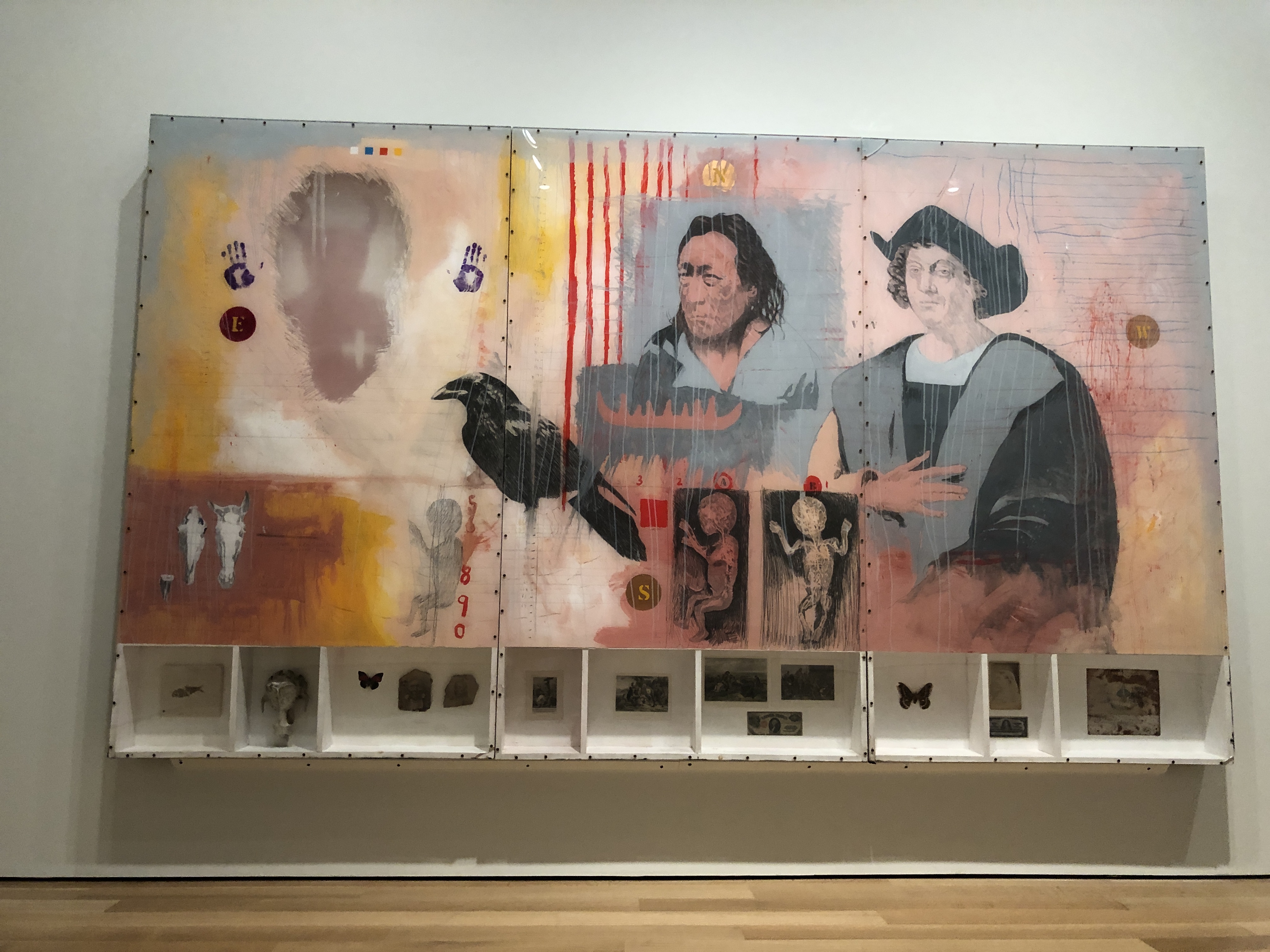
Fortunately, there were numerous restaurants open in Toronto that night and we settled on Si Lom Thai where we had an enjoyable dinner.  Our one full day in Canada’s largest city was spent at the Art Gallery of Toronto, snapping pictures at the Toronto sign, and bar-hopping in the Church and Wellesley neighborhood, which is sadly becoming encroached by developers.  Still, we had a fun time at Woody’s where bartender Chris poured the drinks, regaled us with stories, and even gave Dan & me a pair of souvenir t-shirts.  Cannabis use in Toronto was even more prevalent than in Niagara Falls.  One could simply not escape the smell of reefer.

The obligatory foodie pic

Thought provocation at the Art Gallery of Toronto

It's Toronto!

It's really Toronto, eh?

Public art in Toronto

Neither an endorsement nor a condemnation.

On Wednesday we departed Toronto for the five-hour drive to Montreal.  Here is where it became obvious that Canadian highways are better maintained than their US counterparts.  There wasn’t a pothole to be found on the whole stretch of our journey.  Rest areas were in plentiful supply, and the lower speed limit (100 kilometers, or 62 miles per hour), made for a pleasant drive and better mileage. Normally I am a bit of a lead-foot on highways, much to Dan’s consternation, but I wasn’t about to speed as a foreigner. 

Montreal is in Quebec, which uses French as a primary language.  Dan spent months learning French on the Duolingo app, but whenever he uttered a phrase in French, whoever he was speaking with would immediately reply in English, rendering his studies superfluous.  We spent much of Thursday strolling through the Port, the Latin Quarter, and the Gay Village.  That evening we treated ourselves to poutine at Emilia and spent as much of our Canadian cash as we could at Bar Le Stud

Arrête, au nom de l'amour

No explanation required.


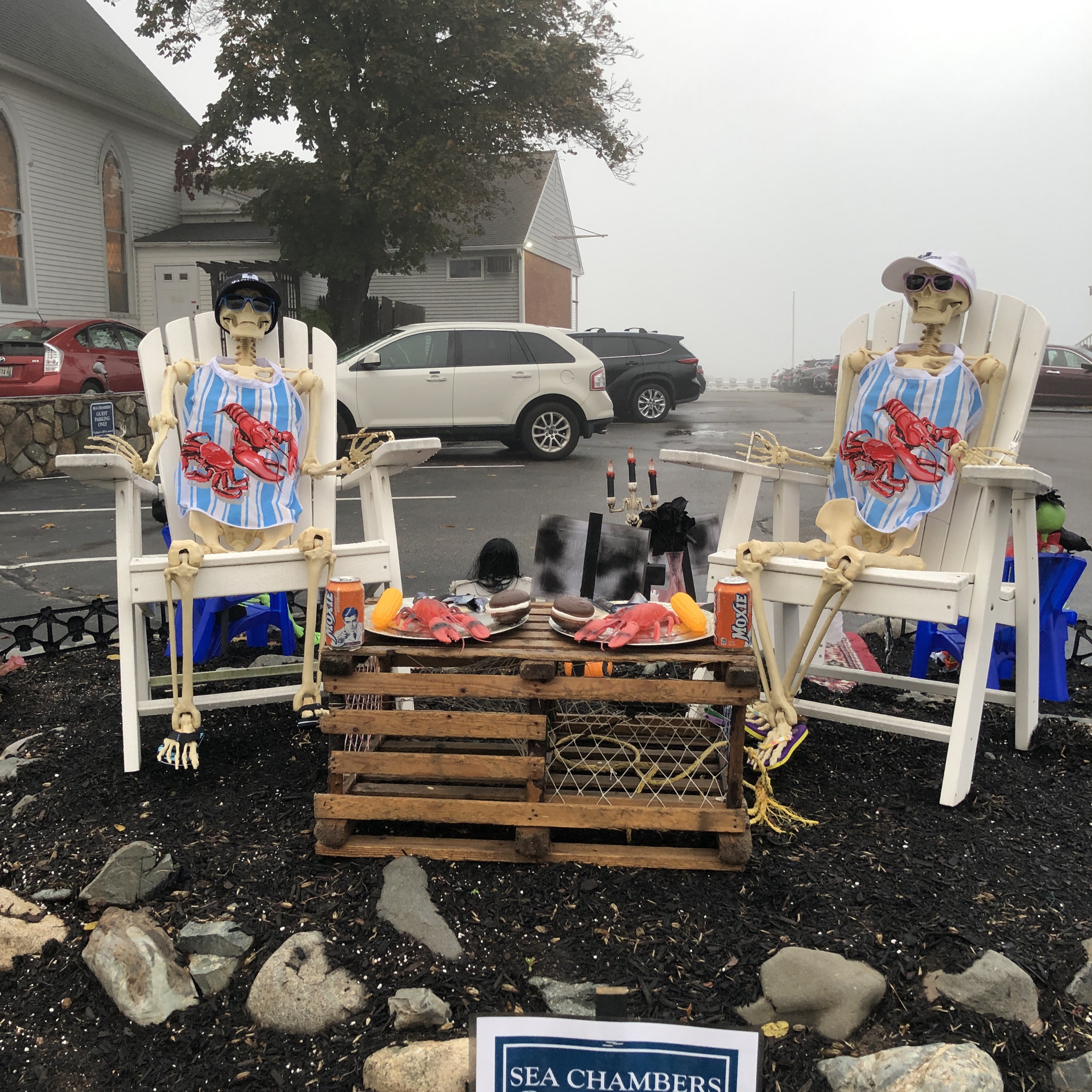
Friday morning we packed the car and headed to Ogunquit, Maine, which I hadn’t visited since 1994.  Since moving back to Ohio that year, I’ve returned to New England several times, including four visits to Provincetown.  Both Ogunquit and P-town have reputations as gay-friendly destinations.  But while P-town has become synonymous with parties and circuit queens, Ogunquit is far less “in your face” while still obviously being an LGBT+ destination for those seeking relaxing fun.  Rainbow flags were everywhere to be seen even though the tourist season was mostly over.  Halloween decorations of every kind were to be displayed outside private homes, restaurants, and hotels/B&Bs.  Dan & I had some fine meals, enjoyable drinks, and walked them off on the town’s beachside Marginal Way. We also took a few hours off at the local cinema to see a dark film entitled “Don’t Worry, Darling.”  By the end of that day Dan & I were mostly travelled out and ready to return to home and hearth.  Be it ever so humble… 

Obligatory pano #2

Drinks at the bar

Dan & I after too much food & drink


Saturday, October 8, 2022

Boulez, Stravinsky, and Saint-Saëns at Severance

A sparse audience greeted guest conductor Thierry Fischer when he strode on stage at Severance last night.  As Daniel and I generally attend orchestra concerts on Saturday evenings, I can’t authoritatively comment on whether the lack of attendance was due to the day of the week or the program – but was likely a combination of both. 

The concert began with Pierre Boulez’s Notations, begun as solo piano pieces in the 1940s, then orchestrated decades later.  Boulez was known for his long association with the Cleveland Orchestra.  Beginning at the invitation of George Szell in 1965, he served as principal guest conductor and musical advisor in the years following Szell’s death in 1970.  He made numerous recordings with the orchestra, most of very high quality, over the course of 40 years.  But, as Arthur Rubinstein said of Rachmaninoff the pianist versus Rachmaninoff the composer, I value Boulez’s work as conductor more than his compositions.  Not one of his works have entered the standard repertoire and, nearly seven years after his death, that fact shows no signs of changing.  Notations was 15 minutes of loony tunes cartoon music from Hell, with entirely predictable dissonance for the sake of same – immaculately performed, of course. 

The next work was Stravinsky’s Violin Concerto, lavishly played by Leila Josefowicz (substituting for Vilde Frang, who was unable to appear due to “travel complications”).  For those who pay attention to such things, she was dressed in a flowing gown which, deliberately or coincidentally, resembled the colors of the flag of Ukraine.  Unlike Boulez, Stravinsky’s works enjoyed popular success by the time he was middle-aged.  Some works, including ballets like Rite of Spring and Firebird, are now repertoire staples.  Others, including the Symphony in Three Movements and the Violin Concerto, hover on the outer edges of the standard repertoire.  But they are highly listenable, and the Violin Concerto in particular is meticulously constructed.  Josefowicz brought a solid technique, burnished tone, and tasteful expressivity with discreet vibrato to the performance.  She was recalled to the stage several times but there was no encore. 

Following intermission was the evening’s most popular work, Saint-Saëns’ so-called “Organ Symphony.”  This was my first time hearing the work in performance, although I have several recordings including the legendary Boston Symphony/Munch version.  The work is popular not merely because it’s a “sonic spectacular”, but because it dovetails symphonic construction with tunefulness and craftsman-like orchestration.  Fischer and organist Todd Wilson brought a sense of musicality to the piece which is often lacking, and I was reminded just how well composed this symphony is.  Yet the performance was not lacking in excitement – with the audience leaping to its feet after the performance – and a loud ovation that belied the audience’s small numbers.

We in Cleveland are doubly lucky that Christoph von Dohnányi (music director from 1984–2002) shepherded the turn of the century renovation of Severance Hall which included the restoration of the hall’s Skinner Organ – otherwise a convincing performance of this work would not have been possible here.

Sunday, July 31, 2022

Reinhardt and Kenney at Blossom

The Cleveland Orchestra’s concert at Blossom Music Center last night was a typical mix of the familiar, less familiar, and unfamiliar, performed with stylistic sureness and nimble virtuosity.  This was Dan and my first concert at Blossom since the pandemic began, and it was nice to be back – especially on such a lovely evening when the weather was cooperative.

Guest conductor Ruth Reinhardt, making her Cleveland Orchestra debut, led the orchestra in a bracing performance of Polish composer Grażyna Bacewicz’s Overture (otherwise unnamed), an optimistic piece that belied the fact it was written during the Nazi occupation of Warsaw in 1943.  This work, new to me and never before played in Cleveland, deserves to be heard more often – and I’ve no doubt there are other works by this composer that are worth the listener’s time.

Grażyna Bacewicz

Violinist Alexi Kenney then took to the stage for Mendelssohn’s justly popular Violin Concerto.  Kenney, also making his Cleveland Orchestra debut, and Reinhardt made the well-known Concerto sound new and fresh.  Kenney’s suave, feathery light intonation, seemingly effortless rapid passagework, and the palpable joy he brought to the performance were a marvel to behold.  The conductor matched the soloist’s metric flexibility and rubato move-for-move.  All the more remarkable was that Kenney was a last-minute substitute for Sergey Khachatryan who was unable to appear due to visa issues.  Yet there was nothing last-minute in the well thought out, yet spontaneous performance.  An encore followed the prolonged ovation.


Reinhardt returned following intermission to lead the orchestra in Dvořák’s Symphony No. 5 in F major.  Although I’ve heard all of Dvořák’s Symphonies, I only really know 6-9.  The 5th shares the spirit of Beethoven’s 6th which is in the same key.  But, despite many beautiful passages, it is not as memorable as either Beethoven’s Pastoral nor Dvořák’s last four Symphonies.  Nevertheless the orchestra’s nimble, lyrical performance was enjoyable.  

Sunday, May 15, 2022

Berg, Rihm, and Schubert at Severance

The Cleveland Orchestra under Franz Welser-Möst continued its recent tradition of including a mix of the familiar and unfamiliar at last night’s concert at Severance Hall, with works from the 19th, 20th, and 21st Centuries.  This is the last concert of the 2021-2022 season at Severance I plan to attend, although there are a few concerts at Blossom Music Center that have caught my interest. 

The concert began with three selections for strings from Alban Berg’s Lyric Suite, completed in 1926.  The work was first presented by the orchestra under Pierre Boulez in 1971, and was recently performed at the height of the pandemic on the orchestra’s Adella app.  As Shostakovich would a few decades later, Berg uses musical notation tied to people’s names as part of the thematic material: in this case, his own initials as well as those of a woman he was having an affair with at the time of composition.  While the work uses twelve-tone methods, it is not atonal.  The dissonance is neither grating nor unpleasant, particularly when presented with the tonal beauty that was heard last night.

The Berg was followed by Wolfgang Rihm’s Verwandlung II, composed in 2005.  This work was totally unfamiliar to me, and I will need to further digest the piece when the concert is broadcast to fully comprehend it.  The performance was marked by the feathery lightness of certain string passages and Welser-Möst’s keen attention to dynamics.

The most well-known work followed intermission (and I’ve no doubt it was placed after intermission to keep butts in seats for the entire concert): Schubert’s Symphony in C major, D. 944. This is a work I’ve been in love with for over 40 years, since my father bought me a cassette tape of the work as played by the Cleveland Orchestra under George Szell.  Although I’ve heard recordings of the work in recordings and broadcasts of various quality – including by Toscanini, Walter, Böhm, von Dohnányi, and many others, this was the first time I’d heard it in concert.  As with every familiar piece I encounter in concert, I am reminded of the inadequacy of even the finest recordings to truly convey the concert experience.  Welser-Möst’s pacing of the Symphony, Schubert’s largest, tended toward the lively, dismissing the phony Gemütlichkeit which has marred too many performances of this work.  The conductor favored a large dynamic range, mixed with transparent textures, along with a minimum of interpretive fuss.  There was one exception, in the Scherzo, where a rhythmic “hiccup” was slightly exaggerated.  As with the orchestra’s 2020 live recording, Welser-Möst observed every repeat, bringing the heavenly length of the work to just under an hour, but it never seemed excessive.


Sunday, April 17, 2022

Beethoven and Bartók at Severance

The last-minute substitution of the scheduled guest conductor didn’t impair the performance at Severance over this past weekend, as the orchestra delivered performances even more refined than usual.  The guest conductor was Kahchun Wong, who hails from Singapore, making his Cleveland Orchestra debut.

The shortish program began with Beethoven’s Violin Concerto, featuring Christian Tetzlaff as soloist.  The performance was marked by pronounced flexibility of tempo along with uncanny balancing between soloist and conductor, featuring pianissimos that the composer would not have been able to hear.  Tetzlaff’s solution was elegant yet inventive: He arranged Beethoven’s own cadenza from his piano arrangement of the Violin Concerto (created at the request of Muzio Clementi) for violin - with timpani accompaniment as written by Beethoven.  A sustained ovation followed the performance and the audience was gifted with an encore, the slow movement from J. S. Bach’s Sonata in A minor.

Bartók’s Music for Strings, Percussion, and Celesta followed the intermission.  The conductor, whose visual style was a mix of theatricality and subtle details, paid particular attention to dynamics with numerous felicities unheard on even the finest recordings.  The punching rhythm of the second movement Allegro remained in the ears, and feet, following the concert.